

729 Possible Packages. Somehow We Keep Mailing the Same One.
Ray Bradbury said, “Quantity produces quality. If you only write a few things, you’re doomed.”
The Fundraising Volume Machine read that as permission to send more appeals and chase donors around the internet with a butterfly net. Bradbury meant creative production, not contact frequency.
There are three very different kinds of quantity in fundraising:
- Quantity of practice. More work, paired with feedback, should improve the work.
- Quantity of ideas. More genuinely different ideas give you more chances to find a strong one.
- Quantity of fundraising. More names, appeals and asks may produce more attributed revenue. They do not necessarily produce better fundraising, better donors or much learning.
The first two tend to improve quality as a natural byproduct, the third? Not so much.
Saturday Night Live develops dozens of possible sketches for each show. Roughly eight make it to air, and if two are memorable it’s a home run. Fundraising has an even larger cutting-room floor. Consider a direct-mail package with six elements: outer-envelope format, callout, letter, image, reply form and insert. Come up with three possibilities for each and you already have 729 potential packages.
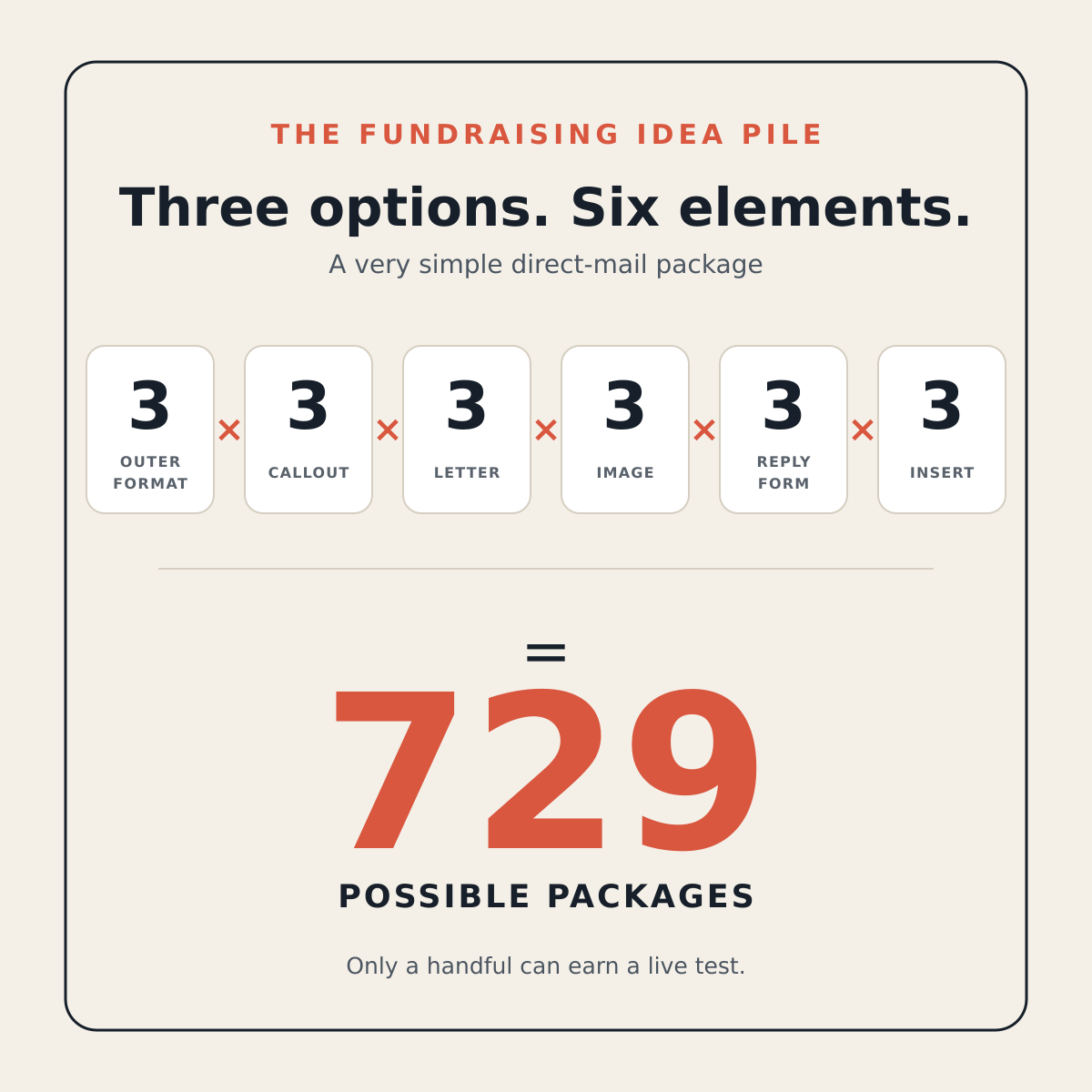
Increase the choices from three to four and the number jumps to 4,096. Add channels, offers, messengers, asks and audience segments, and your brainstorming session has morphed into a combinatorial nightmare.
The problem is rarely a shortage of possible ideas. It’s deciding which tiny handful deserve donor exposure and testing dollars.
Behavioral science helps us create better candidates. Instead of relying on taste, precedent or whatever someone saw in another charity’s package, we build hypotheses around evidence. Would an identity-based message outperform a generic appeal? Would supporting donor autonomy work better than pressure?
That improves the pile, but it doesn’t tell us what to choose. The customary selection method is a meeting in which six people offer opinions until the person with the largest title develops remarkably good taste.
We use experimental pre-testing instead. Different elements are systematically varied and shown to the target audience. Their choices let us estimate which elements add value, which subtract it and which combinations are strongest.
Quantity of ideas supplies the raw material, evidence improves the pile and experimental selection decides what earns a live test.
Bradbury was advocating creative abundance but turning him into the patron saint of the 12th annual appeal seems unfair to the man.
Kevin
P.S. Here’s an archived webinar explaining how the pre-testing works: https://youtu.be/VfDv8NuVo94
Behavioral Science Q & A
Thanks so much for raising this. Yes, capturing donor information can be helpful for stewardship like newsletters, thank-you letters, impact updates. But how you ask matters. Forcing full data capture introduces friction that can significantly depress conversion, many donors may simply abandon the process. Beyond the friction itself, required fields also shift the emotional experience […]
Read Full Answer
Unlike holidays that everyone already knows, Giving Tuesday is a created event. Many donors recognize the name but not the exact timing, so referencing it becomes a helpful cue. It serves as a reminder and taps into social norm activation (“everyone’s giving today”), which boosts response. However, we still want it paired with the mission, […]
Read Full Answer
When a subject line leads with the match (“Your gift matched!”), it risks triggering market-norm thinking: the sense that giving is a financial transaction rather than an act rooted in values, identity, and care. This shift reduces intrinsic motivation and, over time, can weaken donor satisfaction and long-term engagement. It also makes the email indistinguishable […]
Read Full Answer
There’s no evidence that QR codes suppress mid-value giving; all available research suggests they either help or have no negative effect. In fact, behavioral and usability research consistently shows the opposite: reducing friction at any point in the donation process increases completion rates and total response. And that has nothing to do with capacity and […]
Read Full Answer
What you’re experiencing is very common. Resistance often isn’t about capability, but about motivation quality. If board members feel pushed into fundraising, that triggers controlled motivation (low quality motivation) i.e. obligation, guilt, or fear of judgment, which often results in avoidance. Instead, we need to create conditions for volitional motivation (high quality motivation) by satisfying […]
Read Full Answer
That’s a really thoughtful question, and you’re not the first to raise it. Many of our clients have been cautious about placing the ask at the very end. To address their concern, we’ve tested both approaches, and the results are clear: when the ask comes last, even if that means it appears on the second […]
Read Full Answer