

Why “Good Messaging” Keeps Underperforming
Jack Trout, a famous ad guy and thinker, famously said: “If your assignment is to change people’s minds, don’t accept the assignment.”
He wasn’t being cynical, just precise about where effort is usually wasted.
A large randomized experiment on TV advertising and social issues makes his point painfully clear. The study exposed 31,404 voters to three weeks of interest group television ads focused on either immigration or transgender non-discrimination. Participants completed surveys before exposure, immediately after, and again days later, measuring recall, factual knowledge, attitudes, and policy support.
The pattern is hard to ignore.
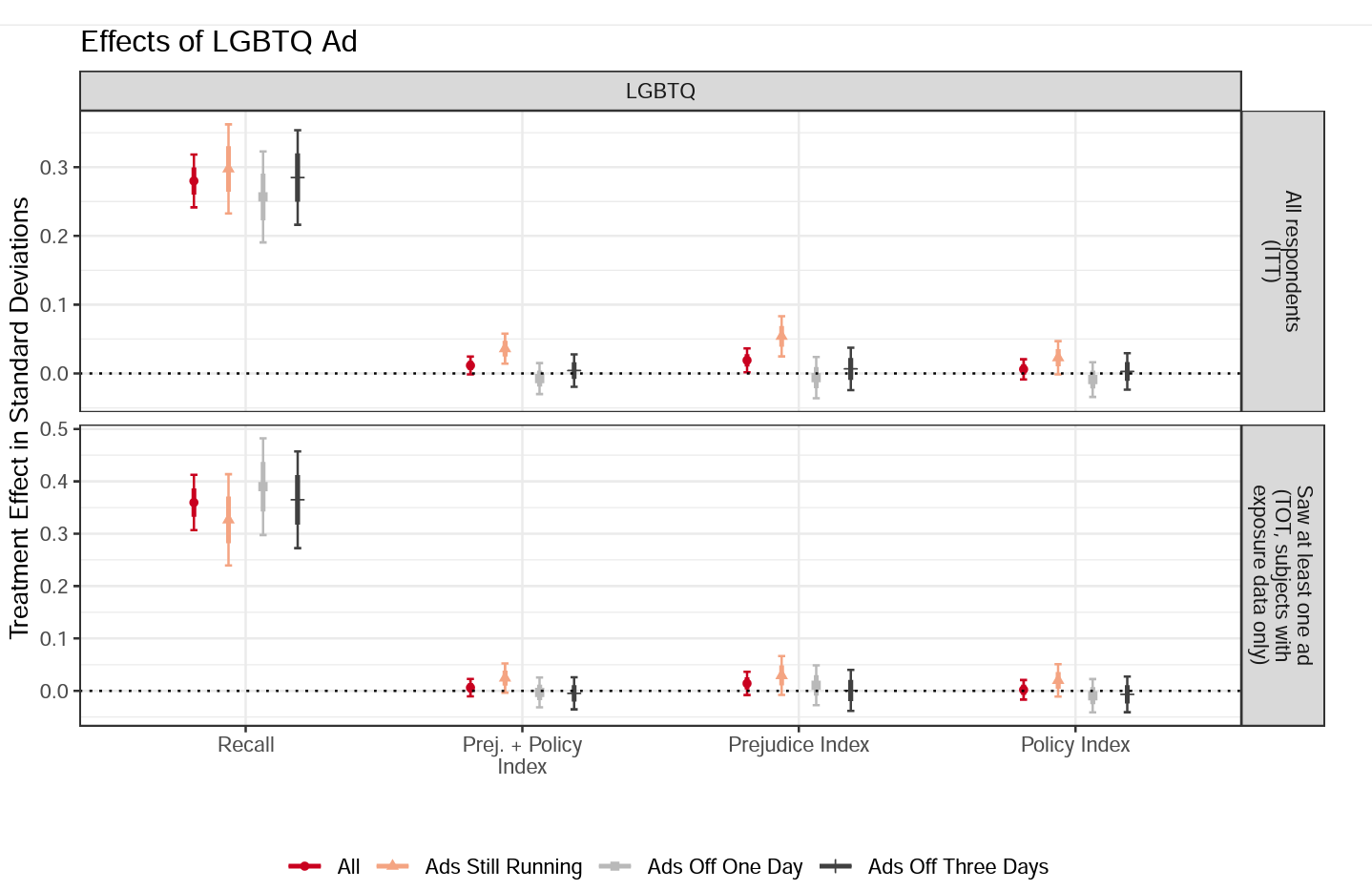
- People definitely saw the ads. Recall jumped sharply and stayed elevated weeks later.
- People retained facts communicated in the ads
- But, attitudes barely moved. If someone started at a 50 on a 0–100 attitude scale, exposure nudged them to roughly 50.5. And this tiny movement evaporated almost immediately, often within a day of the ads stopping. .
Fortunately, most fundraising doesn’t need to be in the persuasion business. In causes like immigration or LGBTQ rights or veteran issues or religious support, there’s no shortage of people who already agree. What’s scarce is awareness, salience, trust, and mental availability among those already aligned. The market of people who are mentally supportive but not paying attention remains largely untapped for most charities.
The media experiment wasn’t designed to test attraction, it was designed to force persuasion by averaging effects across people who strongly agree, strongly disagree, and do not care. That design guarantees dilution and produces false negatives at the aggregate level while masking meaningful differences underneath.
One of the immigration ads in the study was described by its creators as using narrative persuasion paired with American values like family, hard work, and freedom. That framing is not neutral. It’s a moral appeal that resonates far more with some people than others. We know, for example, that more Conscientious individuals are far more responsive to that language than more Open or Agreeable ones.
When you run a single message across everyone and then average the results, you’re not testing whether persuasion works, you’re testing whether blunt instruments outperform human variation; they don’t.
The lesson here isn’t that ads are useless, it’s that one-size-fits-nobody messaging makes persuasion unnecessarily hard and attraction nearly invisible. The effects likely existed, but they were unevenly distributed and washed out in the mean.
Persuasion is a late-stage, high-cost move. Attraction is a first-order growth lever when awareness is low and alignment already exists.
Jack Trout was right, but perhaps not in the way people usually quote him. If your assignment is to change everyone’s mind, do not accept it. If your assignment is to be recognized, chosen, and trusted by people who already agree with you, you are leaving growth on the table if you walk away.
Kevin
Behavioral Science Q & A
Thanks so much for raising this. Yes, capturing donor information can be helpful for stewardship like newsletters, thank-you letters, impact updates. But how you ask matters. Forcing full data capture introduces friction that can significantly depress conversion, many donors may simply abandon the process. Beyond the friction itself, required fields also shift the emotional experience […]
Read Full Answer
Unlike holidays that everyone already knows, Giving Tuesday is a created event. Many donors recognize the name but not the exact timing, so referencing it becomes a helpful cue. It serves as a reminder and taps into social norm activation (“everyone’s giving today”), which boosts response. However, we still want it paired with the mission, […]
Read Full Answer
When a subject line leads with the match (“Your gift matched!”), it risks triggering market-norm thinking: the sense that giving is a financial transaction rather than an act rooted in values, identity, and care. This shift reduces intrinsic motivation and, over time, can weaken donor satisfaction and long-term engagement. It also makes the email indistinguishable […]
Read Full Answer
There’s no evidence that QR codes suppress mid-value giving; all available research suggests they either help or have no negative effect. In fact, behavioral and usability research consistently shows the opposite: reducing friction at any point in the donation process increases completion rates and total response. And that has nothing to do with capacity and […]
Read Full Answer
What you’re experiencing is very common. Resistance often isn’t about capability, but about motivation quality. If board members feel pushed into fundraising, that triggers controlled motivation (low quality motivation) i.e. obligation, guilt, or fear of judgment, which often results in avoidance. Instead, we need to create conditions for volitional motivation (high quality motivation) by satisfying […]
Read Full Answer
That’s a really thoughtful question, and you’re not the first to raise it. Many of our clients have been cautious about placing the ask at the very end. To address their concern, we’ve tested both approaches, and the results are clear: when the ask comes last, even if that means it appears on the second […]
Read Full Answer