

Honey.Bunny and the Case for Matching Message to Person
Imagine getting an email from honey.bunny77@hotmail.de.
What would you immediately infer about this person? Ok, spam and X-rated content but after that you might infer age, maybe gender, maybe a certain playfulness or lack of seriousness. You formed a view about competence and credibility from a string of characters.
That instinct is not random.
Researchers did a study asking strangers to judge a person’s personality based on nothing but an email address. They also measured the personality of the email address owners directly. Two outcomes from this study,
- Strangers tended to agree with each other about the personality behind the email address
- And the strangers were correct, showing statistically significant correlation with the owner’s measured, true personality.
Granted, the effects were modest, nobody is reconstructing a full psyche from “honey.bunny77” but the signal was real. Even thin digital traces carry psychologically meaningful information.
Now look at me. No, seriously, take a look.
On my LinkedIn profile, there is a third party sales app that analyzes my public footprint and produces a Big Five Personality (OCEAN) profile. It then gives prescriptive advice on how to email me, how long the message should be, how direct the ask should be, what tone to use.
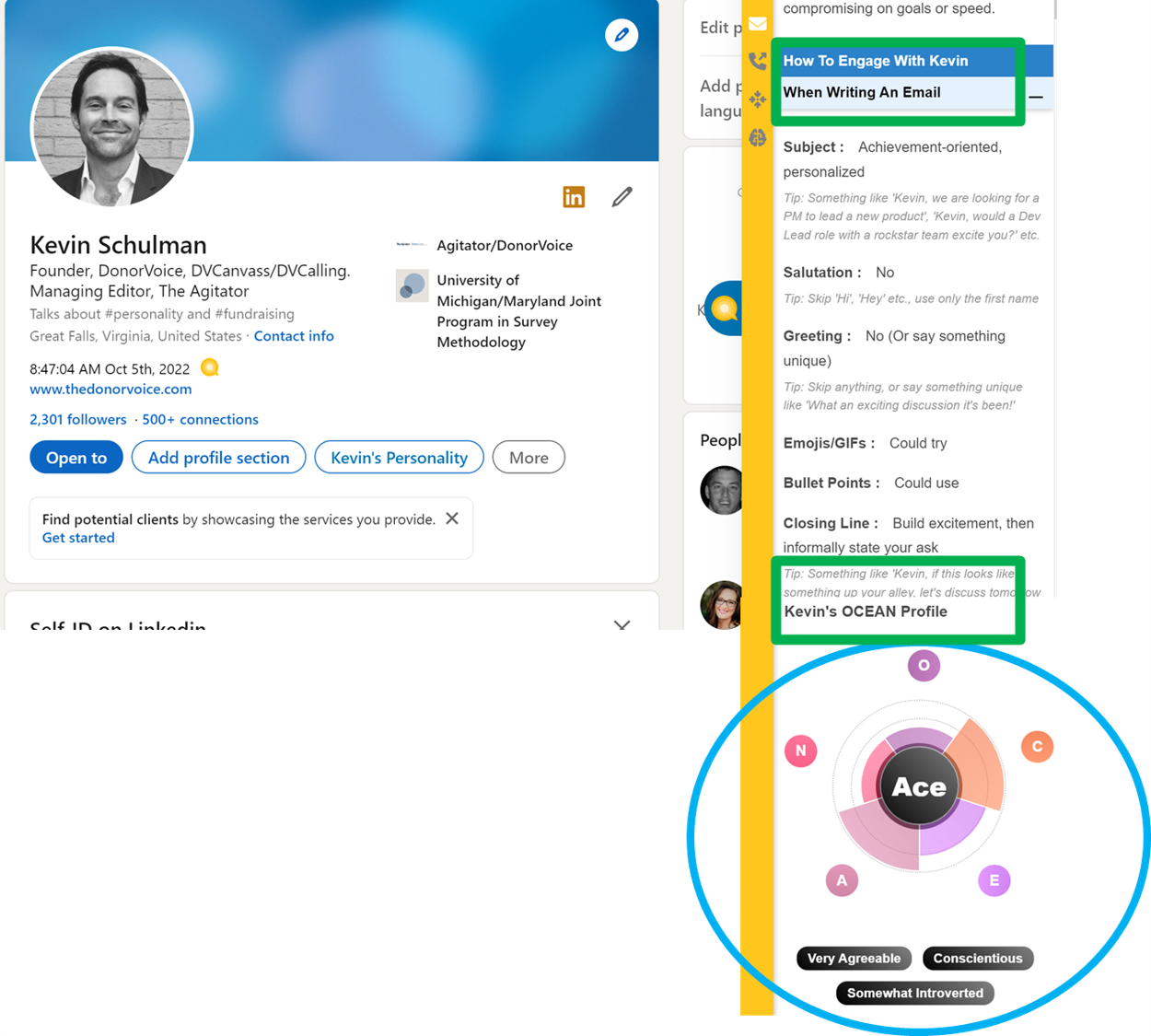
What you do not see in the screenshot is the obvious implication. If a sales team can estimate my personality from language patterns and behavioral residue, then every piece of communication I send is also signaling mine.
Every appeal has a personality but most organizations have never measured it.
That realization is what led us to build our own tool. We wanted to move beyond “voice” as a creative abstraction and treat it as something quantifiable. If strangers can infer traits from an email address, and if companies can infer traits from LinkedIn language, then fundraising copy and it’s authors can be profiled too.
This isn’t to label the writer, but to profile the signal the message is sending. From there, you can compare the personality of the appeal to the personality distribution of your audience.
Message misalignment isn’t theoretical, it happens with every appeal you send unless you are matching that appeal to the person. And the consequence of mismatch is lower response and lifetime value. Fortunately, it’s very fixable.
The honey.bunny email study shows that personality leaks through even the smallest digital cracks. The LinkedIn app shows that markets will invest heavily to operationalize that leakage. The open question for fundraising is simpler. If personality is visible in language and predictive of response, why are we still pretending one voice fits everyone?
Kevin
Behavioral Science Q & A
Thanks so much for raising this. Yes, capturing donor information can be helpful for stewardship like newsletters, thank-you letters, impact updates. But how you ask matters. Forcing full data capture introduces friction that can significantly depress conversion, many donors may simply abandon the process. Beyond the friction itself, required fields also shift the emotional experience […]
Read Full Answer
Unlike holidays that everyone already knows, Giving Tuesday is a created event. Many donors recognize the name but not the exact timing, so referencing it becomes a helpful cue. It serves as a reminder and taps into social norm activation (“everyone’s giving today”), which boosts response. However, we still want it paired with the mission, […]
Read Full Answer
When a subject line leads with the match (“Your gift matched!”), it risks triggering market-norm thinking: the sense that giving is a financial transaction rather than an act rooted in values, identity, and care. This shift reduces intrinsic motivation and, over time, can weaken donor satisfaction and long-term engagement. It also makes the email indistinguishable […]
Read Full Answer
There’s no evidence that QR codes suppress mid-value giving; all available research suggests they either help or have no negative effect. In fact, behavioral and usability research consistently shows the opposite: reducing friction at any point in the donation process increases completion rates and total response. And that has nothing to do with capacity and […]
Read Full Answer
What you’re experiencing is very common. Resistance often isn’t about capability, but about motivation quality. If board members feel pushed into fundraising, that triggers controlled motivation (low quality motivation) i.e. obligation, guilt, or fear of judgment, which often results in avoidance. Instead, we need to create conditions for volitional motivation (high quality motivation) by satisfying […]
Read Full Answer
That’s a really thoughtful question, and you’re not the first to raise it. Many of our clients have been cautious about placing the ask at the very end. To address their concern, we’ve tested both approaches, and the results are clear: when the ask comes last, even if that means it appears on the second […]
Read Full Answer