

Awareness Isn’t a Funnel, It’s a Filter
Coincidence or serendipity intervened for this follow up to my last post, where I argued saying “trust” and “relevance” isn’t the same as understanding it.
On Saturday I came across a real gift, a doctoral researcher shared raw data from a study with real donors across 26 charities that measured relationship and brand concepts from 3 established, donor/brand equity frameworks. His modeling was limited to replicating these 3 frameworks. Interesting, but since none of the 3 fully match what we know matters, we took the raw data and built our own model, cross-pollinating across all three frameworks.
We’ll start with what doesn’t matter to explanation donor relationship strength and giving.
- Brand personality. The idea that donors choose charities because an organization has a distinct, resonant character — warm, bold, innovative — borrows credibility from commercial brand theory. Coca-Cola is “fun.” Apple is “creative.” Therefore your food bank should have a brand personality.
- Differentiation. How different are charities from one another in the same sub-category? Not much. How much does that difference matter? Not at all.
- Brand image — how professional, credible, and polished an organization appears — correlated at 0.70 with organizational reliability. That’s not two constructs, it’s one construct with a fancier sounding name. Once you know whether a donor believes the org delivers on its promises, the image halo adds no explanatory power.
This should prompt some budget conversations if you’re investing in brand personality workshops or differentiation exercises.
Let’s Unpack “Trust”
“Trust” is dangerous as a concept because it collapses two things that are genuinely different, drive relationship strength through different mechanisms, and require completely different interventions to build.
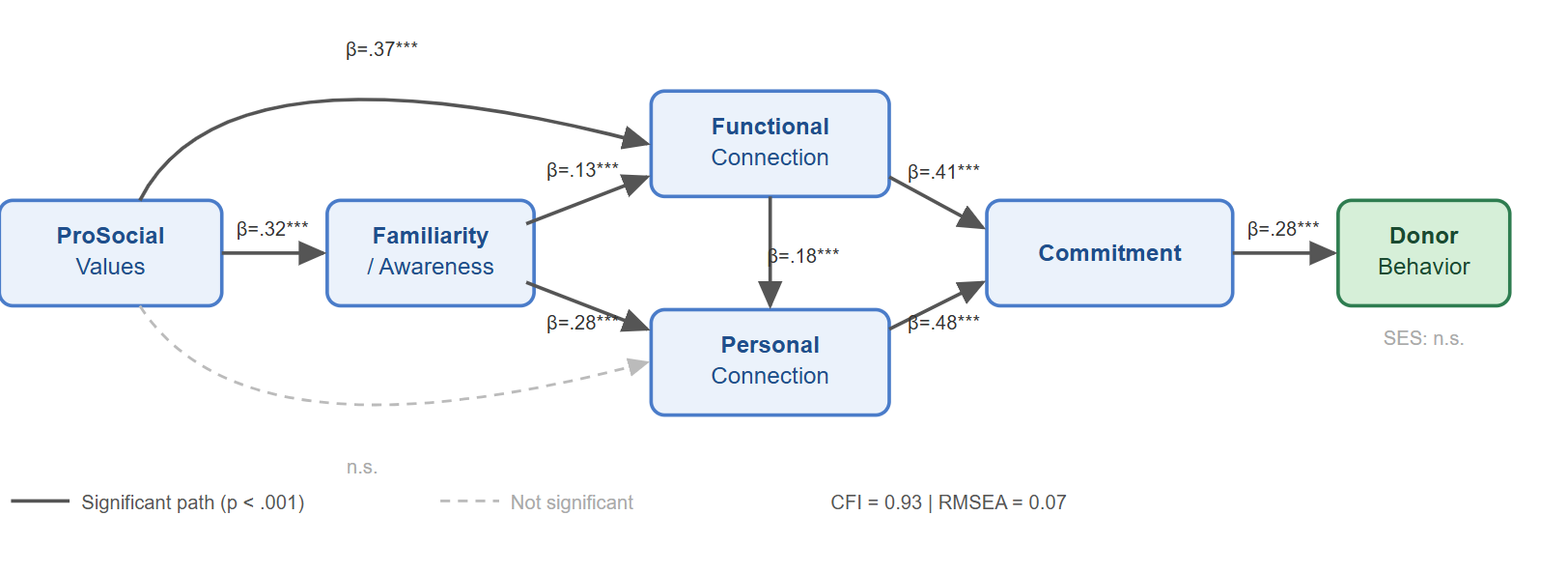
Functional Connection is the reliability dimension. Does the org do what it says? Is it coherent, predictable, competent? This is organizational credibility — not warm, not inspiring, but load-bearing. Your accountant needs to earn this, so does your plumber and so does your charity.
Personal Connection is the values-alignment dimension. Does this cause reflect something I believe about the world? Does supporting this organization say something true about who I am? This is identity.
Both drive relationship strength, neither substitutes for the other, they are separate but together, constitute much of what get’s morphed into the Trust word. So, when someone says “we need to build more donor trust,” they haven’t said anything yet. Building reliability means operational consistency, transparent reporting, delivering on the implicit contract of the gift. Building personal connection means helping donors see themselves in the cause, not what you do, but who it’s for and what it says about both of you.
What Happens Before the Relationship Starts?
What sits upstream of Relationship? This is the world where acquisition and brand building live. And what this shows is that donor values predict brand awareness, which is a precondition for starting the relationship. Think of values as a radio receiver: you don’t pick up the signal if you’re not tuned to the frequency. So any acquisition strategy or brand build around reach and frequency is fighting an upstream current when the audience being reached isn’t identity-matched. You’re paying to be noticed by people who weren’t going to notice you. The job of marketing to people who were already going to notice you isn’t to introduce yourself. It’s to confirm that their intuition was right.
And income? Education level? Predicts nothing once Commitment is in the model. Committed donors of modest means are just as likely to give as committed wealthy donors. The relevant variable is psychological, not financial.
What Do With This
This version of the model is a starting point, not the product. Its value is the diagnostic version but it’s only diagnostic because we started with theory and a model. Chicken and egg, egg and chicken.
Main takeaways:
- Trust says nothing, it’s like saying people want quality healthcare.
- Brand personality/differentiation workshops that feel vague, generic and fuzzy are vague, generic and fuzzy. Brand as personality is total garbage, differentation is often unlikely and practically, not necessary.
- Attention and awareness only matter if you’ve done the hard work of knowing which Identities and values align with your cause (not your brand) and use targeting and message/creative to drive self selection.
- Use this model to get diagnostic.
Kevin
Behavioral Science Q & A
Thanks so much for raising this. Yes, capturing donor information can be helpful for stewardship like newsletters, thank-you letters, impact updates. But how you ask matters. Forcing full data capture introduces friction that can significantly depress conversion, many donors may simply abandon the process. Beyond the friction itself, required fields also shift the emotional experience […]
Read Full Answer
Unlike holidays that everyone already knows, Giving Tuesday is a created event. Many donors recognize the name but not the exact timing, so referencing it becomes a helpful cue. It serves as a reminder and taps into social norm activation (“everyone’s giving today”), which boosts response. However, we still want it paired with the mission, […]
Read Full Answer
When a subject line leads with the match (“Your gift matched!”), it risks triggering market-norm thinking: the sense that giving is a financial transaction rather than an act rooted in values, identity, and care. This shift reduces intrinsic motivation and, over time, can weaken donor satisfaction and long-term engagement. It also makes the email indistinguishable […]
Read Full Answer
There’s no evidence that QR codes suppress mid-value giving; all available research suggests they either help or have no negative effect. In fact, behavioral and usability research consistently shows the opposite: reducing friction at any point in the donation process increases completion rates and total response. And that has nothing to do with capacity and […]
Read Full Answer
What you’re experiencing is very common. Resistance often isn’t about capability, but about motivation quality. If board members feel pushed into fundraising, that triggers controlled motivation (low quality motivation) i.e. obligation, guilt, or fear of judgment, which often results in avoidance. Instead, we need to create conditions for volitional motivation (high quality motivation) by satisfying […]
Read Full Answer
That’s a really thoughtful question, and you’re not the first to raise it. Many of our clients have been cautious about placing the ask at the very end. To address their concern, we’ve tested both approaches, and the results are clear: when the ask comes last, even if that means it appears on the second […]
Read Full Answer