

Are You Growing…Or Just Getting Busier?
Nonprofits love metrics.
They collect them the way some folks where I grew up collected souvenir spoons: polished, displayed, and mostly useless in any practical sense.
They count:
- email volume
- impressions
- clicks
- campaign sends
- open rates
- ROAS
- conversion rate
- “engagement” (a word that means everything and therefore nothing)
And if you’re really modern, you’ve got a dashboard. Possibly several. It looks terrific in board meetings. It makes some folks feel like professionals but also fails to answer the one question that determines whether your organization lives or dies: Are you growing — or are you declining?
Because there are only two real business conditions for a nonprofit: Growing or
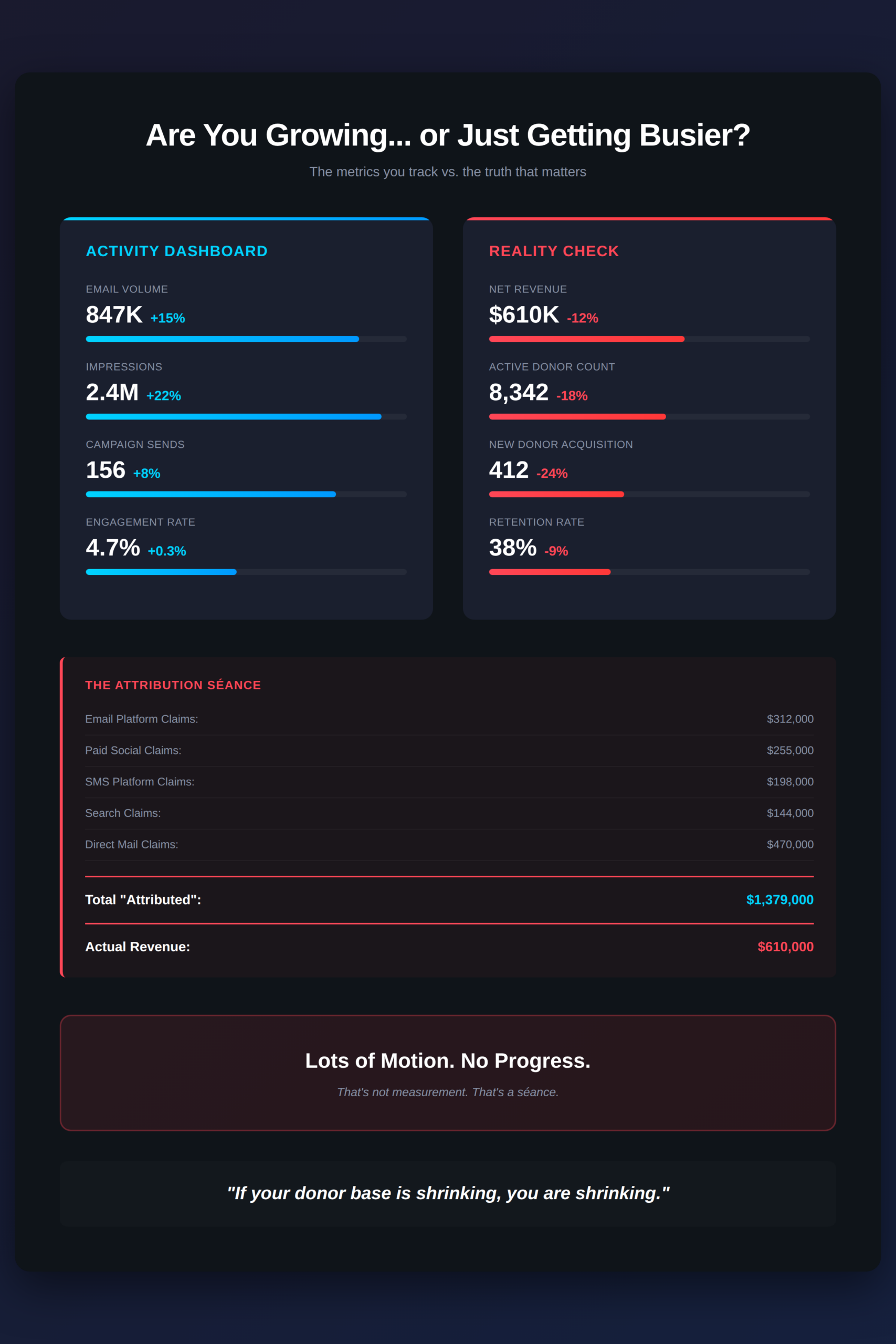
Shrinking (and pretending you aren’t). Your “Activity Dashboard” might celebrate:
- Email Volume: +15%
- Impressions: 2.4M
- Campaign Sends: +8%
But the “Reality Check: Fundraising Health” chart (aka the bank account and donor database) show Net revenue declining. Active donor count declining. And there it is — the full tragedy in one picture: Lots of motion. No progress
Too Many Nonprofits Have Become Factories for Making Busywork
Here’s the dirty secret: Most nonprofits are not measuring growth. They are measuring activity. And activity is comforting because it’s controllable. You can always send more email. You can always buy more ads. You can always make the line go up on some vendor or consultant’s report.
But growth is rude. Growth asks harder questions:
- Are new donors replacing the ones you lose?
- Are you retaining anybody?
- Do donors come back without being bribed or spammed?
- Did net revenue rise — or did you just redistribute credit across platforms?
Growth doesn’t care about your brand lift or clap for your impressions or clicks. It doesn’t attend every meeting, conference and webinar. (Though it does, of course, regularly read The Agitator.)
And this is where I’ll offer my own confession as a grizzled growth metric-fetishist: Every January, I look back across the last several years of a nonprofit’s numbers and ask one thing: are they growing, or not? Period. That’s my number one vital sign. The rest is bedside manner.
This year I was aided by listening to a What The Fundraising podcast conversation between Kevin and Mallory Erickson, and it was oddly refreshing — not only because it offered terrific framework ” but because it dragged us back to the one thing this sector keeps trying to avoid– actual business health.
The Deeply Flawed Volume Model: “People Give Because We Ask”
Why has “growth” — the fundamental metric, the raison d’être of fundraising — fallen out of Fundraising’s Top Five Chart of Metrics?
Because the modern fundraising religion is built on a flawed belief: “People give because we ask. “ That’s the fundamental tenet of the volume model theology.
The cycle goes like this:
- Assumption: Asking causes giving
- Strategy: Brute-force volume
- Result: Sameness & gimmicks
- Outcome: Diminishing returns
And the consequence is the line that should be framed above the doorway of most fundraising offices is “ Efficiency replaces effectiveness. We send the same message to everyone because it’s cheaper, not because it works. “
What a perfect line — and what a damning one. Too much fundraising has become a giant machine for producing cheap sameness–premiums, fake deadlines, faux matches, relentless recycling of creative, and “personalization” that’s really just inserting someone’s first name before insulting their intelligence.
Funnel Vision: Optimizing the Wrong End of the Problem
Then comes the next modern fixation: the funnel — or as Kevin puts it, “Funnel Vision”. The myopic malady of fundraisers obsessing over conversion when the real problem is demand: the need to break into new territory and find new donors, rather than fishing for the same exhausted fish out of co-ops and questionable lists. No matter how many dashboards glow in the dark, you can’t optimize your way to growth with a shrinking donor base. Yet nonprofits will spend six figures on conversion optimization while their donor population collapses like a political promise after Election Day.
It’s like rearranging deck chairs while the ship sinks — except the deck chairs are sponsored by a software vendor and there’s a consultant running a “strategic session” about chair alignment. Which brings us to…
Attribution: The Great Nonprofit Hallucination
We need to talk about attribution — the most beloved form of fiction in fundraising. Because if you believe the reports, every channel “caused” the gift. The donor clicked an email link (email platform takes credit), saw an Instagram ad earlier (Meta takes credit), got a text reminder (SMS vendor takes credit), and then — just for sport — visited your website from a branded search (Google takes credit). Finally, they donated after receiving a direct mail package the week before (direct mail takes credit).
So in the quarterly performance review you hear:
- “Email drove $312,000.”
- “Paid social drove $255,000.”
- “SMS drove $198,000.”
- “Search drove $144,000.”
- “Direct mail drove $470,000.”
And you look at the list and think, we are genius! Then you check the finance report — the rude one, the one without artwork and animation— and it says: Total revenue: $610,000.
Congratulations. Your vendors/consultants/whoever have just “attributed” $1.38 million in fundraising performance out of a $610,000 quarter.
That’s not measurement.That’s a séance.
And here’s the tell — the dead giveaway: When the total attributed revenue exceeds your actual revenue, you don’t have performance. You have over-attribution.
Why So Many Take Credit for So Much
Attribution platforms aren’t built to tell the truth. They are built to answer one question: “How do I prove my technology matters?”Each platform uses its own logic: last click, first click, view-through, time windows, “assists,” multi-touch models that look sophisticated and behave like wishful thinking.
If a donor so much as glanced in the direction of a message, the system declares victory.Marketing reports routinely confuse credit with causality. Standard attribution is the illusion. Incremental testing is the truth.
Here’s what attribution really measures: not what caused the donation, but what touched the donor somewhere on their wandering path to giving.Every platform claims credit for the same donor. This is the polite way to say: standard attribution is double-counting dressed up in a blazer.
The Only Remedy: Prove Attribution Incrementally
The solution is old-fashioned and devastating: control groups, incremental lift, test vs. no treatment.The only adult question: did adding the channel raise EXTRA dollars?
Not claimed dollars. Not credited dollars. Not “donations that happened while we were in the room.”Extra. Incremental. Proven.
The only math that matters in channel testing is this: what happens when you don’t do it? If you stop running paid social for a period and nothing changes, then congratulations: you weren’t driving revenue. You were paying for credit.
Platforms Lie. The Bank Account Doesn’t.
Fundraising effects are indirect, lagged, mixed. An SMS today might stimulate a direct mail gift three weeks later. A brand ad might create mental availability that shows up later in organic giving. Immediate click-attribution misses the full picture.If you really want the truth, here it is: Total bank account value (test) – total bank account value (control) = TRUTH
That’s the grown-up metric. Everything else is PowerPoint designed to justify spend.
Stop Managing Decline. Start Measuring Growth.
Make growth your North Star. Specifically: net revenue + donor count. Not impressions., not campaigns, not conversion rate. Because you can have the world’s best conversion rate on a shrinking donor base — and still go bankrupt with tremendous efficiency.
If you want to stop being played by your own dashboards:Pick two numbers: net revenue and active donor count. Track them year over year. Make growth your only definition of good marketing. If donor count and net revenue aren’t rising, your marketing isn’t “strong.” It’s loud.
Stop worshiping volume. Volume is not strategy. It’s too often panic over a budget. Stop confusing measurement with decoration. Dashboards are Christmas lights on a decaying house: pretty, expensive, electrified, but not structural.
The nonprofit world has become drunk on analytics. Successful fundraisers — and their leadership — remain stone sober about the one metric that matters most: growth. Not fancy reporting just actual growth.. Because in the end there is no fundraising theology, no clever segmentation, no demographic rune-reading, no CRM upgrade, no AI tool, no “journey mapping” workshop that can save you from the simple, brutal arithmetic of reality: If your donor base is shrinking, your organization is shrinking.
Roger
2 responses to “Are You Growing…Or Just Getting Busier?”
Behavioral Science Q & A
Thanks so much for raising this. Yes, capturing donor information can be helpful for stewardship like newsletters, thank-you letters, impact updates. But how you ask matters. Forcing full data capture introduces friction that can significantly depress conversion, many donors may simply abandon the process. Beyond the friction itself, required fields also shift the emotional experience […]
Read Full Answer
Unlike holidays that everyone already knows, Giving Tuesday is a created event. Many donors recognize the name but not the exact timing, so referencing it becomes a helpful cue. It serves as a reminder and taps into social norm activation (“everyone’s giving today”), which boosts response. However, we still want it paired with the mission, […]
Read Full Answer
When a subject line leads with the match (“Your gift matched!”), it risks triggering market-norm thinking: the sense that giving is a financial transaction rather than an act rooted in values, identity, and care. This shift reduces intrinsic motivation and, over time, can weaken donor satisfaction and long-term engagement. It also makes the email indistinguishable […]
Read Full Answer
There’s no evidence that QR codes suppress mid-value giving; all available research suggests they either help or have no negative effect. In fact, behavioral and usability research consistently shows the opposite: reducing friction at any point in the donation process increases completion rates and total response. And that has nothing to do with capacity and […]
Read Full Answer
What you’re experiencing is very common. Resistance often isn’t about capability, but about motivation quality. If board members feel pushed into fundraising, that triggers controlled motivation (low quality motivation) i.e. obligation, guilt, or fear of judgment, which often results in avoidance. Instead, we need to create conditions for volitional motivation (high quality motivation) by satisfying […]
Read Full Answer
That’s a really thoughtful question, and you’re not the first to raise it. Many of our clients have been cautious about placing the ask at the very end. To address their concern, we’ve tested both approaches, and the results are clear: when the ask comes last, even if that means it appears on the second […]
Read Full Answer
Roger, I love the call for true metrics and more in depth analysis. Whether I am helping nonprofits or tech startup companies, finding the 3-5 key North Star metrics is an excercise every board and executive team should undertake. And yes, I have never seen raw web site visits make the final list!
Roger, Thank you for the wake up call. Of course, I am out of the business. However, my desire to be a successful fundraiser was whether I raised a buck or not to advance the institutional mission. As I review the literature and services available to nonprofits, lots of things to do, but little on how being active makes your organization successful. Stunned this last year see an end of the year report of a major nonprofit fundraising organization with words (of achievement ) of activities splashed across the page, the word “money” was not among the hundreds illustrated.
Thanks for reminding fundraisers about what they do.