

Collapsing Conscientiousness? Collapsing Headlines Is More Like It
The Financial Times recently told us that young people’s personalities are “in freefall.” It’s the stuff generational bias dreams are made of. Here are the Big Five in brief:
- Conscientiousness: Reliability, follow-through, discipline. High scorers pay bills on time and floss.
- Neuroticism: Proneness to anxiety and stress. High scorers catastrophize emails.
- Agreeableness: Cooperativeness and empathy. High scorers actually help you move a couch.
- Extraversion: Outgoing and sociable. High scorers still call instead of text.
- Openness (not even charted in the FT graph): Curiosity, imagination, creativity.
The graph is the pièce de résistance: plunging red lines showing 16–39 year-olds hemorrhaging Conscientiousness, Agreeableness, and Extraversion, while spiking in Neuroticism. Read literally, it paints a perfect generational panic postcard: young people who can’t focus, won’t plan, don’t talk to each other, and are one collective panic attack away from collapse.
Ah yes — the TikTok-addled masses: can’t hold a job, ghost their friends, and melt into neurotic puddles at the first whiff of stress. If that’s the story you’re shopping for, this graph delivers.
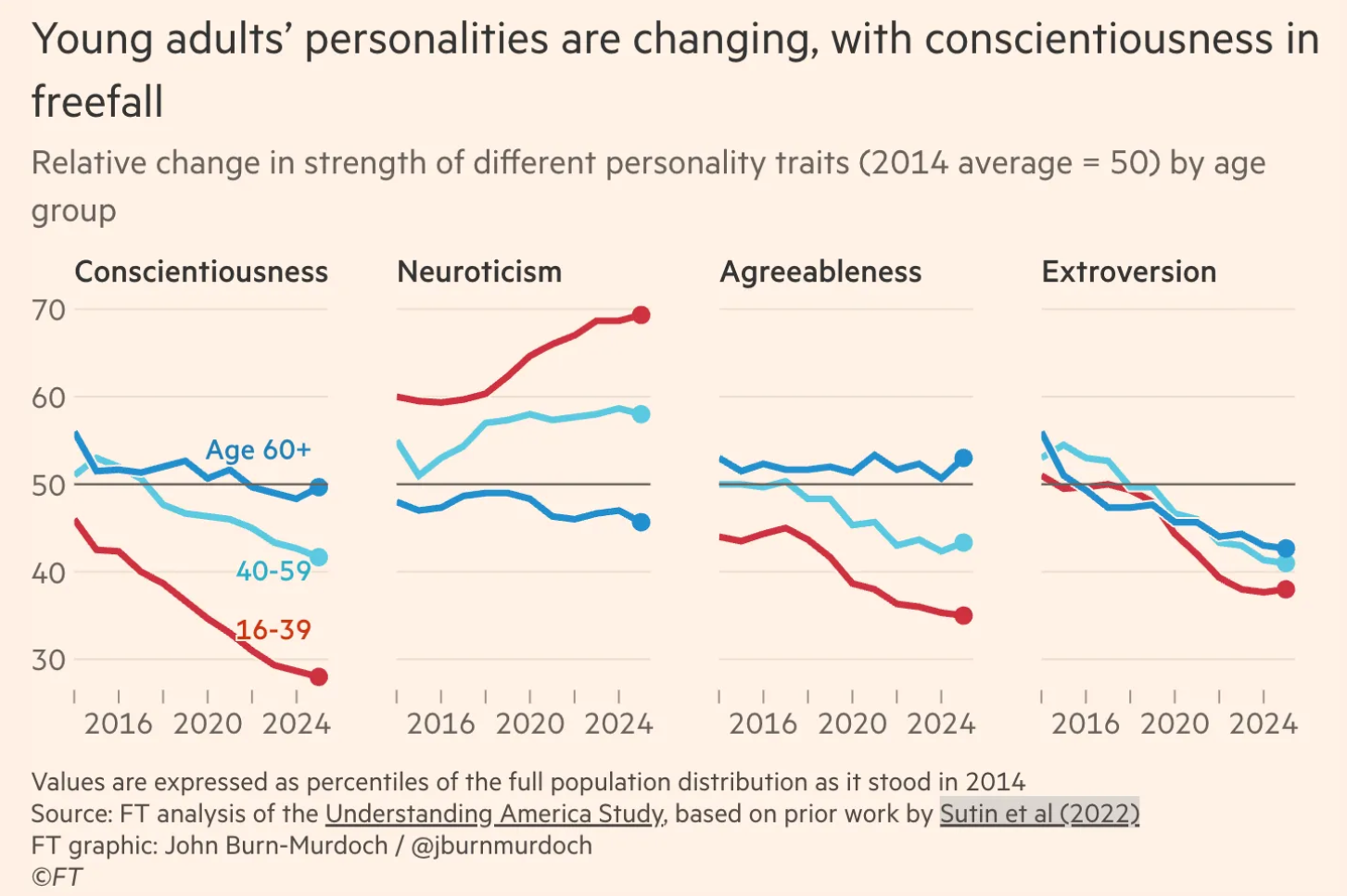
Attention: confirmation bias, your article is calling
The problem is these dramatic picture are almost entirely a product of data manipulation: truncated Y-axes, transformations to make the squiggles look steeper, and, in the journalist’s words, “clarifying for a general audience.” Clarifying here meaning: feeding the generational stereotype that young people can’t work a full day, talk to other humans, or function without a dopamine drip from screens.
The underlying data from the Understanding America Study doesn’t show freefall, it shows modest shifts of a few points on a 45-point scale. When you run the math, all those years between 2015 and 2023 explain just 2–4% of the change in scores. Put differently: eight years of supposed generational decline add up to a rounding error, not the end of civilization.
Enter the Skeptics
Our own behavioral scientist and head personality researcher, Stefano, put it in the most polite Canadian-academic way possible:
“The original paper didn’t make those bold claims, and the journalist seems to be playing psychologist…All this to say that I’m skeptical of the reporting here.”
Translation: bullshit, but said with maple-syrup manners.
And some other heavyweights of personality science — McCrae, Sutin, Donnellan — agree. Small changes, likely artifacts, and nowhere near grounds for claiming a generational freefall. The Generational Bias Playbook is the oldest play in the book:
- Ancient Athens: “Kids today don’t respect their elders.”
- 1950s: “Comic books are rotting children’s brains.”
- 1980s: “Video games will make kids violent shut-ins.”
- Today: “Smartphones are collapsing personalities.”
Occam’s Razor for Trendlines
The lesson here is also as old as time: be skeptical of big, sweeping changes that seem too good or bad to be true. Data tortured to confess should make you suspicious. If something looks out of whack it probably is.
Nine times out of ten, the world hasn’t shifted underneath us, only the Y-axis has.
Kevin
Behavioral Science Q & A
Thanks so much for raising this. Yes, capturing donor information can be helpful for stewardship like newsletters, thank-you letters, impact updates. But how you ask matters. Forcing full data capture introduces friction that can significantly depress conversion, many donors may simply abandon the process. Beyond the friction itself, required fields also shift the emotional experience […]
Read Full Answer
Unlike holidays that everyone already knows, Giving Tuesday is a created event. Many donors recognize the name but not the exact timing, so referencing it becomes a helpful cue. It serves as a reminder and taps into social norm activation (“everyone’s giving today”), which boosts response. However, we still want it paired with the mission, […]
Read Full Answer
When a subject line leads with the match (“Your gift matched!”), it risks triggering market-norm thinking: the sense that giving is a financial transaction rather than an act rooted in values, identity, and care. This shift reduces intrinsic motivation and, over time, can weaken donor satisfaction and long-term engagement. It also makes the email indistinguishable […]
Read Full Answer
There’s no evidence that QR codes suppress mid-value giving; all available research suggests they either help or have no negative effect. In fact, behavioral and usability research consistently shows the opposite: reducing friction at any point in the donation process increases completion rates and total response. And that has nothing to do with capacity and […]
Read Full Answer
What you’re experiencing is very common. Resistance often isn’t about capability, but about motivation quality. If board members feel pushed into fundraising, that triggers controlled motivation (low quality motivation) i.e. obligation, guilt, or fear of judgment, which often results in avoidance. Instead, we need to create conditions for volitional motivation (high quality motivation) by satisfying […]
Read Full Answer
That’s a really thoughtful question, and you’re not the first to raise it. Many of our clients have been cautious about placing the ask at the very end. To address their concern, we’ve tested both approaches, and the results are clear: when the ask comes last, even if that means it appears on the second […]
Read Full Answer