

Democracy Doesn’t Need Your Talking Points. It Needs Your List.
Somewhere in some nonprofit’s Slack channel right now, someone is drafting talking points on “the erosion of voting rights.” Somebody else is scheduling a panel: Protecting Democracy in the Midterms — A Conversation. Nobody in that channel has yet asked a single supporter to show up as a poll worker on November 3.
I’m not going to spend this post cataloging what Trump and the Republican Party are doing to make voting harder. You already know. The plans are public, the litigation is underway, and every week brings a new purge, a new ID requirement, a new vote suppression tactic. Worrying about it out loud has become a genre unto itself. It’s also become an excuse.
Here’s what worrying doesn’t do: it doesn’t staff a precinct. And right now, precincts are short-staffed almost everywhere.
The Shortage Is the Suppression
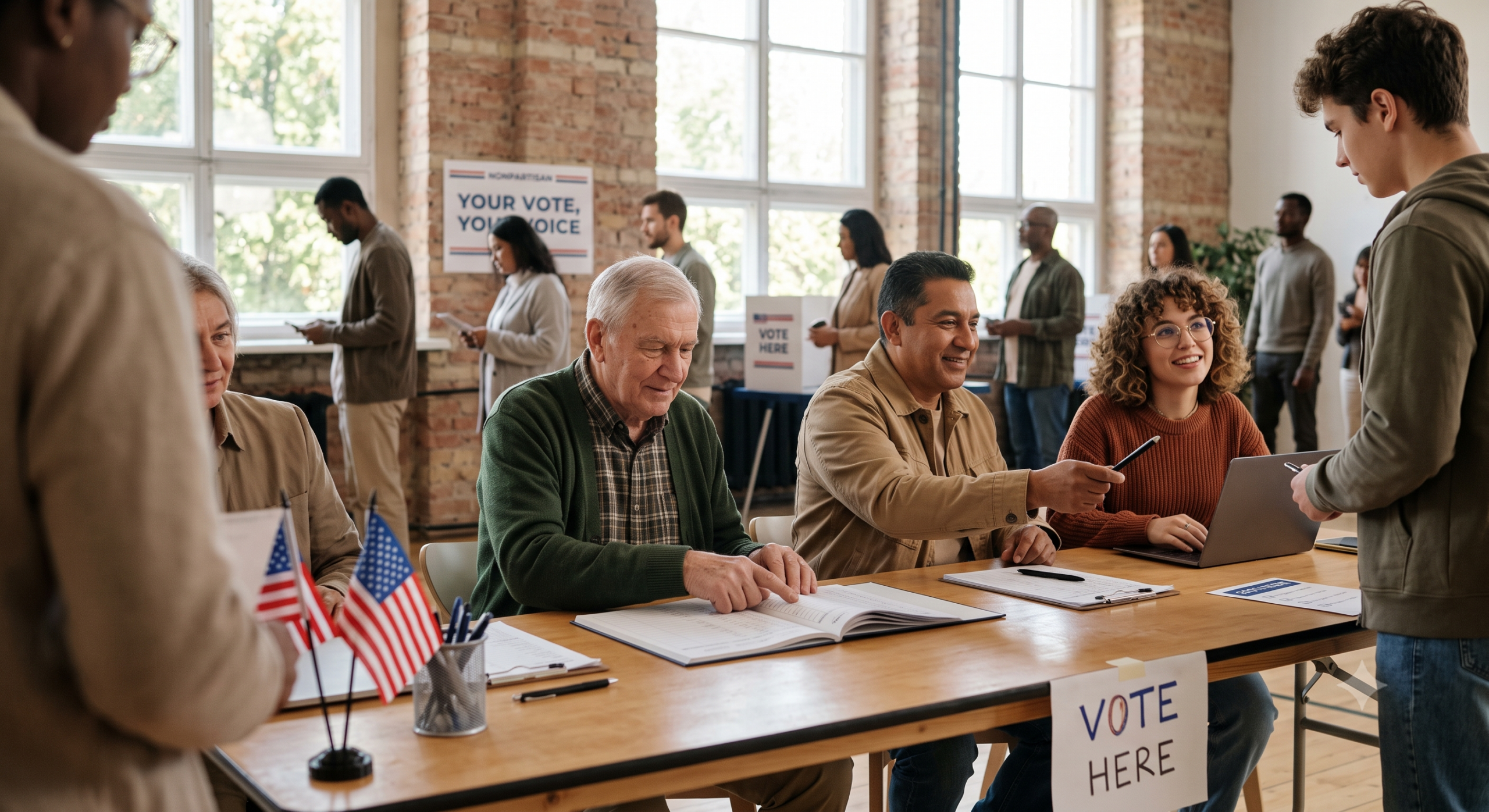
You don’t need a conspiracy to disenfranchise voters. You just need a shortage of trained and committed citizens working the polls, assisting voters, answering questions—assuring order and calm. When states and counties can’t find enough poll workers, they consolidate precincts and shut others down — creating what election administrators now call “voting deserts,” concentrated in rural, low-income, and minority communities where a five-minute walk to vote becomes a forty-minute drive.
Understaffed precincts mean slower check-ins, fewer working scanners, and longer waits for voters using provisional ballots or needing assistance. Hourly workers, parents without childcare, elderly and disabled voters — they’re the ones who give up and leave the waiting line. And sparse, rushed, undertrained staff are exactly the conditions that turn an honest mistake — a misplaced tray, a delayed opening — into a viral “proof of fraud” blasted over Trump’s Truth Social, Fox, and the rest of the right-wing media by 9 A.M. on Election Day.
Meanwhile, the workforce that has quietly run American elections for decades — retirees, median age over 60 — is retiring for real, worn down by harassment and threats nobody signed up for. That’s not a staffing hiccup. That’s institutional memory walking out the door, precinct by precinct.
This is where nonprofits should stop being spectators.
NRDC Proved the Math in One Email
As reported by Rebecca Steadly in M+R’s Insights, in early July, the Natural Resources Defense Council Action Fundpartnered with Power the Polls and sent one email to its list. Result: more than 600 poll workers signed up, 482 of them brand new to the work. In 2024, that same organization recruited 172. One email. A 3.5x increase.
That’s not a fluke of skillful messaging. It’s proof that people are hungry for something more concrete to do with their anger than bitch about it. NRDC AF didn’t run a government hiring program. It used the thing every nonprofit already has — a list of people who trust the organization enough to open its email — and pointed that trust at a folding table in a school gymnasium.
Common Cause Built a Whole Playbook
If NRDC AF shows what one email can do, Common Cause shows what a sustained strategy with thousands and thousands of volunteers looks like. Their model runs on three tracks at once. State chapters in Florida, Wisconsin, and Texas partner with Power the Polls on targeted digital and student campaigns to recruit first-time, bilingual, tech-savvy poll workers — the people most likely to lower the average age of a precinct staff and keep it running.
Outside the polls, Common Cause co-leads the nonpartisan Election Protection Coalition, stationing trained monitors at high-risk sites to catch long lines and machine failures before they become disenfranchisement, and routing problems to the 866-OUR-VOTE hotline in real time.
And at the state and local level, they’re lobbying for the boring, unglamorous fixes that actually keep poll workers on the job: $15–$17-an-hour stipends, paid leave for public employees who want to serve, and anti-intimidation laws that protect the people doing this work from the harassment that’s been driving them out.
Recruitment, protection, and policy — that’s not a slogan, it’s a checklist. Any organization with a list, a newsletter, or a staff meeting can pick up at least one line of it.
Yes, You’re Allowed to Do This
Save this sentence for the next board meeting where someone gets nervous: poll worker recruitment is completely legal, for 501(c)(3) organizations and 501(c)(4)s alike. NRDC Action Fund is a c4. It doesn’t matter. Encouraging nonpartisan civic participation — helping your community staff the machinery of a free election — isn’t political activity under the Internal Revenue Code. It’s exactly the kind of public service your tax exemption was designed to enable. If your general counsel tells you otherwise, get a new general counsel.
That includes your own staff. Give them paid time off to work the polls, especially if your organization has people in swing districts. NRDC AF didn’t just ask supporters. It asked itself.
One Week. One Ask.
National Poll Worker Recruitment Day is next Tuesday, August 11. That’s not a symbolic date — it’s a deadline. Every organization reading this has a list, a newsletter, a social channel, or a staff all-hands between now and then. Use one of them. Point people to the sign up page at Power the Polls, to their state and local election office listed at USA.gov. It takes less time to write that email than it took you to read this post.
You can keep having the panel discussion. Just don’t let it be the whole plan. The voters standing in a four-hour line in a shuttered-precinct district don’t need your concern. They need someone at the check-in table who showed up.
Roger
Behavioral Science Q & A
Thanks so much for raising this. Yes, capturing donor information can be helpful for stewardship like newsletters, thank-you letters, impact updates. But how you ask matters. Forcing full data capture introduces friction that can significantly depress conversion, many donors may simply abandon the process. Beyond the friction itself, required fields also shift the emotional experience […]
Read Full Answer
Unlike holidays that everyone already knows, Giving Tuesday is a created event. Many donors recognize the name but not the exact timing, so referencing it becomes a helpful cue. It serves as a reminder and taps into social norm activation (“everyone’s giving today”), which boosts response. However, we still want it paired with the mission, […]
Read Full Answer
When a subject line leads with the match (“Your gift matched!”), it risks triggering market-norm thinking: the sense that giving is a financial transaction rather than an act rooted in values, identity, and care. This shift reduces intrinsic motivation and, over time, can weaken donor satisfaction and long-term engagement. It also makes the email indistinguishable […]
Read Full Answer
There’s no evidence that QR codes suppress mid-value giving; all available research suggests they either help or have no negative effect. In fact, behavioral and usability research consistently shows the opposite: reducing friction at any point in the donation process increases completion rates and total response. And that has nothing to do with capacity and […]
Read Full Answer
What you’re experiencing is very common. Resistance often isn’t about capability, but about motivation quality. If board members feel pushed into fundraising, that triggers controlled motivation (low quality motivation) i.e. obligation, guilt, or fear of judgment, which often results in avoidance. Instead, we need to create conditions for volitional motivation (high quality motivation) by satisfying […]
Read Full Answer
That’s a really thoughtful question, and you’re not the first to raise it. Many of our clients have been cautious about placing the ask at the very end. To address their concern, we’ve tested both approaches, and the results are clear: when the ask comes last, even if that means it appears on the second […]
Read Full Answer