

Does Supporting Your Mission Require A Free Jacket?
Walt Kelly’s comic strip character, Pogo, gave us the line, “We have met the enemy and he is us.” In fundraising, the enemy often arrives bearing address labels and a complimentary jacket.
In 2023, 60% of acquisition mail used premiums, another 28% used matching gifts or faux supporter cards, and just 12% was mission mail. Charities with wildly different purposes have arrived at remarkably similar offers and in turn, we’ve given the mission a supporting role in its own fundraising.
That sameness creates an opening for any charity willing to understand why someone might care about its work. Yet the familiar defense persists: you need premiums to make acquisition work. Which may be true if the alternative is generic copy addressed to a generic person about a generic need. Beating that tells you very little about what a better alternative could achieve.
Consider the ads below, the control leads with a quilted jacket while the other begins, “As a conservationist,” then connects that identity to protecting wetlands, clean water and wildlife.
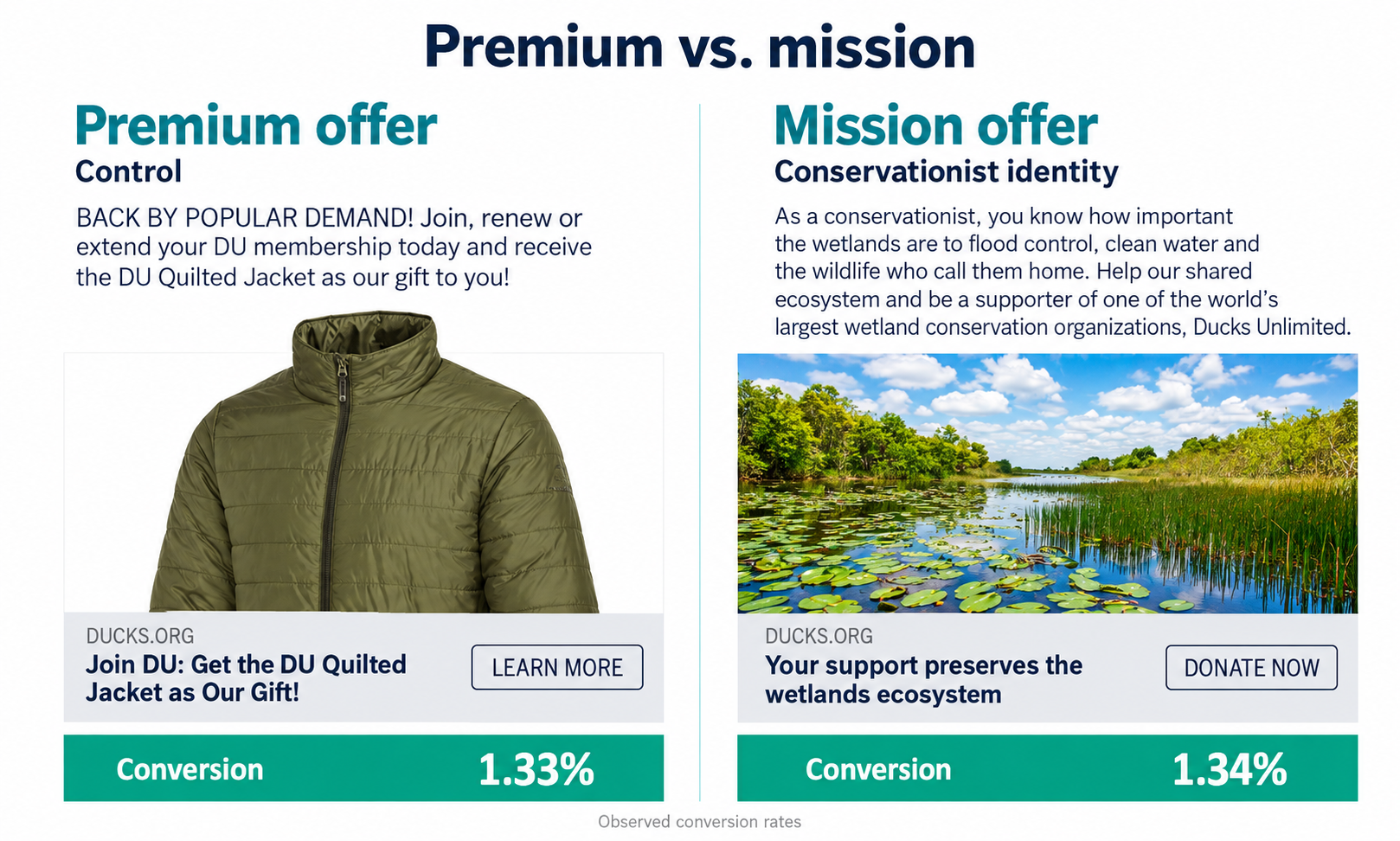
Observed conversion was 1.33% for the jacket offer and 1.34% for the conservationist offer. Those figures give us reason to question the jacket’s necessity, not least of which when you factor in the merchandise and fulfilment costs.
Then comes the more consequential question: what reason for giving have you encouraged?
Leading with merchandise can attract people who want the merchandise. Leading with a relevant identity gives people a reason to support the work that can survive the disappearance of the offer. If the next gift requires another inducement, your acquisition success has come with a recurring expense.
A Ducks Unlimited jacket can also reinforce someone’s identity as a conservationist. The issue is making the jacket the reason to join and assuming commitment to conservation will follow.
A stronger alternative takes more work than removing the premium:
- Use primary research to understand people’s motivations.
- Build messages around relevant identities and personality differences.
- Evaluate gift amounts, costs, second gift conversion and net lifetime value alongside initial response.
“Mission offers” aren’t automatically good. They still need to connec to the person reading the appeal. But when we treat that connection as optional and the giveaway as essential, we shouldn’t be surprised when donors learn to shop our offers.
Pogo would recognise the problem and he might even qualify for a free jacket.
Kevin
Behavioral Science Q & A
Thanks so much for raising this. Yes, capturing donor information can be helpful for stewardship like newsletters, thank-you letters, impact updates. But how you ask matters. Forcing full data capture introduces friction that can significantly depress conversion, many donors may simply abandon the process. Beyond the friction itself, required fields also shift the emotional experience […]
Read Full Answer
Unlike holidays that everyone already knows, Giving Tuesday is a created event. Many donors recognize the name but not the exact timing, so referencing it becomes a helpful cue. It serves as a reminder and taps into social norm activation (“everyone’s giving today”), which boosts response. However, we still want it paired with the mission, […]
Read Full Answer
When a subject line leads with the match (“Your gift matched!”), it risks triggering market-norm thinking: the sense that giving is a financial transaction rather than an act rooted in values, identity, and care. This shift reduces intrinsic motivation and, over time, can weaken donor satisfaction and long-term engagement. It also makes the email indistinguishable […]
Read Full Answer
There’s no evidence that QR codes suppress mid-value giving; all available research suggests they either help or have no negative effect. In fact, behavioral and usability research consistently shows the opposite: reducing friction at any point in the donation process increases completion rates and total response. And that has nothing to do with capacity and […]
Read Full Answer
What you’re experiencing is very common. Resistance often isn’t about capability, but about motivation quality. If board members feel pushed into fundraising, that triggers controlled motivation (low quality motivation) i.e. obligation, guilt, or fear of judgment, which often results in avoidance. Instead, we need to create conditions for volitional motivation (high quality motivation) by satisfying […]
Read Full Answer
That’s a really thoughtful question, and you’re not the first to raise it. Many of our clients have been cautious about placing the ask at the very end. To address their concern, we’ve tested both approaches, and the results are clear: when the ask comes last, even if that means it appears on the second […]
Read Full Answer