

Five Days. Five Years. Same Checks.
Five days after the mob stormed the Capitol on January 6th in 2021—while the broken glass was still being swept up and the flags were still being folded—we posted Funding the Insurrection.
Our question then was blunt and unavoidable: Would corporate America keep funding the politicians who tried to overturn a presidential election?
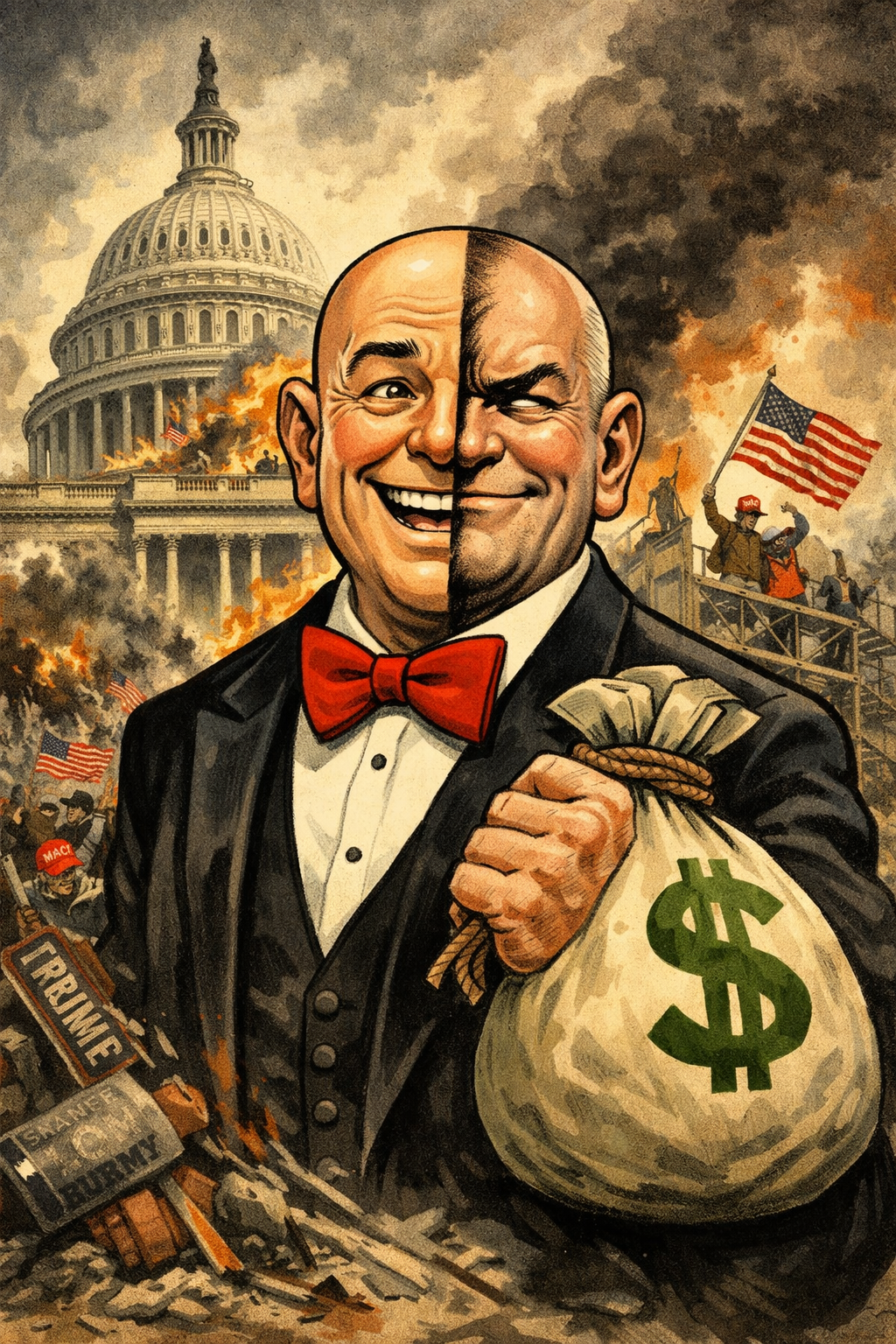 Back then, the answer was still forming, the Capitol was still smoldering. Corporate America, startled like golfers who’d just stepped on a rattlesnake, rushed out statements condemning the January 6 insurrection. PACs were paused. Donations were “under review.” Democracy, we were assured, was sacred.
We wrote then: Money in politics is a very powerful force. So is withholding it.
Five years later, the Agitator can finally answer the question posed when the smoke hadn’t yet cleared.
The Five-Year Report Card
Fast-forward just one year after the mob attack and we noted that the rattlesnake had wandered off, the golfers were back to their swings; and the checks had started to flow.
In our 2022 post, Corporate Political Giving: A Threat to Democracy or Just a Study in Hypocrisy? the early verdict wasn’t encouraging. Hundreds of corporations had already resumed giving to what Citizens for Responsibility and Ethics in Washington (CREW) aptly labeled the “Sedition Caucus.” Performative outrage had expired. Business, as always, resumed.
Why? Because outrage, as we noted then, is often temporary. Money is patient.
And hypocrisy—well, hypocrisy is forever
Now, in 2026, Popular Information has done the long, patient work of tracking who actually meant what they said—and who treated January 6 like a PR inconvenience that would pass with the news cycle. Spoiler alert: outrage was temporary. Money was patient. Hypocrisy proved immortal.
Five winters after January 6, most corporate vows melted away. Many companies that swore never again quietly returned to funding the very lawmakers who tried to erase a democratic vote.
But ten did not blink.
In a landscape of broken promises, they remain rare proof that memory can last longer than outrage—and that restraint, though unfashionable, is still possible.
The Ones Who Meant It
Let’s start with the exceptions—the corporations that didn’t flinch, didn’t lawyer their way out, didn’t quietly drift back to their lobbyists offices on K Street once the coast was clear.
These companies have not funded election deniers in the five years since January 6:
- Farmers Insurance
- Airbnb
- Expedia Group
- Nike
- Clorox
- Eversource Energy
- Holland & Hart
- Qurate Retail (now QVC Group)
- Lyft
- Whirlpool
In a landscape of broken promises, they remain rare proof that memory can last longer than outrage.
And they did it absent victory laps and without ads about courage. Just restraint—an endangered corporate behavior.
The Blinkers
Then there’s the rest.
These companies pledged to stop funding lawmakers who voted to overturn the 2020 election—and later resumed giving anyway, often with exquisite explanations about “peaceful transitions,” “committee structures,” or “revised criteria”:
- Cigna
- Comcast
- General Mills
- Blue Cross Blue Shield
- Allstate
- Marriott International
- Hilton Worldwide
- Ecolab
- NRG Energy
- Cozen O’Connor
- Amazon
- Walmart
Some came back quickly. Some waited a respectable interval. None announced their return with the same moral clarity they used when they left. This is not inconsistency. It’s choreography.
What Five Years Tells Us
In January 2021, corporations were afraid of being photographed too close to the crime scene. In 2022, they were betting the public had moved on. In 2026, we know the answer: most were right.
Corporate America didn’t radicalize. It recalibrated. It learned that democracy outrage has a shelf life, while access never spoils.
Which brings us back to that line we wrote five days after the January 6th insurrection—still doing the heavy lifting five years later: Money in politics is a very powerful force. So is withholding it.
The problem, as it turns out, is not that corporations didn’t understand that truth. It’s that most of them never intended to live by it.
Roger
Behavioral Science Q & A
Thanks so much for raising this. Yes, capturing donor information can be helpful for stewardship like newsletters, thank-you letters, impact updates. But how you ask matters. Forcing full data capture introduces friction that can significantly depress conversion, many donors may simply abandon the process. Beyond the friction itself, required fields also shift the emotional experience […]
Read Full Answer
Unlike holidays that everyone already knows, Giving Tuesday is a created event. Many donors recognize the name but not the exact timing, so referencing it becomes a helpful cue. It serves as a reminder and taps into social norm activation (“everyone’s giving today”), which boosts response. However, we still want it paired with the mission, […]
Read Full Answer
When a subject line leads with the match (“Your gift matched!”), it risks triggering market-norm thinking: the sense that giving is a financial transaction rather than an act rooted in values, identity, and care. This shift reduces intrinsic motivation and, over time, can weaken donor satisfaction and long-term engagement. It also makes the email indistinguishable […]
Read Full Answer
There’s no evidence that QR codes suppress mid-value giving; all available research suggests they either help or have no negative effect. In fact, behavioral and usability research consistently shows the opposite: reducing friction at any point in the donation process increases completion rates and total response. And that has nothing to do with capacity and […]
Read Full Answer
What you’re experiencing is very common. Resistance often isn’t about capability, but about motivation quality. If board members feel pushed into fundraising, that triggers controlled motivation (low quality motivation) i.e. obligation, guilt, or fear of judgment, which often results in avoidance. Instead, we need to create conditions for volitional motivation (high quality motivation) by satisfying […]
Read Full Answer
That’s a really thoughtful question, and you’re not the first to raise it. Many of our clients have been cautious about placing the ask at the very end. To address their concern, we’ve tested both approaches, and the results are clear: when the ask comes last, even if that means it appears on the second […]
Read Full Answer