

Fundraising Keeps Asking Strangers to Act Like Supporters
If the list, offer and package are right, response will follow. Sort of, sometimes, maybe.
This fundraising holy trinity leaves out a tiny detail: whether people know who the hell you are. That might sound obvious but obvious can be in limited supply.
The chart shows acquisition analysis looking at how much mail went into a region, how many donors came back out, and how familiar people in that region were with the organization.
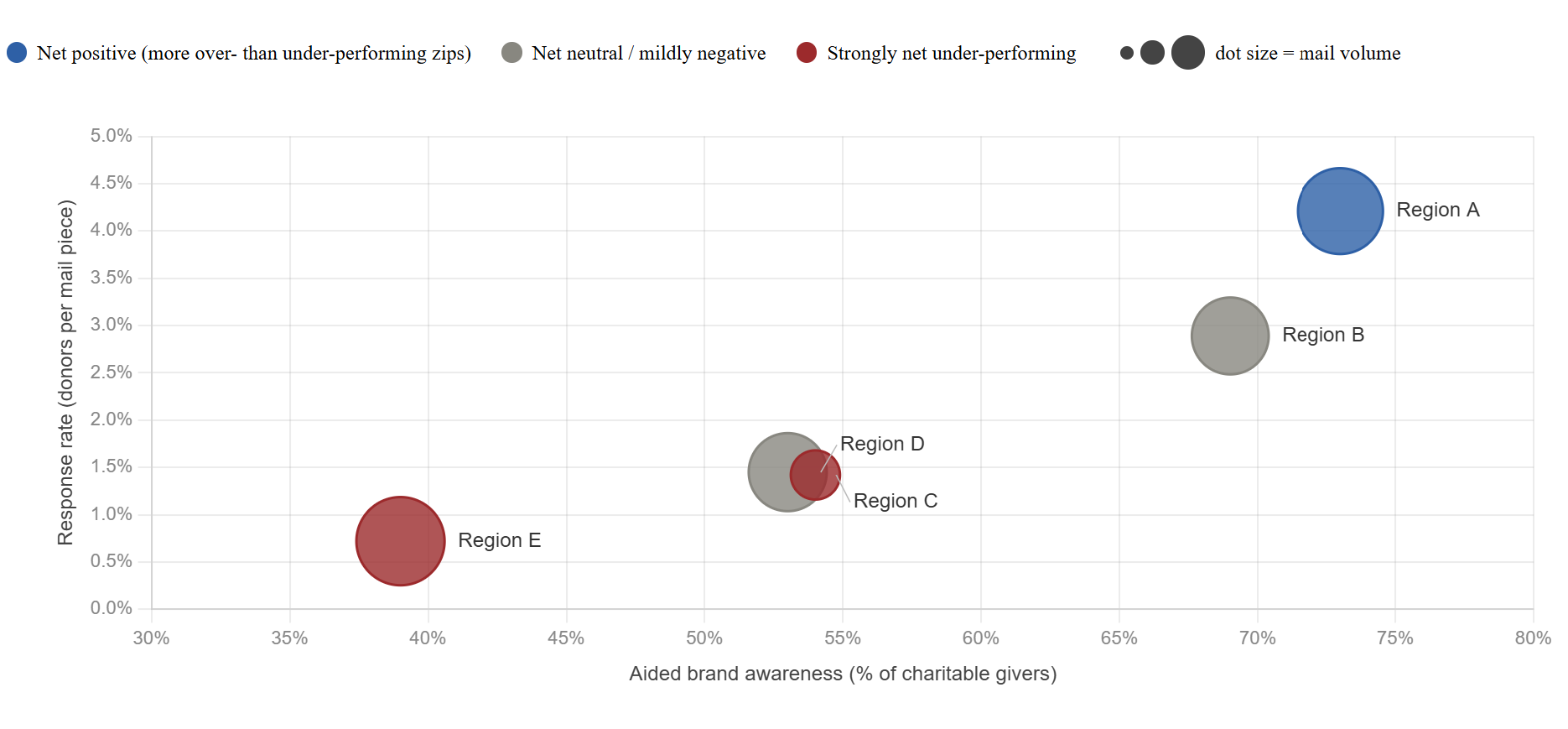
The relationship isn’t subtle, higher brand awareness = higher response rates. Roughly speaking, every additional 10 percentage pts of awareness corresponds to one additional point increase in response.
This is where someone will reflexively say, “Correlation is not causation”. True but mechanisms matter. Brand awareness isn’t decorative mist floating above the fundraising machine. Awareness means the organization has a place in memory, that people recognize the name and have some faint understanding of what it does.
If you take nothing else from this post, ponder this, fundraising is not persuasion, it’s retrieval. The appeal has to call something up: a belief, a memory, a sense of fit, a feeling of trust, a category association, a reason this organization deserves attention among all the other organizations currently elbowing their way into the mailbox.
If none of that exists, the appeal has to do everything at once and that’s a lot to put on a piece of mail.
But doesn’t acquisition mail (or digital acquisition) count as brand building? Look at the dot sizes. Region E has the largest mail volume because it has the densest population area. But it also has the lowest aided awareness and response. More acquisition mail didn’t fix the problem. And repeating the soliciting to essentially the exact same people year after year isn’t brand building or acquiring the familiar as much as it is training avoidance.
I grant acquisition mail may create some brand value early on – the first mailing, the 2nd, the 3rd… but mailing 47, 48, and 49? You are feeding a negatively sloped line and the economics look like a loyalty rewards program to your printer.
Three truths emerge,
- Exposure isn’t same as memory.
- Volume isn’t same as demand.
- A large population isn’t same as a ready market.
Nobody is arguing that building brand means you can send a beige brochure with a vague invite to “partner with us in impact” and wait for the checks to fly in.
But those package tactics perform inside a market condition and one of the most important conditions is whether people already know you.
Brand investment is fundraising infrastructure. It creates the mental availability that makes future asks work better by lowering the cost of response.
That is the growth argument and it’s missing from the standard fundraising apartus that is very good at finding people who have donated before but much worse at finding new audience.
Growth doesn’t occur in a tidy 30-day attribution dashboard with efficiency metrics. But over time, brand building creates the conditions under which fundraising becomes less expensive, less gimmick-dependent, and less reliant on extracting more from the same overworked donor universe.
That is why the “brand versus fundraising” debate is a category error. Weak brand is one of the reasons fundraising has to work so hard.
The chart tells a simple story. Higher awareness, higher response. Lower awareness, lower response. And in the region with the most mail but the weakest awareness, more acquisition volume did not save the day.
There is a lesson in that, assuming we have not trained ourselves to ignore it too.
Kevin
Behavioral Science Q & A
Thanks so much for raising this. Yes, capturing donor information can be helpful for stewardship like newsletters, thank-you letters, impact updates. But how you ask matters. Forcing full data capture introduces friction that can significantly depress conversion, many donors may simply abandon the process. Beyond the friction itself, required fields also shift the emotional experience […]
Read Full Answer
Unlike holidays that everyone already knows, Giving Tuesday is a created event. Many donors recognize the name but not the exact timing, so referencing it becomes a helpful cue. It serves as a reminder and taps into social norm activation (“everyone’s giving today”), which boosts response. However, we still want it paired with the mission, […]
Read Full Answer
When a subject line leads with the match (“Your gift matched!”), it risks triggering market-norm thinking: the sense that giving is a financial transaction rather than an act rooted in values, identity, and care. This shift reduces intrinsic motivation and, over time, can weaken donor satisfaction and long-term engagement. It also makes the email indistinguishable […]
Read Full Answer
There’s no evidence that QR codes suppress mid-value giving; all available research suggests they either help or have no negative effect. In fact, behavioral and usability research consistently shows the opposite: reducing friction at any point in the donation process increases completion rates and total response. And that has nothing to do with capacity and […]
Read Full Answer
What you’re experiencing is very common. Resistance often isn’t about capability, but about motivation quality. If board members feel pushed into fundraising, that triggers controlled motivation (low quality motivation) i.e. obligation, guilt, or fear of judgment, which often results in avoidance. Instead, we need to create conditions for volitional motivation (high quality motivation) by satisfying […]
Read Full Answer
That’s a really thoughtful question, and you’re not the first to raise it. Many of our clients have been cautious about placing the ask at the very end. To address their concern, we’ve tested both approaches, and the results are clear: when the ask comes last, even if that means it appears on the second […]
Read Full Answer