

Kill Channels. Long Live Channels
Defining donors by channel is a bit like defining me by whether Amazon, USPS, UPS or Fed-Ex delivers my packages. It’s accurate and objective but I rarely make that choice and it’s inconsequential to why I bought what I bought.
The channel I give in is often a function of exposure and where I happened to see and act on the ask. And of course, the channel of transaction is always given way too much credit for the gift.
And lastly, saying people who give in multiple channels are better donors is akin to saying people who give us more are worth more. It’s tautological, not insightful.
Death to Channels.
But wait, channels are a useful proxy for what matters in the game of reach and frequency.
If Reach is King, Frequency is the Court Jester. It’s believing in the bettor’s fallacy, that good outcomes are just around the corner if we just keep sending more. Email results in 2022 vs. 2021 show the sector send more emails to fewer people and raised less money.
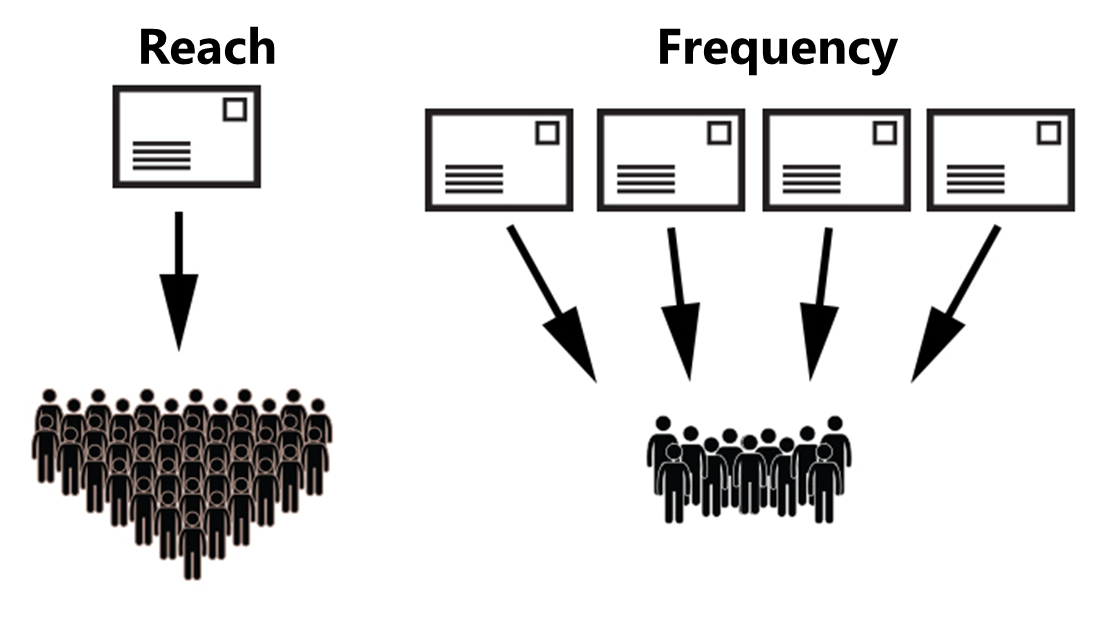
But hey, if you don’t ask, they can’t give, right?
Reach is breadth, the number of people exposed once to your campaign. Frequency is repetition and it has massive diminishing returns, very quickly reached and turning negative, more = less.
But, you can’t run a campaign without some repetition, the same person being exposed more than once. How to minimize frequency and tuning out? I
Reach is King, Modality is Queen. I use modality here to refer to different presentations of the same pitch – oral vs. visual vs. written, long vs. short, etc.
It turns out that I can greatly reduce the downside of irritation from over-exposure by mixing up modality. My brain doesn’t process it as redundant, it processes as novel and different. And channels tend to have innately different modalities – e.g., SMS, Facebook ad, email, direct mail.
Long live channels.
But the law of diminishing returns is undefeated and there is Goldilocks modality/channel mix of 3-4.
Five or higher causes not just diminishing but negative returns. More = less, again.
Kevin
2 responses to “Kill Channels. Long Live Channels”
Behavioral Science Q & A
Thanks so much for raising this. Yes, capturing donor information can be helpful for stewardship like newsletters, thank-you letters, impact updates. But how you ask matters. Forcing full data capture introduces friction that can significantly depress conversion, many donors may simply abandon the process. Beyond the friction itself, required fields also shift the emotional experience […]
Read Full Answer
Unlike holidays that everyone already knows, Giving Tuesday is a created event. Many donors recognize the name but not the exact timing, so referencing it becomes a helpful cue. It serves as a reminder and taps into social norm activation (“everyone’s giving today”), which boosts response. However, we still want it paired with the mission, […]
Read Full Answer
When a subject line leads with the match (“Your gift matched!”), it risks triggering market-norm thinking: the sense that giving is a financial transaction rather than an act rooted in values, identity, and care. This shift reduces intrinsic motivation and, over time, can weaken donor satisfaction and long-term engagement. It also makes the email indistinguishable […]
Read Full Answer
There’s no evidence that QR codes suppress mid-value giving; all available research suggests they either help or have no negative effect. In fact, behavioral and usability research consistently shows the opposite: reducing friction at any point in the donation process increases completion rates and total response. And that has nothing to do with capacity and […]
Read Full Answer
What you’re experiencing is very common. Resistance often isn’t about capability, but about motivation quality. If board members feel pushed into fundraising, that triggers controlled motivation (low quality motivation) i.e. obligation, guilt, or fear of judgment, which often results in avoidance. Instead, we need to create conditions for volitional motivation (high quality motivation) by satisfying […]
Read Full Answer
That’s a really thoughtful question, and you’re not the first to raise it. Many of our clients have been cautious about placing the ask at the very end. To address their concern, we’ve tested both approaches, and the results are clear: when the ask comes last, even if that means it appears on the second […]
Read Full Answer
Hi Kevin, happy holidays. This is a fascinating topic and something most nonprofits, consultants and agencies struggle with. What’s the right mix of channels and the right segments to target? Does making a gift online mean that you should stop sending direct mail? Does making a DAF gift mean that you need to start treating the donor differently? What is too much, what is not enough? We know stopping direct mail means less money for the nonprofit. We can’t only depend on email as one of the channels either… but how much do we need to spend on other channels and social media? How about texting? How long before it becomes overkill? And for the nonprofits, how much time and effort can one person spend on all of these channels? I’d love to see more testing and sharing of those tests so that we can learn from each other. Ultimately, we often share donors amongst different verticals… children’s cause donors will also give to environmental and animal charities… but how much multi-channel exposure can one donor bear before it’s too much? Maybe we can get a bit closer to that answer in 2026.
Hi Erica,
Here is a quick example of a channel level question many are wrestling with and how to properly answer it while noting how it’s typically done and why that doesn’t work.
A concrete way to think about SMS is this: I don’t decide to include it in the mix because an A/B test shows “SMS present” beats “SMS absent” on clicks or SMS-attributed gifts. That’s still a channel-centric read of the world.
Should we start texting people? Hold out a true no-SMS control, send text messages in Month 1 to the test group. The evaluation window however is six months of time and you are only looking at total giving as the metric. If the test group gives more over six months, SMS earned its place in the mix even if almost none of that lift shows up as SMS transactions or clicks.
This is where most A/B testing goes wrong. In our SMS example it can look identical in structure – there is a test group that gets SMS and a holdout group that does not. But the analysis collapses back to channel metrics and short windows looking at clicks and SMS platform claimed revenue. Incrementality is different by intent. It’s explicitly asking whether SMS creates new behavior, not whether it can claim credit for behavior that would have happened anyway.
Run an “A/B” split test on SMS and ask the SMS platform if it won and it will almost always tell you, yes. Run an incremental lift test and find out if any new behavior was created and you may get a very different answer.
Kevin