

Paychecks, Purpose, and the Real Math of Job Satisfaction
Money isn’t everything. In fact, sometimes it makes things worse.
In one experiment, low-income people were given $2,000, $500, or nothing at all. Those who received cash were objectively better off — they paid bills, bought food, covered school costs. But subjectively? They reported higher stress and anxiety than the control group who got nothing.
The lesson: money solves problems but doesn’t guarantee psychological well-being. Sometimes, it even highlights how precarious life still feels.
Now, flip the lens back to your organization. What’s your aim for staff — pay them well, fulfill them psychologically, or both? Of course, the obvious answer is “both.” But if you had to choose, the data is crystal clear: you’re better off focusing on psychological fulfillment.
A global survey of 16,000 workers showed that the biggest drivers of job satisfaction were:
- Interpersonal relationships
- Interesting work
Together, those accounted for about 40% of satisfaction. Pay explained only 4%. That’s a 10-to-1 ratio in favor of “soft and fuzzy” over dollars.
And job satisfaction isn’t just a feel-good metric, it’s one of the strongest predictors of churn.
The Big Three: Competence, Autonomy, Relatedness
The best framework for understanding what drives staff satisfaction isn’t buzzwords like purpose, meaning or engagement. It’s three core psychological needs:
- Competence → Do people feel they’re building skills, gaining mastery, and growing in ways that matter? Or do they feel like imposters stuck on a treadmill?
- Autonomy → Do leaders give guidance and guardrails but also trust staff to figure out the “how”? Or is it micromanagement all the way down?
- Relatedness → Do people feel connected, not just to coworkers, but also to the brand and mission? Do they feel part of something larger than themselves?
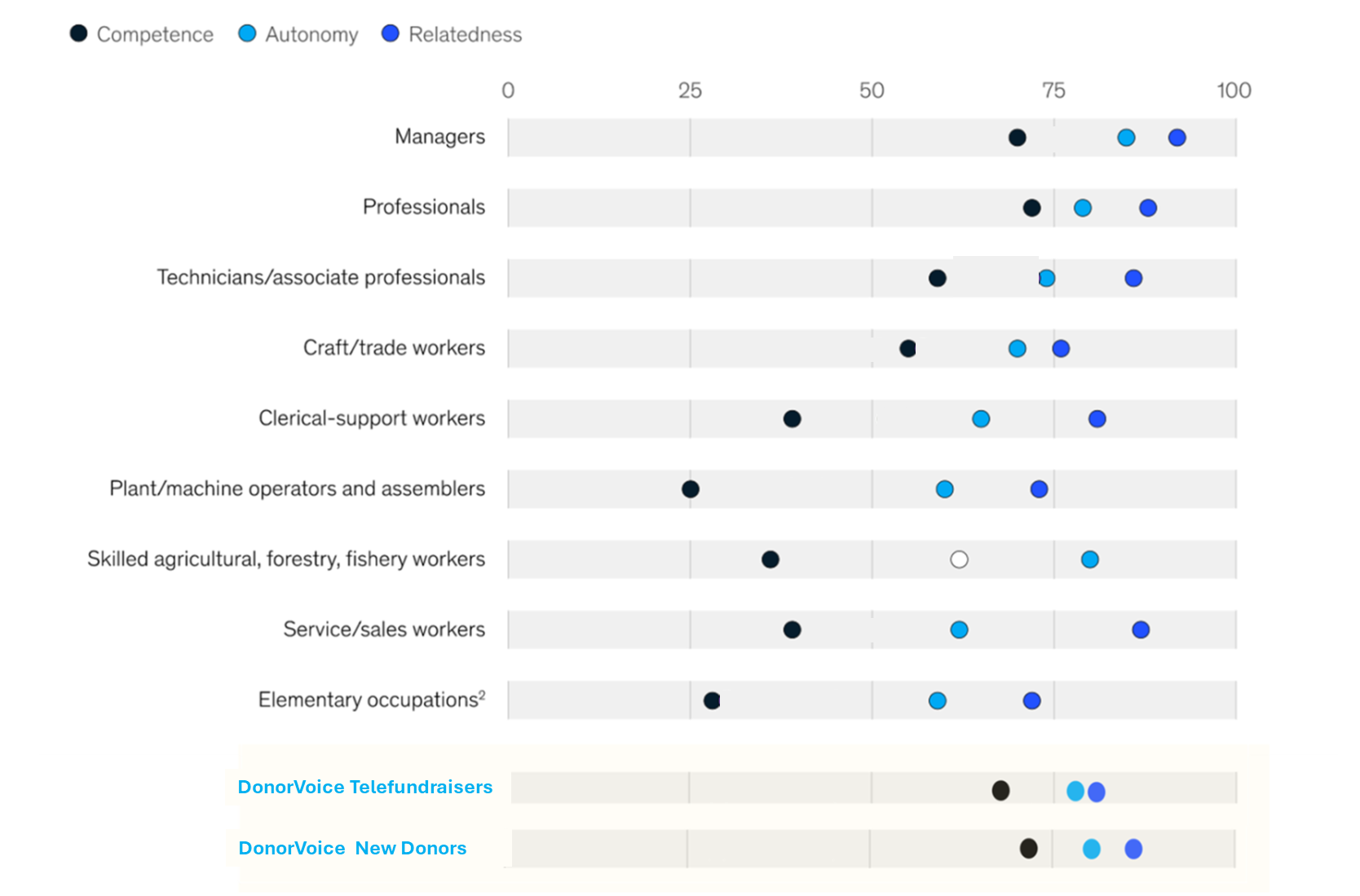
Measure these three well, and you’ll know where you stand. Measure them poorly (or not at all), and you’re managing blind. Here’s data from a study measuring different professions and how their job satisfaction as function of these three needs.
What’s clear is that competence is a tough nut to crack and there is a lot of variance.
Why This Matters Beyond HR
Staff satisfaction is contagious. We’ve seen it firsthand in our own telefundraising work. The last two rows are our data, showing satisfaction for our frontline fundraisers and the donors they signup. It’s a very tight correlation but flip that around, and dissatisfaction spreads just as easily.
And for non-frontline staff, churn is expensive and disruptive. Every exit ripples outward, whether you see it in donor experience or not.
Here’s a 3 part do now plan:
- Start measuring staff satisfaction in the right way. Competence, autonomy, and relatedness are the levers that matter. (ask our team for guidance)
- Look at the data. Treat it like you would a donor file, track it, test interventions, learn.
- Fix what you find. Don’t just nod along when results come back. Adjust training, leadership style, or team structures where the gaps are clearest.
The truth is simple: paychecks matter, but psychological fulfillment matters ten times more.
Kevin
Behavioral Science Q & A
Thanks so much for raising this. Yes, capturing donor information can be helpful for stewardship like newsletters, thank-you letters, impact updates. But how you ask matters. Forcing full data capture introduces friction that can significantly depress conversion, many donors may simply abandon the process. Beyond the friction itself, required fields also shift the emotional experience […]
Read Full Answer
Unlike holidays that everyone already knows, Giving Tuesday is a created event. Many donors recognize the name but not the exact timing, so referencing it becomes a helpful cue. It serves as a reminder and taps into social norm activation (“everyone’s giving today”), which boosts response. However, we still want it paired with the mission, […]
Read Full Answer
When a subject line leads with the match (“Your gift matched!”), it risks triggering market-norm thinking: the sense that giving is a financial transaction rather than an act rooted in values, identity, and care. This shift reduces intrinsic motivation and, over time, can weaken donor satisfaction and long-term engagement. It also makes the email indistinguishable […]
Read Full Answer
There’s no evidence that QR codes suppress mid-value giving; all available research suggests they either help or have no negative effect. In fact, behavioral and usability research consistently shows the opposite: reducing friction at any point in the donation process increases completion rates and total response. And that has nothing to do with capacity and […]
Read Full Answer
What you’re experiencing is very common. Resistance often isn’t about capability, but about motivation quality. If board members feel pushed into fundraising, that triggers controlled motivation (low quality motivation) i.e. obligation, guilt, or fear of judgment, which often results in avoidance. Instead, we need to create conditions for volitional motivation (high quality motivation) by satisfying […]
Read Full Answer
That’s a really thoughtful question, and you’re not the first to raise it. Many of our clients have been cautious about placing the ask at the very end. To address their concern, we’ve tested both approaches, and the results are clear: when the ask comes last, even if that means it appears on the second […]
Read Full Answer