

Please Submit Something Disruptive That Fits in Our Spreadsheet
“We want creative and innovative ideas.”
What self-respecting agency doesn’t like hearing that? The rub is when it’s neutered by also needing to forecast within three percent of plan, survive a board meeting, and resemble something a peer organization has already tested.
What I’ve realized is that wanting novelty that behaves like familiarity isn’t hypocrisy, it’s incentive alignment.
Familiar ideas come with a shared, often unspoken, mental model and evaluation criteria. Everyone in the room has seen some version of it before, so evaluation feels objective. The channel mix looks responsible, the revenue model resembles last year, the creative feels adjacent to something that “worked.” Agreement emerges because the template already exists.
Truly novel ideas don’t come with that template so the room improvises. One person evaluates through brand risk, another through short term revenue pressure and another through personal taste. Disagreement increases and in committee environments, disagreement is quietly translated into risk.
There is a pyschological solve.
In one study, sandwich shop employees rated potential menu items.
- Control condition: Half were asked how successful each sandwich would be. The more unusual the sandwich, the more the ratings spread out. Turkey and cheese clustered tightly. The inventive combinations produced variance.
- Test Condition: Researchers changed a single line in the instructions, asking employees to judge success defined by serving sandwiches no one had tried before.
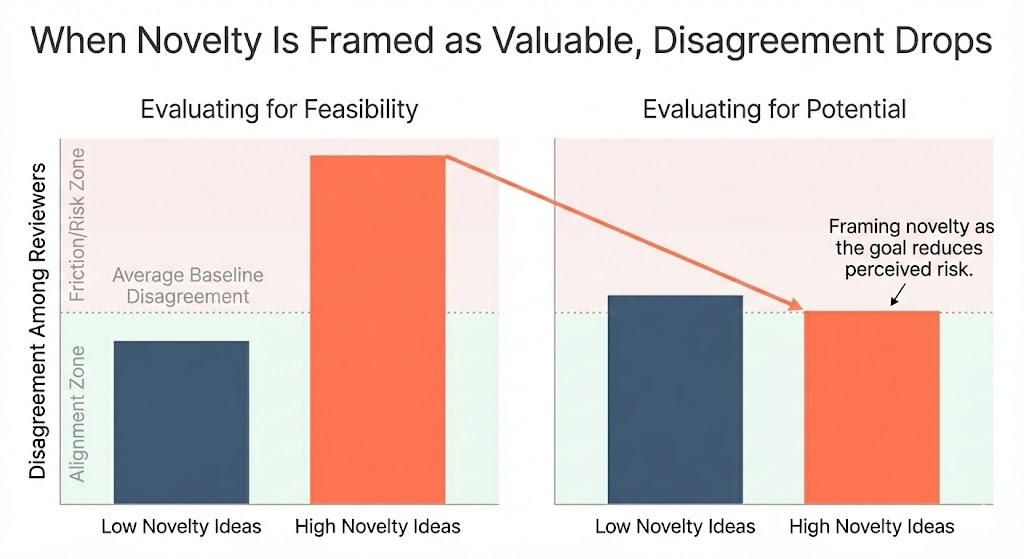
Same sandwiches, different frame. Disagreement around the high novelty sandwiches melted away like swiss on a rueben. Evaluators aligned more closely when novelty was part of the value proposition. Meanwhile, the conventional sandwiches began to generate more spread.
The only thing that changed was the evaluative lens, now zoom out to fundraising.
The Volume Machine fundraising model rewards predictability and treats forecast variance as a governance problem. In the quest for efficiency an idea that cannot be benchmarked feels irresponsible, even if leadership is simultaneously declaring that growth requires bold thinking.
So the machine selects for what it can model.
This is where I am less sympathetic. If you say you want innovation but insist on calculating precise ROI on something that has no precedent, you are not being disciplined. You are confusing the appearance of control with control itself. The spreadsheet is not neutral, it becomes your default strategy and it always encodes yesterday’s assumptions as the starting point.
If you want different ideas, you have to change the grading rubric. In RFPs and creative reviews, make novelty an explicit dimension rather than an implicit liability. Separate strategic incoherence from personal discomfort. Treat genuinely new initiatives as portfolio bets with asymmetric upside instead of demanding the same certainty you expect from incremental tweaks.
Otherwise you will continue approving the most defensible variation of what you already do and wondering why retention is flat and acquisition is more expensive every year.
If you frame novelty as risk, it will look risky, if you frame it as part of the strategy, the room recalibrates.
Kevin
Behavioral Science Q & A
Thanks so much for raising this. Yes, capturing donor information can be helpful for stewardship like newsletters, thank-you letters, impact updates. But how you ask matters. Forcing full data capture introduces friction that can significantly depress conversion, many donors may simply abandon the process. Beyond the friction itself, required fields also shift the emotional experience […]
Read Full Answer
Unlike holidays that everyone already knows, Giving Tuesday is a created event. Many donors recognize the name but not the exact timing, so referencing it becomes a helpful cue. It serves as a reminder and taps into social norm activation (“everyone’s giving today”), which boosts response. However, we still want it paired with the mission, […]
Read Full Answer
When a subject line leads with the match (“Your gift matched!”), it risks triggering market-norm thinking: the sense that giving is a financial transaction rather than an act rooted in values, identity, and care. This shift reduces intrinsic motivation and, over time, can weaken donor satisfaction and long-term engagement. It also makes the email indistinguishable […]
Read Full Answer
There’s no evidence that QR codes suppress mid-value giving; all available research suggests they either help or have no negative effect. In fact, behavioral and usability research consistently shows the opposite: reducing friction at any point in the donation process increases completion rates and total response. And that has nothing to do with capacity and […]
Read Full Answer
What you’re experiencing is very common. Resistance often isn’t about capability, but about motivation quality. If board members feel pushed into fundraising, that triggers controlled motivation (low quality motivation) i.e. obligation, guilt, or fear of judgment, which often results in avoidance. Instead, we need to create conditions for volitional motivation (high quality motivation) by satisfying […]
Read Full Answer
That’s a really thoughtful question, and you’re not the first to raise it. Many of our clients have been cautious about placing the ask at the very end. To address their concern, we’ve tested both approaches, and the results are clear: when the ask comes last, even if that means it appears on the second […]
Read Full Answer