

Responsive Multiples: The Donors You Can’t Treat Like Clones
After a first gift, most donors fall into two camps.
-
The majority never give again.
-
The next most common group gives exactly once a year, the Mode of 1.
But there’s a third group. Smaller, more valuable, and more complex. They’re the donors open to giving more than once a year and we call them Responsive Multiples. These are the donors most fundraisers salivate over and they’re also the ones most often mishandled.
Jack and Jill, Redux
-
Jill donates frequently and is more likely to donate today than Jack, who donates less often.
-
But if Jill donates today, she’s less likely to donate tomorrow.
Both statements are true. Traditional models do the first comparison: pit Jill against Jack, rank by recency and frequency (even if using fancy models), and flood Jill with appeals. The assumption: past response = future response.
But that’s only half the picture. Because Jill isn’t just a datapoint relative to Jack, she’s an individual whose behavior changes in response to your behavior. And if your “behavior” is an onslaught of asks, you’ll eventually turn Jill into Jack.
That’s the paradox of frequency, more contact drives some donations, but it also breeds irritation. Every donor eventually takes a break from the treadmill and the only question is whether that break is temporary or permanent.
The DonorVoice Approach: Personalized Pulsing
Our model takes a different tack and it’s conceptually simple and intuitively appealing.
We look at how each individual donor responds to the charity’s inputs — the actual solicitation history. Not just their gifts, but how their giving changes in response to being asked.
That means Jill’s cadence isn’t determined by comparing her to Jack. It’s determined by Jill’s own response pattern.
For Responsive Multiples, we use machine learning to predict the months we should and shouldn’t mail, for each person. The result is a personalized cadence:
-
Engage donors when they’re most receptive.
-
Hold off when contact is more likely to irritate than inspire.
-
Reduce the total number of appeals while increasing net revenue.
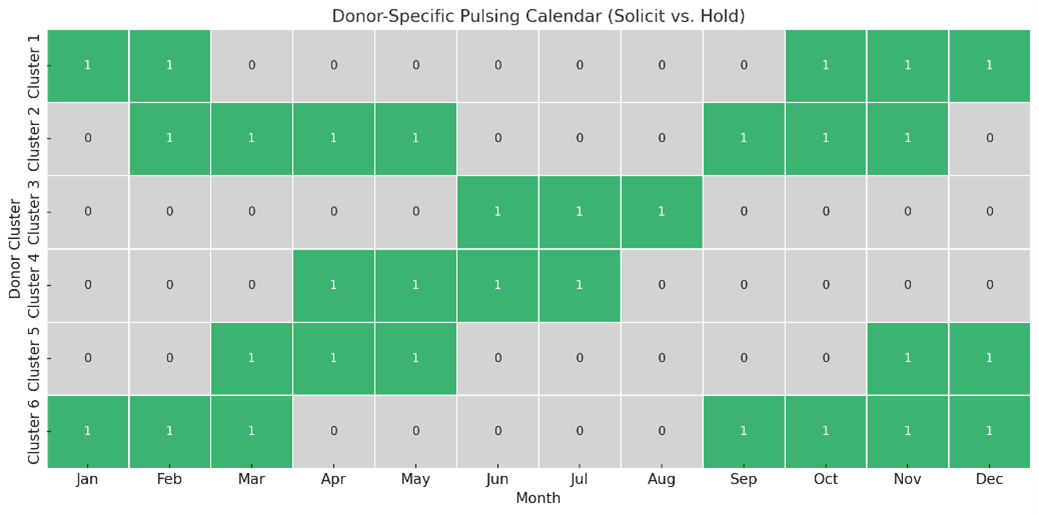
Knowing when to ask, and just as importantly, when not to.
We’ll be showing what Responsive Multiples look like in practice — and how personalized pulsing works at scale — in our upcoming webinar: Stop Asking, Start Aligning: How Donor Rhythms Beat Default Frequency
Kevin
Behavioral Science Q & A
Thanks so much for raising this. Yes, capturing donor information can be helpful for stewardship like newsletters, thank-you letters, impact updates. But how you ask matters. Forcing full data capture introduces friction that can significantly depress conversion, many donors may simply abandon the process. Beyond the friction itself, required fields also shift the emotional experience […]
Read Full Answer
Unlike holidays that everyone already knows, Giving Tuesday is a created event. Many donors recognize the name but not the exact timing, so referencing it becomes a helpful cue. It serves as a reminder and taps into social norm activation (“everyone’s giving today”), which boosts response. However, we still want it paired with the mission, […]
Read Full Answer
When a subject line leads with the match (“Your gift matched!”), it risks triggering market-norm thinking: the sense that giving is a financial transaction rather than an act rooted in values, identity, and care. This shift reduces intrinsic motivation and, over time, can weaken donor satisfaction and long-term engagement. It also makes the email indistinguishable […]
Read Full Answer
There’s no evidence that QR codes suppress mid-value giving; all available research suggests they either help or have no negative effect. In fact, behavioral and usability research consistently shows the opposite: reducing friction at any point in the donation process increases completion rates and total response. And that has nothing to do with capacity and […]
Read Full Answer
What you’re experiencing is very common. Resistance often isn’t about capability, but about motivation quality. If board members feel pushed into fundraising, that triggers controlled motivation (low quality motivation) i.e. obligation, guilt, or fear of judgment, which often results in avoidance. Instead, we need to create conditions for volitional motivation (high quality motivation) by satisfying […]
Read Full Answer
That’s a really thoughtful question, and you’re not the first to raise it. Many of our clients have been cautious about placing the ask at the very end. To address their concern, we’ve tested both approaches, and the results are clear: when the ask comes last, even if that means it appears on the second […]
Read Full Answer