

Snake Oil, Plain Tofu, and the Broken Compass of Fundraising
It never fails. Every few years some bright-eyed consultant with a PowerPoint addiction announces they’ve cracked the code on donors.
Not by, say, asking donors what they care about. Not by measuring what they actually do. No, no—by asking if they’ve ever used a rotary phone, or sent a postcard, or listened to music on a Walkman. One point for each thing you’ve never done, and voila—your donor identity, distilled to a BuzzFeed quiz.
Imagine betting your annual revenue on whether Mrs. Callahan in Des Moines once rented a VHS tape from Blockbuster. Yet this is what passes for “insight” in too many conference ballrooms.
The Snake Oil Checklist
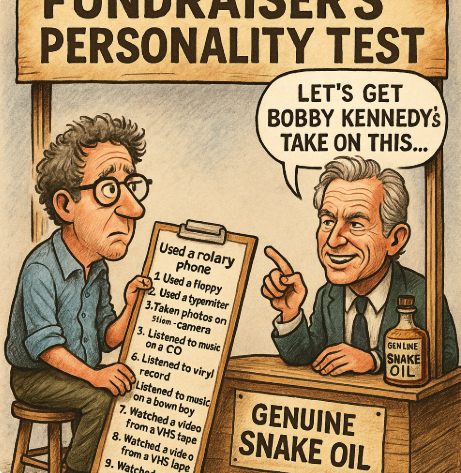 This sampling of a generational “test” is a perfect example. A Frankenstein mix of nostalgia and irrelevance:
- Have you ever recorded music from the radio onto a cassette?
- Used a paper map to get somewhere?
- Owned an encyclopedia?
And fundraisers are supposed to build strategy on this? That’s not science—it’s astrology with better fonts. Asking people what they think of themselves and then parroting their answers back is not sociology; it’s ego karaoke.
Generational Marketing, a.k.a. Lazy Thinking
Kevin’s already torn apart generational marketing in Gen Z to Save The Day —the idea that birth year explains behavior. Spoiler: it doesn’t. The differences between any two “generations” are dwarfed by the differences within one.
Treating Gen Z or Boomers or any generation as a hive mind is as useful as consulting horoscopes before sending your year-end appeal.
But snake oil sells, and lazy thinking has great profit margins. And, afterall, it’s far easier to stereotype a generation than to understand context, environment, and personality.
Enter the Trolls
And on the other end, we’ve got the trolls—those self-anointed experts with a thimble of knowledge they mistake for an ocean—sniffing at AI as plain tofu or white bread without the crusts. These are the same people who once thought email was a fad and that no one would ever get engaged or become better informed let alone give money online.
Here’s the irony: dismissing AI’s practical uses in fundraising (personalized asks, real-time testing, frictionless giving) is just as bad as selling snake oil personality charts. Both deny evidence and both leave fundraisers stuck chasing shadows.
The Real Medicine
Fundraising isn’t about whether your donor once dialed into AOL or still owns a paper map. It’s about:
- Gratitude: Sending thank-you notes.
- Substance: Offering a bigger meal, not a Big Mac. Real stories, real data, not cotton candy.
- Connection: Socialization, belonging, friendly greetings that sound human.
- Context: Personality, identity, environment—what actually shapes behavior.
Ignore that, and you’re as reckless as the wellness guru selling $89 detox water.
So beware the fundraising snake oil peddlers—on both sides. The ones promising cosmic insight from a checklist of stereotype demographic traits. And the ones too stubborn to see that AI can be grandma’s french onion soup instead of low sodium broth.
Because in this trade, betting your fundraising strategy on astrology by birthdate isn’t just hubris—it’s malpractice.
And as for bringing in RFK Jr. for his opinion on AI? Only if we’re diagnosing the measles outbreak in your donor file.
Roger
Behavioral Science Q & A
Thanks so much for raising this. Yes, capturing donor information can be helpful for stewardship like newsletters, thank-you letters, impact updates. But how you ask matters. Forcing full data capture introduces friction that can significantly depress conversion, many donors may simply abandon the process. Beyond the friction itself, required fields also shift the emotional experience […]
Read Full Answer
Unlike holidays that everyone already knows, Giving Tuesday is a created event. Many donors recognize the name but not the exact timing, so referencing it becomes a helpful cue. It serves as a reminder and taps into social norm activation (“everyone’s giving today”), which boosts response. However, we still want it paired with the mission, […]
Read Full Answer
When a subject line leads with the match (“Your gift matched!”), it risks triggering market-norm thinking: the sense that giving is a financial transaction rather than an act rooted in values, identity, and care. This shift reduces intrinsic motivation and, over time, can weaken donor satisfaction and long-term engagement. It also makes the email indistinguishable […]
Read Full Answer
There’s no evidence that QR codes suppress mid-value giving; all available research suggests they either help or have no negative effect. In fact, behavioral and usability research consistently shows the opposite: reducing friction at any point in the donation process increases completion rates and total response. And that has nothing to do with capacity and […]
Read Full Answer
What you’re experiencing is very common. Resistance often isn’t about capability, but about motivation quality. If board members feel pushed into fundraising, that triggers controlled motivation (low quality motivation) i.e. obligation, guilt, or fear of judgment, which often results in avoidance. Instead, we need to create conditions for volitional motivation (high quality motivation) by satisfying […]
Read Full Answer
That’s a really thoughtful question, and you’re not the first to raise it. Many of our clients have been cautious about placing the ask at the very end. To address their concern, we’ve tested both approaches, and the results are clear: when the ask comes last, even if that means it appears on the second […]
Read Full Answer