

Stop Dangling the Baby Seal. The Science Against Half-Told Stories
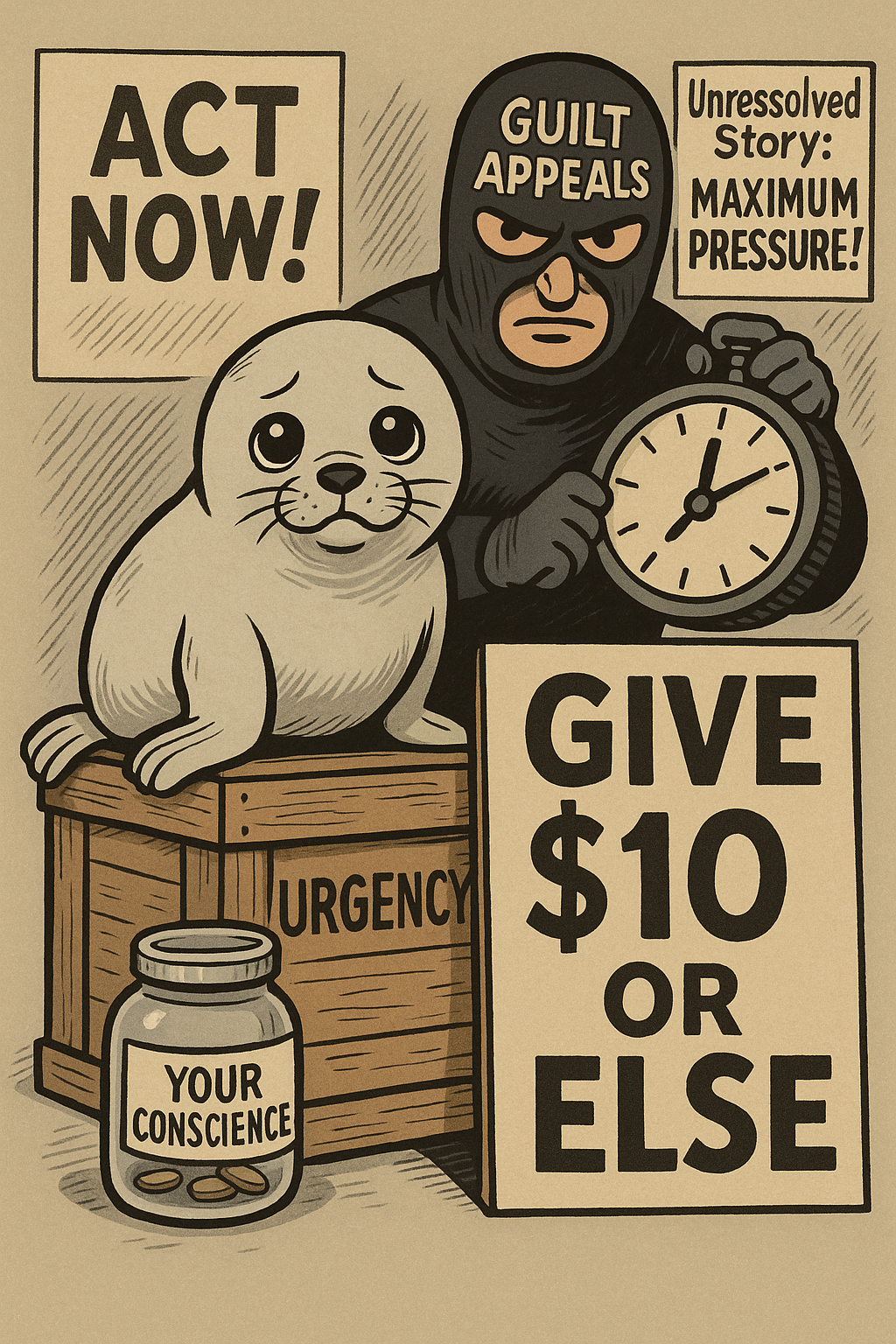 I came across a ‘best-practice’ guide for storytelling whose main recommendation is to write what they dub, Incomplete Stories. This is garbage advice.
That’s my hot take. And if you look at the evidence, it’s not just hot, it’s accurate.
The incomplete story isn’t a new idea, it’s a lightly sanitized version of the fly-laden child or the bludgeoned baby seal.
The underlying rationale hasn’t changed: urgency at all costs. Show the need. Stop the story before anything gets resolved to keep the tension high so the donor feels compelled to act. The idea is that if you complete the story, you somehow deflate the urgency. That donors need to be kept on the hook, stuck in discomfort, to keep them motivated.
Here’s the problem:
That discomfort doesn’t translate into sustained giving. It doesn’t build connection. And it doesn’t even reliably drive more initial gifts when you put it to the test against complete storytelling that shows donors their help will matter.
We’ve tested this head-to-head. Complete stories consistently create more empathy, more positive emotion, and more confidence that giving will actually resolve the negative feeling. That sense of efficacy isn’t a footnote, it’s the backbone of why people give.
Behavioral science is unambiguous on this point. Experiments have shown that showing positive outcomes increases donations and donor satisfaction. When people see the positive impact, it activates the same reward circuits in the brain that light up when they experience personal success.
One landmark study found that sad appeals do evoke emotion, but sadness without a clear path to efficacy triggers withdrawal, not action. If the story never resolves, people feel worse and do nothing. Check that, they do something, it’s called not giving, which is a very active choice.
Even if you do manage to wring a one-off gift out of it, what then? Our own research linking motivation to actual giving shows exactly zero staying power when the reason to give is externally imposed—guilt, pressure, faux urgency.
The only ones who stick are the ones whose motivation is internal, when the message connects with their identity and values and reinforces autonomy (“I choose this”), competence (“I can make a difference”), and relatedness (“I belong here”).
Completing the story does exactly that. It shows the donor the path from feeling to action to outcome, it proves their participation matters.
The evidence is abundant:
-
Outcome information increases giving.
-
Closure drives empathy and moral satisfaction.
-
A sense of efficacy in the reader is a top predictor of donation likelihood and repeat giving.
-
Sadness without efficacy creates paralysis, not action.
If you think those things don’t matter, by all means, keep dangling the baby seal as bait. But don’t kid yourself that this is a higher road if your visuals are less graphic. It’s still emotional hostage-taking.
Show donors the whole story. Let them see that they can be part of the ending and that it’s possible. That’s how you create lasting motivation.
Kevin
2 responses to “Stop Dangling the Baby Seal. The Science Against Half-Told Stories”
Behavioral Science Q & A
Thanks so much for raising this. Yes, capturing donor information can be helpful for stewardship like newsletters, thank-you letters, impact updates. But how you ask matters. Forcing full data capture introduces friction that can significantly depress conversion, many donors may simply abandon the process. Beyond the friction itself, required fields also shift the emotional experience […]
Read Full Answer
Unlike holidays that everyone already knows, Giving Tuesday is a created event. Many donors recognize the name but not the exact timing, so referencing it becomes a helpful cue. It serves as a reminder and taps into social norm activation (“everyone’s giving today”), which boosts response. However, we still want it paired with the mission, […]
Read Full Answer
When a subject line leads with the match (“Your gift matched!”), it risks triggering market-norm thinking: the sense that giving is a financial transaction rather than an act rooted in values, identity, and care. This shift reduces intrinsic motivation and, over time, can weaken donor satisfaction and long-term engagement. It also makes the email indistinguishable […]
Read Full Answer
There’s no evidence that QR codes suppress mid-value giving; all available research suggests they either help or have no negative effect. In fact, behavioral and usability research consistently shows the opposite: reducing friction at any point in the donation process increases completion rates and total response. And that has nothing to do with capacity and […]
Read Full Answer
What you’re experiencing is very common. Resistance often isn’t about capability, but about motivation quality. If board members feel pushed into fundraising, that triggers controlled motivation (low quality motivation) i.e. obligation, guilt, or fear of judgment, which often results in avoidance. Instead, we need to create conditions for volitional motivation (high quality motivation) by satisfying […]
Read Full Answer
That’s a really thoughtful question, and you’re not the first to raise it. Many of our clients have been cautious about placing the ask at the very end. To address their concern, we’ve tested both approaches, and the results are clear: when the ask comes last, even if that means it appears on the second […]
Read Full Answer
Would you say telling a whole story and highlighting the opportunity to help make more stories like that come true aligns with the science and your own testing?
Hi Frank, yes, precisely. Emotion is the goal, not cause of behavior. People do not give because you make them feel angry or sad. They give because you’ve shown them that giving is the best way to resolve that emotion and replace with a sense of agency, efficacy and connection. And yeah, telling a complete story is a great way to show this to them.