

Stop Saying “Deliverability.” Start Worrying About “See-Ability”.
For years, our sector acted like email was a clear hallway: hit “send,” it lands, it gets opened, it earns its keep. But today it’s really fog.
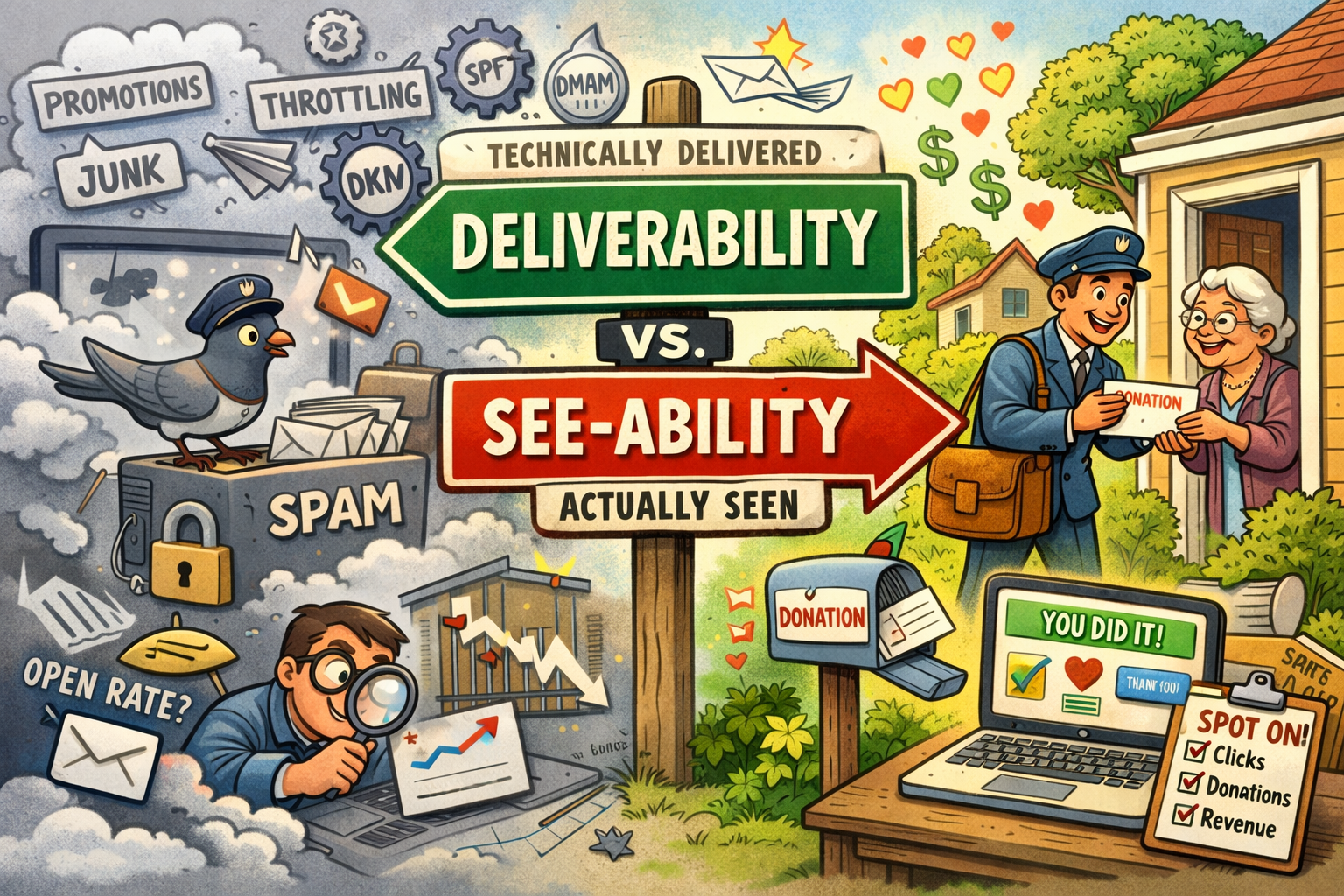
Nonprofits still talk about deliverability like it’s 2009: “Did it send?” “Did it bounce?” “Did it technically arrive?” But deliverability isn’t the problem. See-ability is: Did a real donor actually see it—or was it quietly shunted into Promotions, clipped, throttled, buried, or treated like a suspicious package left on a bus seat?
Because here’s the truth: Your email was delivered. But no one saw it.
Open Rates Are a Mirage. Stop Steering By Them.
Open Rates used to be a crude compass. Now they’re often a hallucination.
Apple’s Mail Privacy Protection preloads images and hides IP addresses in the background—not when someone opens the email, but when it arrives—specifically to prevent senders from tracking when and how recipients view messages. Meanwhile, Gmail, Yahoo, and Outlook have tightened their rules: fail the authentication sniff test or rack up too many complaints, and your message lands in Promotions, spam, or gets throttled into oblivion.
So if your board report still leads with Open Rate, you’re measuring fog. And the fog was 37%.
The Math Is Getting Worse
Email fundraising efficiency, based on M+R benchmarks, is in free fall:
- 2022: $90 raised per 1,000 fundraising emails
- 2023: $76 per 1,000
- 2024: $58 per 1,000
- It took an estimated 1,700 emails to get a single gift in 2024
That’s not weak copy. That’s a system turning on itself.
Meanwhile, “Dead” Direct Mail Still Delivers
“Direct mail is dead” is what people say before they look at their own numbers.
Direct mail to house lists has an average 161% ROI, compared to 44% for email (per the ANA Response Rate Report). Sure, postal mail is more expensive to send. But unlike email, it arrives where people live. Email hasn’t failed you—yet. But the ground beneath it has shifted. The inbox is no longer neutral space. It’s a battleground of algorithms, privacy filters, and automated suspicion.
What To Do? Fix the Fundamentals
Understanding these acronyms isn’t optional anymore—they’re your passport to the inbox:
- SPF (Sender Policy Framework): says which servers can send email from your domain
- DKIM (DomainKeys Identified Mail): cryptographic proof the message wasn’t tampered with
- DMARC (Domain-based Message Authentication, Reporting, and Conformance): ties SPF + DKIM together, enforces alignment, and tells inboxes how to treat failures
If any of these are misconfigured or missing, you’re halfway to the spam filter before you hit “Send.” Learn this alphabet, then fix what’s broken—or have your IT folks check under the hood.
5 Checks That Determine Whether You’re Seen—Or Silenced
1) Authenticate Like You Mean It
SPF. DKIM. DMARC. Check them. Align them. Enforce them. And make sure every platform you use to send is properly authenticated—not just your main Email Service Provider.
2) Watch Your Spam Rate Like a Heart Monitor
Google says keep complaints below 0.1%. Yahoo gives you a hard stop at 0.3%. Anything higher and you’re not just filtered—you’re flagged.
Apple doesn’t spell out a number, so assume the practical threshold for maintaining good reputation across all major providers is:
- < 0.1% complaint rate = healthy
- >0.1%–0.3% = warning zone
- > 0.3% = high risk of filtering or deliverability damage
3) Make Unsubscribing Easy—Or Pay the Price
One-click unsubscribe is no longer a nice-to-have. It’s the difference between “goodbye” and “go to spam.” Make it obvious and instant, or get throttled.
4) Warm Up, Don’t Blow Up
New domain? Don’t blast a huge quantity with your first mailing. Start small. Send to your most engaged supporters. Ramp up gradually. Treat trust as something earned—not presumed.
5) Respect the Plumbing You’re Using
Outlook.com and Microsoft 365 have hard sending limits. If you’re using a personal or workplace email account for bulk sends… stop. Use a real email platform built for scale, or suffer the silent throttling of amateur hour.
Your New Metrics: Ditch “Opens.” Follow the Money.
Open Rates lie. Clicks, conversions, and revenue per 1,000 delivered don’t. Measure:
- Click → donation page → gift
- Revenue per 1,000 delivered
- Complaint and unsubscribe rates
- Inbox placement over time
- And—if you’re brave—run holdout tests to prove what email causes, not just what it accompanies
What is “Inbox Placement Over Time”?
This refers to where your email ends up—not just whether it was “delivered,” but whether it landed in the primary inbox, the Promotions tab, spam, or vanished into a void.
Tracking inbox placement over time helps you spot:
- A gradual decline in visibility (e.g., more mail routed to Promotions)
- The impact of a domain or IP change
- Whether a spike in complaints or a poor campaign damaged your reputation
How to track it: Use tools like Google Postmaster Tools, Yahoo Sender Hub, or commercial options (Validity, Inbox Monster, GlockApps) to monitor trends. Test using seed lists—accounts you control across Gmail, Yahoo, Outlook, etc., to see where your emails go. Look for patterns: Did you start hitting Promotions right after a new vendor or bad send? Did one segment trigger more spam placement?
What Is a “Holdout Test”?
A simple but powerful technique to prove whether your email (or any channel) is actually causing results. Instead of emailing everyone on your list, you:
- Hold out a small, random subset—say, 10%—who receive nothing
- Measure what percentage of that group donates during the campaign window
- Compare that to the percentage who did get the email
Why it matters:
- Proves incrementality: did the email cause the gift, or would it have happened anyway?
- Stops you from over-crediting email when it was just “present,” not persuasive
- Especially valuable for multi-touch programs (mail + email + SMS + ads) where attribution gets muddy
For a campaign that claims $25K raised from email, a holdout test might show only $12K was actually caused by the send. That changes how you budget—and how you write. (For more in-depth discussion of attribution and testing to arrive at accurate attribution, see Kevin’s post here.)
Rebuild Trust, Restore Visibility
The inbox is no longer neutral space. It’s a battleground of algorithms, privacy filters, and automated suspicion. So rebuild your organization’s trust factor, respect the gatekeepers, treat email visibility like the scarce resource it’s become.
And for the love of ROI, stop pretending postal direct mail is dead. It’s not. It’s standing at your front door holding a check.
Roger
Behavioral Science Q & A
Thanks so much for raising this. Yes, capturing donor information can be helpful for stewardship like newsletters, thank-you letters, impact updates. But how you ask matters. Forcing full data capture introduces friction that can significantly depress conversion, many donors may simply abandon the process. Beyond the friction itself, required fields also shift the emotional experience […]
Read Full Answer
Unlike holidays that everyone already knows, Giving Tuesday is a created event. Many donors recognize the name but not the exact timing, so referencing it becomes a helpful cue. It serves as a reminder and taps into social norm activation (“everyone’s giving today”), which boosts response. However, we still want it paired with the mission, […]
Read Full Answer
When a subject line leads with the match (“Your gift matched!”), it risks triggering market-norm thinking: the sense that giving is a financial transaction rather than an act rooted in values, identity, and care. This shift reduces intrinsic motivation and, over time, can weaken donor satisfaction and long-term engagement. It also makes the email indistinguishable […]
Read Full Answer
There’s no evidence that QR codes suppress mid-value giving; all available research suggests they either help or have no negative effect. In fact, behavioral and usability research consistently shows the opposite: reducing friction at any point in the donation process increases completion rates and total response. And that has nothing to do with capacity and […]
Read Full Answer
What you’re experiencing is very common. Resistance often isn’t about capability, but about motivation quality. If board members feel pushed into fundraising, that triggers controlled motivation (low quality motivation) i.e. obligation, guilt, or fear of judgment, which often results in avoidance. Instead, we need to create conditions for volitional motivation (high quality motivation) by satisfying […]
Read Full Answer
That’s a really thoughtful question, and you’re not the first to raise it. Many of our clients have been cautious about placing the ask at the very end. To address their concern, we’ve tested both approaches, and the results are clear: when the ask comes last, even if that means it appears on the second […]
Read Full Answer