

The Cigar Box Checkout: Why Your Donation Page May Be Killing Your Campaigns
Imagine this:
You’re in a checkout line. It’s long, sure, but you’ve waited. You’re ready. You’ve got your items in hand, maybe a kid tugging your sleeve, maybe a dog in the car. And when you get to the front of the line, the clerk pulls out a cigar box.
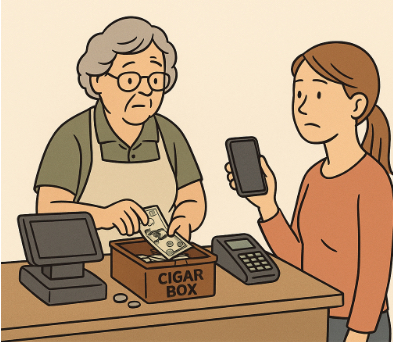 She counts change by hand. She doesn’t take all credit cards. That’s OK because you want to use Apple Pay online anyway. So, , she rummages under the counter for a machine that hasn’t been charged. You’d walk out, wouldn’t you?
Now picture that same scene—only it’s your organization’s donation form.
In a world where 68% of web traffic comes from mobile devices, but only 30% of nonprofit revenue does compare to 55% in the for profit world, we’ve got a real gap. And not a small one. Not a quaint one. Not something you can ignore like that dusty PayPal button you never connected. It’s a billion-dollar problem born of poor payment systems, outdated donor forms, and the maddening refusal to meet donors where they are: on their phones, with a thumb hovering, ready to tap.
When I started in this trade, donor tech meant stamps and call sheets. Now? It means knowing that desktop one-time donations average $203, while mobile lags far behind at $101. It means knowing that 85% of e-commerce platforms accept Apple Pay—and only 25% of nonprofits do. It means that even something as small as not pre-checking the “cover the fees” box can tank your conversion rate depending on the donor’s device, the hour of day, or the size of their gift.
What happens when we don’t keep up?
Simple. The donor walks. The form’s too slow. The ask amounts aren’t right. There’s no Venmo, no PayPal, no mobile Apple or Google wallet. She wanted to help. She clicked. She meant to give. But the site buffered, the baby cried, the subway arrived—and that moment, that fragile, fleeting emotional yes, disappeared.
What I Saw Opened My Eyes
Recently, I sat in on a demo of FundraiseUp, the donation platform. I expected to see just a better button. Maybe an updated template. What I got was a look at what all donation tech should be.
FundraiseUp isn’t just streamlining checkout—it has rebuilt it around the donor. Using AI, it tailors the entire experience: gift arrays shift depending on the device the donor is using, location, time of day, and giving history. It knows what you’re likely to give—and it meets you there.
Giving on an iPhone? You might see slightly higher ask amounts. Logged in from a high-income ZIP code? Adjusted again. Late at night? You’ll get a softer, end-of-day nudge.
And it works. The numbers FundraiseUp revealed are startling:
- 172% higher conversion rates for nonprofits using modern donation tech.
- A 63% increase in average donation amounts.
- At San Francisco SPCA, monthly donors jumped from 400 to over 1,000 after switching platforms.
- Now 42% of their revenue comes from mobile, with 13% through Apple Pay and 4% through Google Pay.
And here’s a kicker:
iPhone users give 30% more than Android users.
Yet, only 25% of nonprofits accept Apple Pay. Compared to 85% of e-commerce platforms. That’s not a missed opportunity—it’s a hole in the bucket.
And if you needed one more reminder…
We’re not selling sneakers. We’re not hawking mattresses. We’re offering the donor a fleeting emotional return: the chance to feel generous, to act with purpose on her values, to help.
But that feeling—the one that opens the purse—vanishes fast. If we make it even a little bit hard, it’s gone. And donors don’t always come back.
So yeah, your appeal may be brilliant. Your campaign urgent. But if your donation form acts like a clerk with a cigar box and no Apple Pay and all the other payment options? That donor’s not staying in line.
And neither would you.
Roger
P.S. For a fascinating, in-depth look at some very valuable insights on donor behavior gleaned from millions of transactions from more than 500 nonprofits check out the Fundraiseup /Stripe Pulse of the donor report. Some real eye openers
4 responses to “The Cigar Box Checkout: Why Your Donation Page May Be Killing Your Campaigns”
Behavioral Science Q & A
Thanks so much for raising this. Yes, capturing donor information can be helpful for stewardship like newsletters, thank-you letters, impact updates. But how you ask matters. Forcing full data capture introduces friction that can significantly depress conversion, many donors may simply abandon the process. Beyond the friction itself, required fields also shift the emotional experience […]
Read Full Answer
Unlike holidays that everyone already knows, Giving Tuesday is a created event. Many donors recognize the name but not the exact timing, so referencing it becomes a helpful cue. It serves as a reminder and taps into social norm activation (“everyone’s giving today”), which boosts response. However, we still want it paired with the mission, […]
Read Full Answer
When a subject line leads with the match (“Your gift matched!”), it risks triggering market-norm thinking: the sense that giving is a financial transaction rather than an act rooted in values, identity, and care. This shift reduces intrinsic motivation and, over time, can weaken donor satisfaction and long-term engagement. It also makes the email indistinguishable […]
Read Full Answer
There’s no evidence that QR codes suppress mid-value giving; all available research suggests they either help or have no negative effect. In fact, behavioral and usability research consistently shows the opposite: reducing friction at any point in the donation process increases completion rates and total response. And that has nothing to do with capacity and […]
Read Full Answer
What you’re experiencing is very common. Resistance often isn’t about capability, but about motivation quality. If board members feel pushed into fundraising, that triggers controlled motivation (low quality motivation) i.e. obligation, guilt, or fear of judgment, which often results in avoidance. Instead, we need to create conditions for volitional motivation (high quality motivation) by satisfying […]
Read Full Answer
That’s a really thoughtful question, and you’re not the first to raise it. Many of our clients have been cautious about placing the ask at the very end. To address their concern, we’ve tested both approaches, and the results are clear: when the ask comes last, even if that means it appears on the second […]
Read Full Answer
The carrot and the stick, both well applied. Thank you .
So true! I’m strangely passionate about those who won’t accept Amex. In Aus, NZ and UK it’s not such a big player… but Amex donors give more and retain more. Sure, they can chuck it on their Visa but that’s not what they wanted to do.
Also, can you explain the context of the San Francisco SPCA example? ‘Monthly donors jumped from 400 to over 1,000 after switching platforms.’ Neat, but likely there was something else that changed? Wouldn’t a more useful metric to measure a change in payment method be the click / donate ratio (if otherwise identical response forms)?
Hi, Sean. Happy to add some color here… some of what Roger is writing about comes from this session presented in San Francisco at Stripe Sessions: https://stripe.com/sessions/2025/buying-into-giving-ecommerce-strategies-for-nonprofits.
To be completely honest, there wasn’t anything else. In fact, they’re now well over 1,500 monthly donors. How the technology works and prioritizes revenue through AI and dynamic asks, paired with an excellent digital donor experience, pays off in spades for organizations.
Think of it this way: What if Netflix simply had “Buy a month of Streaming” as the default option, with another option for subscribing. When you select “Buy A Month”, it doesn’t prompt you nor incentivize you to move to monthly. Can you imagine what their growth would have been like? Subscribers at multiples lower.
Now, let’s pair that with a clunky process that is dated, no modern payment methods, no address autocomplete, and barely mobile responsive let alone mobile-first.
This is essentially what the nonprofit and charity space is dealing with as a whole.
When you address experience through technology, donors (customers) reward you with adoption and brand support.
Absolutely brilliant. One HUGE thing nonprofits can do to skyrocket their donation completion. Offer. More. Payment Options. And this should include making it easy to give from DAFs on the spur of the moment. Thanks for sharing.