

The Crusonia Donor
University of Chicago economist Frank Knight came up with a thought experiment called the Crusonia plant. It was a miraculous organism. You planted it once and it produced fruit year after year, without labor, maintenance, risk, depletion, or decay.
It was meant to be absurd, using the Crusonia to imagine an asset whose value came from the fruit it would produce, without the labor, upkeep, risk, or decay that eat into future value. The model is super clean, 1 plant = X fruit, but not grounded to reality.
The Fundraising volume machine seems to have mistaken the clean model for reality and the donors as Crusonia plants.
Acquire, re-solicit, harvest the fruit. The buried assumption is that a donor, once acquired, remains a productive asset as long as the organization keeps asking.
But a donor isn’t a magic, self-renewing asset. A donor is a human being whose willingness to give depends on conditions the fundraising volume machine is poor at seeing: identity, trust, meaning, autonomy, emotional fit, timing, perceived efficacy, moral relevance, social context, personal salience, and the sense that the organization understands them as more than a name attached to a response curve.
The machine sees the gift but misses the conditions that made the gift possible.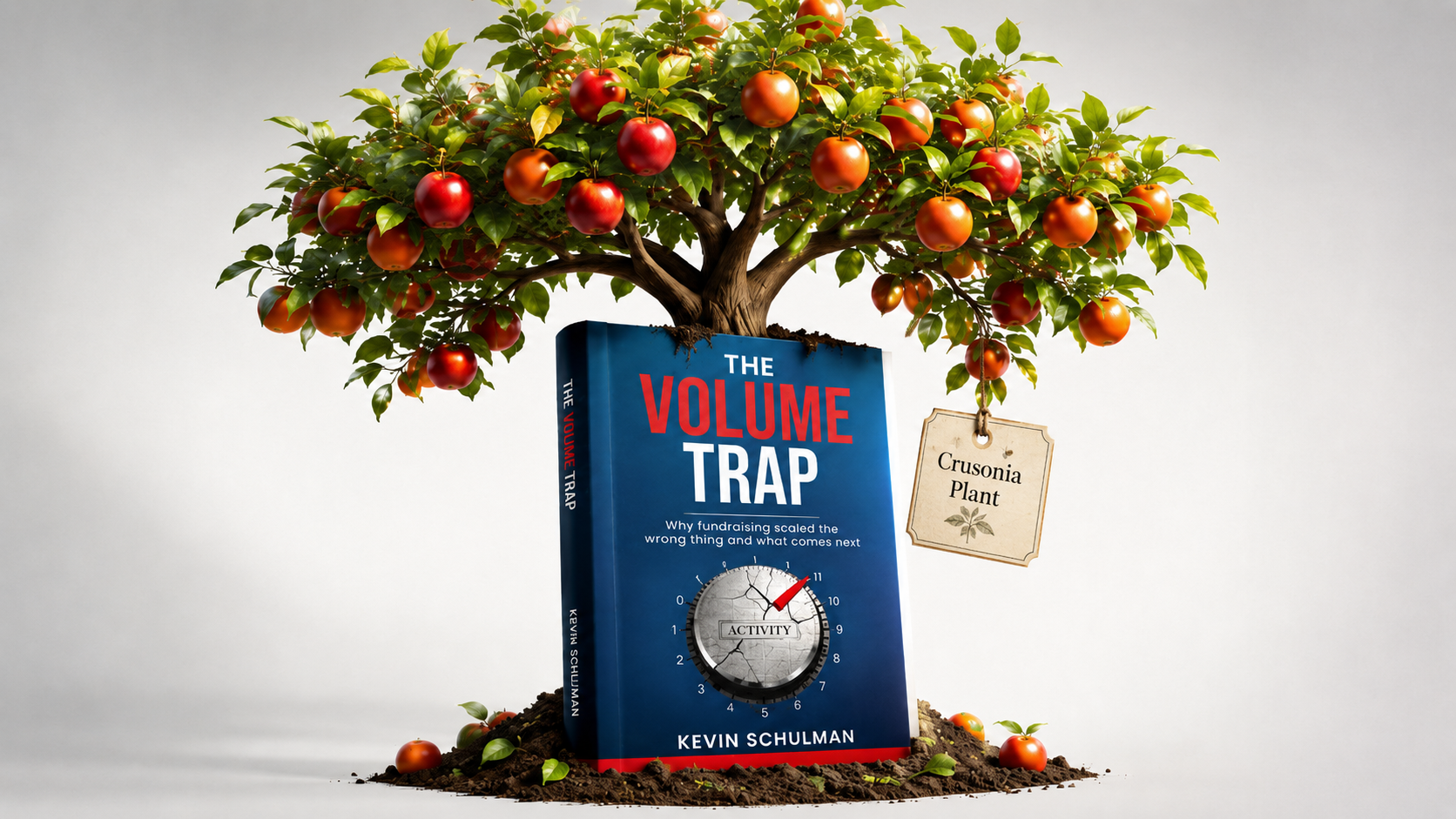
This is why the old model overcredits the ask and the the list, the package, the deadline, the match, the creative, the channel, the ask string become the hero becuase they are all visible and fit in a campaign report.
The donor’s psychological state rarely makes it into the operating system. Was the appeal consonant with how this person sees themselves? Did the message regulate emotion or merely dump suffering on the reader? Did the ask preserve agency or trigger resistance? Did the communication increase trust or borrow from it? Did the cadence match the donor’s relationship with the cause, or did it treat them like every other “active 0 to 12”?
The system usually cannot answer those questions, so it behaves as if they don’t matter. But the Crusonia plant is dangerous precisely because it hides depreciation. It lets us imagine that fruit today tells us everything we need to know about tomorrow’s productive capacity.
Donors depreciate. Not in the accounting sense, but in the only sense that matters. Their attention gets spent. Their trust gets borrowed against. Their emotional availability gets used up. Their sense of agency gets crowded out by pressure. Their identity connection weakens when every communication reduces the relationship to another need, another deadline, another institutional emergency.
The machine calls it donor attrition, as if the donor wandered off for mysterious reasons. The polite explanation is that people are busy, distracted, financially pressured, or hard to reach. All true enough, and all conveniently incomplete. The harder explanation is that the fundraising system has spent decades optimizing harvest while underinvesting in soil.
This is the line between the volume machine and a human-centered fundraising system.
The volume machine is built around institutional need. It starts with the organization’s revenue requirement and works backward into a calendar of asks. Donors are sorted by transactional signals: active, lapsed, high value, low value, monthly, midlevel, major, recently acquired. These labels have use, but they are thin.
A human-centered system starts with the donor as a meaning-making organism. That may sound lofty, but it is practical. People give through the filter of who they are, what they value, what they notice, what they can emotionally tolerate, and how much agency they feel in the moment. The same cause can mean very different things to different people. The same story can inspire one donor, overwhelm another, and bore a third. The same ask can feel empowering in one context and manipulative in another.
If a donor relationship is an asset, the asset has to be maintained. If trust creates future cash flow, trust belongs in the strategy. If connection increases response, connection is not decoration. If autonomy reduces resistance, pressure has a cost. If emotional fit determines whether someone leans in or shuts down, creative strategy cannot be reduced to “make it more urgent.”
The next era of fundraising will be won by organizations that understand why a donor says yes in the first place, what makes them want to say yes again, and what slowly teaches them to stop listening. The book detailing how this human-operating system works has been written, (literally, you can buy it here).
The Crusonia plant was useful because it was impossible. The Crusonia donor is dangerous because the Volume Trap model has acted as if it were real.
Kevin
Behavioral Science Q & A
Thanks so much for raising this. Yes, capturing donor information can be helpful for stewardship like newsletters, thank-you letters, impact updates. But how you ask matters. Forcing full data capture introduces friction that can significantly depress conversion, many donors may simply abandon the process. Beyond the friction itself, required fields also shift the emotional experience […]
Read Full Answer
Unlike holidays that everyone already knows, Giving Tuesday is a created event. Many donors recognize the name but not the exact timing, so referencing it becomes a helpful cue. It serves as a reminder and taps into social norm activation (“everyone’s giving today”), which boosts response. However, we still want it paired with the mission, […]
Read Full Answer
When a subject line leads with the match (“Your gift matched!”), it risks triggering market-norm thinking: the sense that giving is a financial transaction rather than an act rooted in values, identity, and care. This shift reduces intrinsic motivation and, over time, can weaken donor satisfaction and long-term engagement. It also makes the email indistinguishable […]
Read Full Answer
There’s no evidence that QR codes suppress mid-value giving; all available research suggests they either help or have no negative effect. In fact, behavioral and usability research consistently shows the opposite: reducing friction at any point in the donation process increases completion rates and total response. And that has nothing to do with capacity and […]
Read Full Answer
What you’re experiencing is very common. Resistance often isn’t about capability, but about motivation quality. If board members feel pushed into fundraising, that triggers controlled motivation (low quality motivation) i.e. obligation, guilt, or fear of judgment, which often results in avoidance. Instead, we need to create conditions for volitional motivation (high quality motivation) by satisfying […]
Read Full Answer
That’s a really thoughtful question, and you’re not the first to raise it. Many of our clients have been cautious about placing the ask at the very end. To address their concern, we’ve tested both approaches, and the results are clear: when the ask comes last, even if that means it appears on the second […]
Read Full Answer