

The Dead Man Who Knows More About Fundraising Than You Do
Let me tell you about Lyman Pierce.
He raised the equivalent of $5 billion before anyone had heard of a CRM. He invented the capital campaign, the gift table, the volunteer team structure, and the daily accountability report — then 1942 he died and was largely forgotten.
HOWEVER…he left behind a fundraising manual that went out of print, disappeared into library basements, and was essentially forgotten for 80 years. He never had a computer. Never ran an A/B test. Never attended a Bridge Conference or sat through a deck on donor journey mapping.
Between 1905 and 1923, he personally helped raise the equivalent of five billion dollars — that is not a typo — for nonprofit organizations across four continents. He invented the downtown campaign headquarters. He invented organized volunteer teams with accountability structures. He invented the gift table, the daily progress report, the public scoreboard, and what we now call the capital campaign.
In other words: Lyman Pierce invented most of what your consultants think they invented.
Steve MacLaughlin — who wrote the best data book our sector has produced in the last decade, Data Driven Nonprofits — somehow discovered that Pierce was born in Stockton, New York, the same tiny Chautauqua County town where MacLaughlin’s own family lived. He tracked down one of the few remaining original copies of Pierce’s 1932 book How to Raise Money, read it, and had the good sense to think: this man’s ideas should not stay buried.
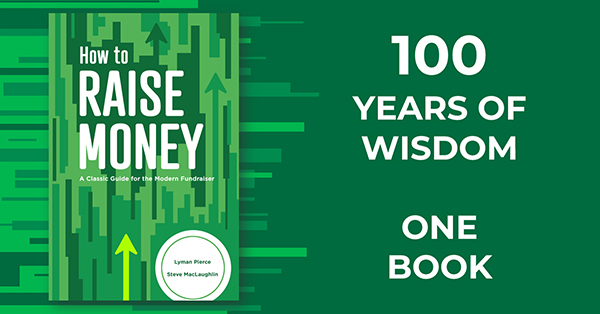
The result is one of the most useful — and in places, quietly devastating — books our trade has seen in years — How to Raise Money by Lyman L. Pierce and Steve MacLaughlin . It was published yesterday. Order it today.
Laugh or Weep?
Here is what should make every fundraiser either laugh or weep, depending on how far along you are in your career:
The nonprofit sector spends approximately $3 billion annually on fundraising consultants, CRM systems, analytics platforms, AI tools, donor journey maps, and conference registrations to figure out how to raise more money.
A man who died before the invention of the ballpoint pen already had the answer. He just couldn’t get anyone to read it.
Pierce and his colleague Charles Ward discovered — through actual campaigns, with actual donors, using card files and telegrams — that 10 to 20 percent of donors provide 80 to 90 percent of funds. That lead gifts determine campaign success before you launch. That personal solicitation by volunteers outperforms paid solicitors, often by a factor of two or three. That constituency building takes years and can never stop. That the most dangerous thing an organization can do is operate campaign-to-campaign without permanent development infrastructure.
All of this was documented in 1920. We are still arguing about it in 2026.
What Steve MacLaughlin Actually Did — and Why It Matters
Pierce’s original text was, to put it charitably, a product of its era. The language was dense, the references dated, and the sentence structures designed for readers who had nothing competing for their attention except perhaps the radio.
MacLaughlin took the 1932 original, digitized it, and systematically restored and modernized it — using a language model (Anthropic’s Claude, as it happens) to translate archaic phrasing into something a working fundraiser in 2026 can actually read. He was transparent about this process in the book’s notes. At a moment when AI-assisted writing is everywhere and almost nobody admits it, that transparency alone earns points in my book.
But the more important thing MacLaughlin did was resist the temptation to be reverential. This is not a hagiography. He examines Pierce’s predictions with the eye of a data analyst: what held up, what didn’t, and why.
Pierce was wrong about charitable gift annuities becoming a dominant vehicle. He was wrong about insurance-based giving schemes. He was significantly wrong about investment trusts — the 1929 crash corrected that in the most expensive way possible.
HE Was Spectacularly Right About Almost Everything Else.
The 11 essential elements of campaign success Pierce identified a century ago — compelling cause, competent leadership, reasonable objective, informed constituency, timeliness, numerous points of contact, adequate preparation time, balanced scale of giving, significant early gifts, tested methods, expert guidance — are, today, the agenda of every competent capital campaign planning meeting. Not as historical curiosities. As actual checklists.
The MacLauhlin Twist: Pierce Was Data-Driven. He Just Lacked the Data.
Here is where MacLaughlin makes his most interesting argument — and where the book does something a pure historical restoration couldn’t do. MacLaughlin spent years writing Data Driven Nonprofits, arguing that our sector’s failure to use data intelligently was its central strategic problem. Reading Pierce, he found something remarkable: Pierce was practicing data-driven fundraising in 1920. He was just doing it with card files instead of Salesforce or Bloomerang, or Raiser’s Edge.
Pierce’s insistence on complete prospect listing — “if there is in the community any person who might under favorable conditions give a subscription of $100 whose name is omitted, we suffer a possible loss of that amount” — is a statement about data quality and opportunity cost that any modern analytics director would recognize immediately.
His daily telegraphed campaign reports were scorecards. His prospect rating and classification system was manual propensity scoring. His team competition structures were gamified performance management before anyone invented the term.
MacLaughlin’s Conclusion is Pointed
The barriers to data-driven fundraising are not primarily technological. They are cultural. Organizations that resist systematic prospect management, daily metrics, and data-informed major gift strategy aren’t failing to adopt new ideas. They are failing to implement ideas that have been proven for over a hundred years.
That is not a comfortable observation. It shouldn’t be.
The Chapter Every Planned Giving Officer Should Read Twice
Part 4 of the book covers bequests, annuities, insurance policies, and endowments — the full range of what Pierce called “variations in money-raising”. (The term “planned giving” didn’t came into vogue until decades later. For sheer historical illumination, the bequest chapter is remarkable. Pierce documented in the 1930s that roughly half of all endowment came from bequests, and argued — correctly — that this vehicle was dramatically underutilized relative to its potential.
It remains dramatically underutilized relative to its potential. Ninety years later.
A word of caution here, which MacLaughlin himself acknowledges: the legal, tax, and regulatory landscape governing planned giving in 2026 is substantially more complex than anything Pierce could have anticipated. The chapters on specific vehicles are historically valuable, but any practitioner acting on them should do so with current legal counsel in hand.
What the Book Won’t Tell You — And Why That’s Honest
The most significant gap in the book is one that Pierce couldn’t have known to address and MacLaughlin engages only glancingly: the equity question. Pierce’s model was built around wealth concentrations that don’t exist equally across all nonprofit sectors.
The 80/20 rule operates very differently for a food bank serving an under-resourced community than for a university capital campaign. The volunteer peer-solicitation model — which genuinely does outperform paid solicitors — presupposes a constituency with the social capital, existing relationships, and professional networks, and a geographic proximity to one another to execute it effectively.
This doesn’t invalidate Pierce’s principles. It contextualizes them. For organizations that have historically operated outside the traditional philanthropy infrastructure, the book is a useful set of principles that requires translation rather than direct application. That translation work is the reader’s responsibility, not the book’s failure.
The Bottom Line for Agitator Readers
You’ve been in this trade – probably for years. You’ve read the books. You’ve attended the conferences. You’ve heard about retention and major gifts and the importance of the donor relationship so many times you could recite the principles in your sleep.
Here’s what this book does that most of those resources don’t: it shows you where the principles came from. It shows you that the people who discovered them weren’t theorizing — they were running campaigns, losing sometimes, winning more often, and writing down what worked. It gives the fundamentals a century of ballast instead of a decade of consulting fees.
The fundraisers in the 1920s who built genuine relationships, made compelling cases, asked clearly and specifically, and stewarded donors with gratitude — they raised more money than the ones chasing clever schemes or the equivalent of whatever the 1920s version of shiny object syndrome was. This remains true in 2026. MacLaughlin’s final line captures it as well as anything I’ve read: “The tools will change. The principles won’t.”
Buy it. Read it. Then look at your organization’s prospect list and ask yourself whether Lyman Pierce, armed only with a card file and a telegram, would recognize what you’re doing as fundraising.
If the answer is no — that’s the real review.
Roger
P.S. Pairs nicely with: Data Driven Nonprofits by Steve MacLaughlin— the author who that brought Pierce back, and the one who explains how to execute his vision at modern scale.
Behavioral Science Q & A
Thanks so much for raising this. Yes, capturing donor information can be helpful for stewardship like newsletters, thank-you letters, impact updates. But how you ask matters. Forcing full data capture introduces friction that can significantly depress conversion, many donors may simply abandon the process. Beyond the friction itself, required fields also shift the emotional experience […]
Read Full Answer
Unlike holidays that everyone already knows, Giving Tuesday is a created event. Many donors recognize the name but not the exact timing, so referencing it becomes a helpful cue. It serves as a reminder and taps into social norm activation (“everyone’s giving today”), which boosts response. However, we still want it paired with the mission, […]
Read Full Answer
When a subject line leads with the match (“Your gift matched!”), it risks triggering market-norm thinking: the sense that giving is a financial transaction rather than an act rooted in values, identity, and care. This shift reduces intrinsic motivation and, over time, can weaken donor satisfaction and long-term engagement. It also makes the email indistinguishable […]
Read Full Answer
There’s no evidence that QR codes suppress mid-value giving; all available research suggests they either help or have no negative effect. In fact, behavioral and usability research consistently shows the opposite: reducing friction at any point in the donation process increases completion rates and total response. And that has nothing to do with capacity and […]
Read Full Answer
What you’re experiencing is very common. Resistance often isn’t about capability, but about motivation quality. If board members feel pushed into fundraising, that triggers controlled motivation (low quality motivation) i.e. obligation, guilt, or fear of judgment, which often results in avoidance. Instead, we need to create conditions for volitional motivation (high quality motivation) by satisfying […]
Read Full Answer
That’s a really thoughtful question, and you’re not the first to raise it. Many of our clients have been cautious about placing the ask at the very end. To address their concern, we’ve tested both approaches, and the results are clear: when the ask comes last, even if that means it appears on the second […]
Read Full Answer