

The Donor Hunger Games: May the Highest RFM Score Win
If people gave because we asked, one-size-fits-all fundraising would be the smartest system ever invented.
Put the same appeals on the same calendar and dial up your activity to see generosity roll in. The orginal sin is believing or at least behaving as if you belive asking = getting.
Fundraising has two jobs: what we say and when we say it. Miss either and you drift into one of three bad quadrants.
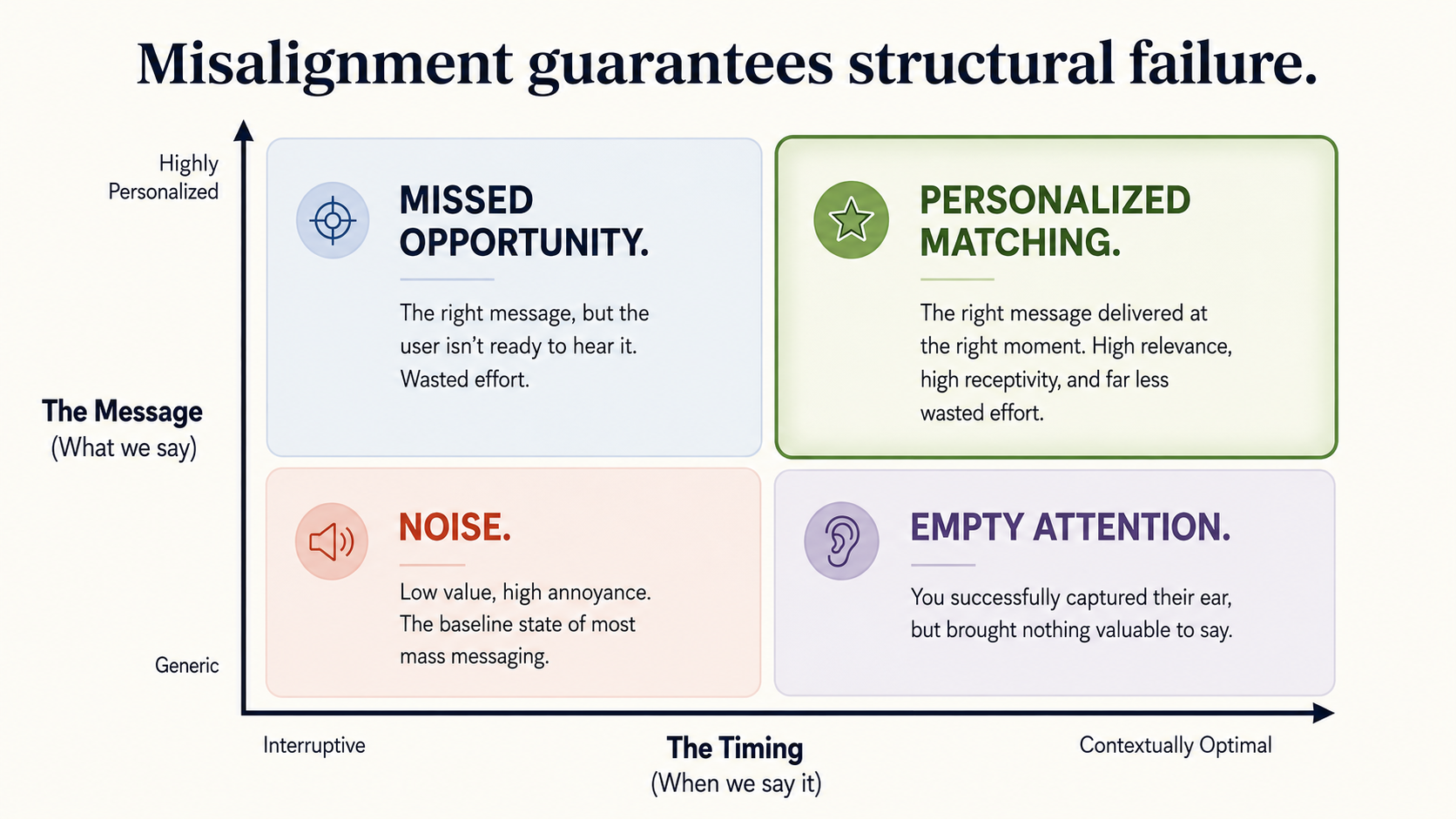
If the message is generic and the timing is interruptive, you get noise. This is the default state of the volume model of fundraising: low value, high annoyance, and a donor wondering why every organization has a matching gift addiction or seemingly the same copywriter.
If the message is strong but the timing is wrong, you get missed opportunity. The appeal may be emotionally intelligent, beautifully written, even personally relevant, but the donor isn’t ready if they gave last month. You brought the right key to the wrong door.
If the timing is right but the message is generic, you get empty attention. You managed to reach someone when they might have listened, then rewarded that attention with “Dear Friend”.
Only one quadrant works: personalized matching. The right message delivered at the right moment.
That means two kinds of personalization.
- The first is message fit. This means matching the message to identity and trait. Identity tells you why the donor might care about the mission at all. Trait tells you how that identity shows up in language, emotion, proof, pacing, and moral frame. “Active donor” and “lapsed donor” and all derivations thereof tell you nothing useful about message fit.
- The second is cadence fit. This is where the calendar starts looking especially out of whack with reality. Donors have rhythms, some are annual givers, others respond in bursts. Almost all need space right after a gift because their recent donation signals connection, not readiness for another ask. Traditional RFM and response models often miss this because they rank donors against each other. Jill gave $100 last week, Jack gave $50 six months ago, so Jill looks better. But Jill may be the worst person to ask tomorrow. Jack may be ready. The model needs to read each donor against their own behavior, not shove everyone into a donor Hunger Games bracket.
This is the mistake baked into a lot of “optimization.” It over-selects the people who look best on paper and over-asks them until the relationship gets brittle. It under-selects donors whose current score looks weaker but whose timing may actually be better.
The better question is not “Who is most valuable?” It is “For this person, right now, is another ask likely to create value or create irritation?”
That is the shift from calendar mode to human mode.
The calendar is a container and treating it as strategy is akin to confusing the lunchbox for the meal.
Ask less randomly and ask better personally using a system built on how people actually decide.
Kevin
Behavioral Science Q & A
Thanks so much for raising this. Yes, capturing donor information can be helpful for stewardship like newsletters, thank-you letters, impact updates. But how you ask matters. Forcing full data capture introduces friction that can significantly depress conversion, many donors may simply abandon the process. Beyond the friction itself, required fields also shift the emotional experience […]
Read Full Answer
Unlike holidays that everyone already knows, Giving Tuesday is a created event. Many donors recognize the name but not the exact timing, so referencing it becomes a helpful cue. It serves as a reminder and taps into social norm activation (“everyone’s giving today”), which boosts response. However, we still want it paired with the mission, […]
Read Full Answer
When a subject line leads with the match (“Your gift matched!”), it risks triggering market-norm thinking: the sense that giving is a financial transaction rather than an act rooted in values, identity, and care. This shift reduces intrinsic motivation and, over time, can weaken donor satisfaction and long-term engagement. It also makes the email indistinguishable […]
Read Full Answer
There’s no evidence that QR codes suppress mid-value giving; all available research suggests they either help or have no negative effect. In fact, behavioral and usability research consistently shows the opposite: reducing friction at any point in the donation process increases completion rates and total response. And that has nothing to do with capacity and […]
Read Full Answer
What you’re experiencing is very common. Resistance often isn’t about capability, but about motivation quality. If board members feel pushed into fundraising, that triggers controlled motivation (low quality motivation) i.e. obligation, guilt, or fear of judgment, which often results in avoidance. Instead, we need to create conditions for volitional motivation (high quality motivation) by satisfying […]
Read Full Answer
That’s a really thoughtful question, and you’re not the first to raise it. Many of our clients have been cautious about placing the ask at the very end. To address their concern, we’ve tested both approaches, and the results are clear: when the ask comes last, even if that means it appears on the second […]
Read Full Answer