

The Donor Newsletter Is Dead. Long Live The Donor Newsletter.
Tom Ahern’s newsletter just landed in my inbox again.
I treat it like a gold-embossed invitation to the attic of good sense and bright ideas. Not dusty. Not precious. Just sharp, useful, and often—like this week—unexpectedly timely. [Subscribe Free here.]
This issue, Tom tells the story of Remo, a Twin Cities artist who leans heavily on ChatGPT (whimsically renamed “Molly”) to write the e-newsletter for his arts district. Remo can’t write “for beans,” he says. But Molly can. With the right prompt, she crafts warm, clear, donor-ready copy.
It’s a sweet story. But here’s the part that matters:
Even the smartest AI can’t save a newsletter that’s still talking about the wrong person.
And most nonprofit newsletters pick exactly the wrong person.
Let me say it straight: If your newsletter talks about your organization more than it talks about your donor, it’s not a donor newsletter. It’s a vanity project.
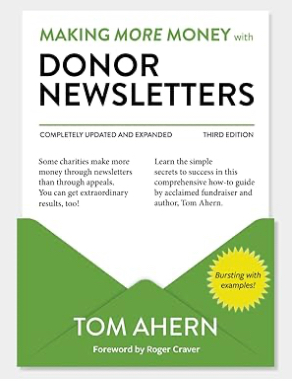 Tom Ahern has written what I consider one of the most essential—and overlooked—books in fundraising: Making More Money with Donor Newsletters. In it, he lays down the law with the kind of precision that makes good fundraisers weep with gratitude and bad ones clutch their pearls.
Your newsletter should not be about your programs. It should be about what the donor made possible.
That’s the pivot too few organizations make. Instead, they send out “updates” that read like reports to a disinterested city council: lots of acronyms, little joy, zero emotional payoff.
But when you get it right? When the newsletter makes the donor feel like the hero? Things change.
Look at Gillette Children’s Hospital. Their old newsletter raised about $5,000 per issue. After they rewrote it with the donor at the center of every story—cutting the copy, swapping “we” for “you,” showing real outcomes instead of abstract stats—the result was a tenfold increase in revenue. One issue pulled in $50,000.
Let me repeat that: tenfold.
So yes, by all means, use AI. Name it. Prompt it. Invite it to your creative table. But only if you know where you’re going. And where you should be going is straight into the heart of your donor.
Here’s a prompt you can use. It’s not magic. But it’s grounded in Tom’s model and it works:
🛠️ Donor Newsletter AI Prompt (Ahern Style):
“You are my donor newsletter assistant. Write like a human. Be warm, grateful, and donor-focused.
Your job is to create a four-page print newsletter.
Each story must center on what the donor made possible—not what we did.
Use ‘you’ language. Begin with appreciation. End with an invitation to continue the journey. Include joy, clarity, and emotion.
No jargon. No internal news. Just stories that make the donor feel proud, useful, and surprised.”
Also, don’t kid yourself—email alone won’t get it done. E-newsletters are fine for light touches and reminders. But if you want revenue—actual, measurable, open-the-envelope-and-find-a-check or online revenue via an included QR scan code —you need print. You need to mail it. You need to include a reply device and QR code.
You need to write like your job depends on it. Because in today’s junk-filled competitive blizzard of digital nonsense it just might.
Tom calls newsletters the “ugly duckling of fundraising.” He’s right. But done right, that duck lays golden eggs.
You can’t afford to ignore it.
Roger
P.S. If you haven’t read Making More Money with Donor Newsletters, buy it. It’s short, smart, and one of the most practical guides you’ll ever read. Think of it as your newsletter rehab manual.
P.P.S. AI won’t make your newsletter donor-centric. You will.
2 responses to “The Donor Newsletter Is Dead. Long Live The Donor Newsletter.”
Behavioral Science Q & A
Thanks so much for raising this. Yes, capturing donor information can be helpful for stewardship like newsletters, thank-you letters, impact updates. But how you ask matters. Forcing full data capture introduces friction that can significantly depress conversion, many donors may simply abandon the process. Beyond the friction itself, required fields also shift the emotional experience […]
Read Full Answer
Unlike holidays that everyone already knows, Giving Tuesday is a created event. Many donors recognize the name but not the exact timing, so referencing it becomes a helpful cue. It serves as a reminder and taps into social norm activation (“everyone’s giving today”), which boosts response. However, we still want it paired with the mission, […]
Read Full Answer
When a subject line leads with the match (“Your gift matched!”), it risks triggering market-norm thinking: the sense that giving is a financial transaction rather than an act rooted in values, identity, and care. This shift reduces intrinsic motivation and, over time, can weaken donor satisfaction and long-term engagement. It also makes the email indistinguishable […]
Read Full Answer
There’s no evidence that QR codes suppress mid-value giving; all available research suggests they either help or have no negative effect. In fact, behavioral and usability research consistently shows the opposite: reducing friction at any point in the donation process increases completion rates and total response. And that has nothing to do with capacity and […]
Read Full Answer
What you’re experiencing is very common. Resistance often isn’t about capability, but about motivation quality. If board members feel pushed into fundraising, that triggers controlled motivation (low quality motivation) i.e. obligation, guilt, or fear of judgment, which often results in avoidance. Instead, we need to create conditions for volitional motivation (high quality motivation) by satisfying […]
Read Full Answer
That’s a really thoughtful question, and you’re not the first to raise it. Many of our clients have been cautious about placing the ask at the very end. To address their concern, we’ve tested both approaches, and the results are clear: when the ask comes last, even if that means it appears on the second […]
Read Full Answer
Thank you, Roger! I hope people are paying attention, because they’re leaving good money – that funds good missions – on the table when they send braggy newsletters.
Thanks for this Roger.
An expert copywriter can “fix” AI copy. But someone with less expertise cannot. I think this is something that many expert writers are overlooking. They can look at any piece of writing and see what needs to be fixed. But others cannot. They can take the output, from whatever prompts, and fix it. Good prompts are important but the high level of copywriting skill is what actually makes it work.
A big difference between organizations is whether or not their newsletter is expected to raise money. A good donor-focused newsletter can both inspire loyalty and raise money.
In organizations that use their newsletter to inform and inspire loyalty, but don’t expect to raise money… an AI written article or two will be fine. Mediocre, but fine.
But for organizations that are used to making money with their newsletters it simply won’t get the job done. An expert copywriter can “fix” AI copy. But someone with less expertise really cannot.
We’re being flooded with AI written email, blogs, and social media posts. It’s a tsunami of beige goo. If your newsletter sounds anything like the ocean of bland… it will be ignored.
High-performing donor newsletters… written by expert copywriters… are pulling 7-9% Response Rates in the US and 7-14% in other countries. A less experienced writer will not be able to achieve this and AI simply isn’t going to help, no matter the prompts.
Money making newsletters are measured by hard cold $$$ metrics. They either work or they don’t. Sounding ok doesn’t get the job done(as you well know). Mediocre doesn’t make money and AI at its best is mediocre. It takes an expert to use the tool at a high level.