

The Doom Loop Is a Media Problem, Not a Donor Motivator
If it bleeds, it leads, a cliche if there ever were. The usual interpretation is media force-feeding us a steady diet of misery and we reluctantly choke it down. But the more honest question is the uncomfortable one: are they shoving negativity at us, or are they simply serving what we reliably choose?
A Russian news outlet, City Reporter, ran an experiment of a full day of only positive stories. No tragedy, no scandal, no outrage. Their audience responded by disappearing. Two-thirds of their readers vanished in twenty-four hours.
The broader research says the same thing. Take a standard-length headline, add one more negative word and click-through goes up by about 2.3 percent. Our attraction to the dark isn’t an editorial conspiracy, it’s econ 101, supply and demand.
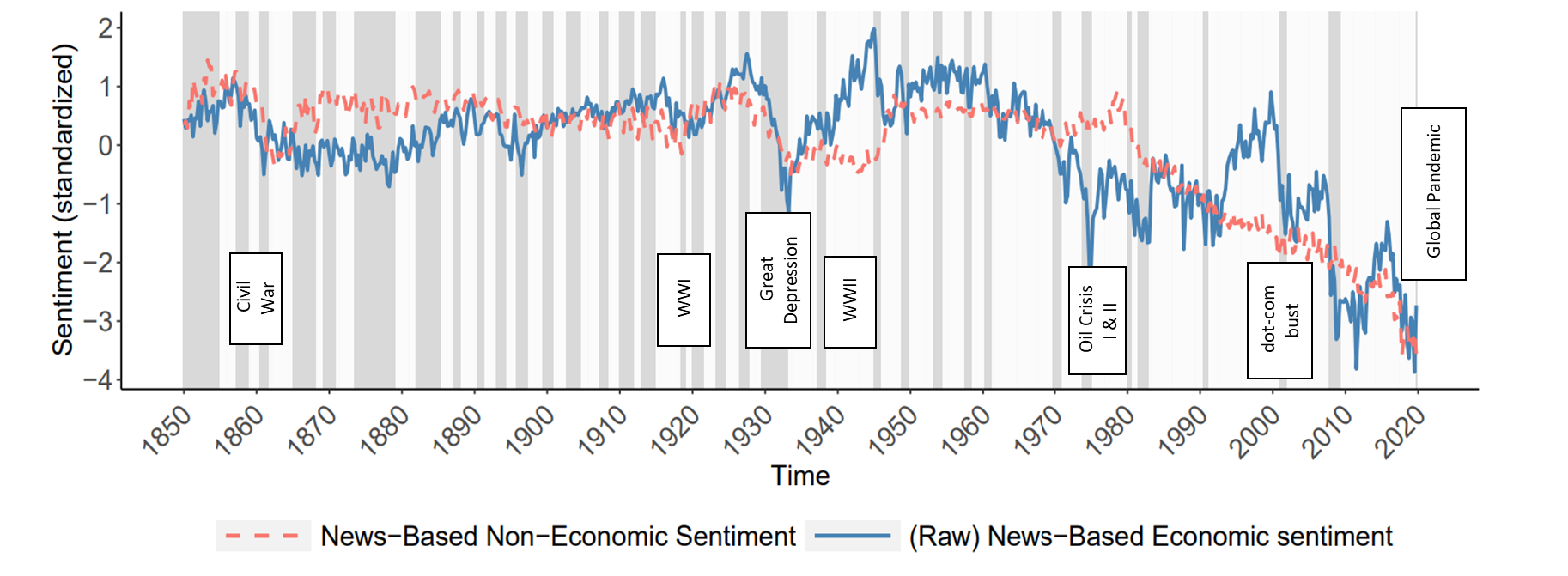
But a more interesting analysis involved a dataset that’s almost absurd in scale: 170 years of digitized American newspapers, 13,000 local papers, roughly a billion articles. Researchers looked at if media sentiment predicts economic outcomes like GDP and found it tracks them with surprising precision.
Look at the long-run sentiment trends they parsed: economic coverage and everything else, plotted across nearly two centuries. Drop in the major historical shocks—Civil War, Great Depression, World Wars—and then look where the cliffs actually are. Economic sentiment starts tanking after 1998. Non-economic sentiment starts sliding in the late 1970s. The darkest periods in U.S. history barely dent the chart compared to the plunge of the last few decades.
Now look at the gray recession bars across the timeline. The early decades are packed with more frequent and more severe downturns. If there were ever moments where gloom was justified, they lived there. Yet the sentiment during those eras looks almost cheerful compared to what passes as baseline now.
So what happened? In a word, competition. Cable, internet, social platforms, push alerts, podcasters, infinite outlets and the business model shifts from info to attention seeking. And attention optimizes toward the most reliable lever, negativity. And once everyone plays that game, the only way to stand out is to ratchet the negativity further. The doom loop is a market outcome, not a moral failing.
And here’s where fundraising misreads this dynamic.
Fundraisers copy the media logic because they think “people respond to negative” is a psychological truth. It isn’t. It’s a competitive artifact. In a media ecosystem optimized for clicks, negativity wins the race to the bottom because
- the emotional cost is low
- the friction is zero and
- the supply is infinite.
Your appeal is none of those things. You don’t have infinite pipeline of conflict, catastrophe and outrage. And even if you did, you can’t compete with a global doom machine that aggregates every awful thing everywhere and pushes it to your donor’s phone before you even wake up. Trying to win by out-dooming a system designed to industrialize doom is delusional.
So what’s the fundraising point?
Lead. Stop following the media’s emotional economics as if they apply to you, they don’t.
A doom vortex that already includes your problem—plus millions like it—is not your ally. The donor doesn’t feel urgency, they feel coerced, helpless or both and neither yields giving.
Giving is autobiographical. People give to reinforce the values they hold, the identity they claim, the goals they’re pursuing. They give to feel agency, competence and connection, not to stack one more hopeless crisis on top of a mountain of existing ones. Fear, guilt and anger can grab attention for a second, but they rarely convert and almost never build lasting commitment.
Hope isn’t soft and uplift isn’t sentimental. These are the psychological engines that allow donors to see themselves in the story and feel like their action matters.
If you want to motivate someone to step forward, don’t drag them deeper into the sludge, give them a narrative where their values are reflected back to them, where the world feels a little more coherent and where they can actually do something that aligns with who they believe themselves to be.
Kevin
2 responses to “The Doom Loop Is a Media Problem, Not a Donor Motivator”
Behavioral Science Q & A
Thanks so much for raising this. Yes, capturing donor information can be helpful for stewardship like newsletters, thank-you letters, impact updates. But how you ask matters. Forcing full data capture introduces friction that can significantly depress conversion, many donors may simply abandon the process. Beyond the friction itself, required fields also shift the emotional experience […]
Read Full Answer
Unlike holidays that everyone already knows, Giving Tuesday is a created event. Many donors recognize the name but not the exact timing, so referencing it becomes a helpful cue. It serves as a reminder and taps into social norm activation (“everyone’s giving today”), which boosts response. However, we still want it paired with the mission, […]
Read Full Answer
When a subject line leads with the match (“Your gift matched!”), it risks triggering market-norm thinking: the sense that giving is a financial transaction rather than an act rooted in values, identity, and care. This shift reduces intrinsic motivation and, over time, can weaken donor satisfaction and long-term engagement. It also makes the email indistinguishable […]
Read Full Answer
There’s no evidence that QR codes suppress mid-value giving; all available research suggests they either help or have no negative effect. In fact, behavioral and usability research consistently shows the opposite: reducing friction at any point in the donation process increases completion rates and total response. And that has nothing to do with capacity and […]
Read Full Answer
What you’re experiencing is very common. Resistance often isn’t about capability, but about motivation quality. If board members feel pushed into fundraising, that triggers controlled motivation (low quality motivation) i.e. obligation, guilt, or fear of judgment, which often results in avoidance. Instead, we need to create conditions for volitional motivation (high quality motivation) by satisfying […]
Read Full Answer
That’s a really thoughtful question, and you’re not the first to raise it. Many of our clients have been cautious about placing the ask at the very end. To address their concern, we’ve tested both approaches, and the results are clear: when the ask comes last, even if that means it appears on the second […]
Read Full Answer
“Hope isn’t soft and uplift isn’t sentimental. These are the psychological engines that allow donors to see themselves in the story and feel like their action matters.” That statement? My head spun 360° (a good thing). Thank(sgiving) you.
[…] “you,” “your” and sometimes “together.” As Kevin Shulman, the Agitator/DonorVoice recently put it: “Giving is autobiographical. People give to reinforce the values they hold, the […]