

The Fundraiser’s Phone Ban
We love tidy levers. Teens are anxious, so ban phones. Revenue is flat, so send more appeals. If the dashboard blips, we pat ourselves on the back. If it doesn’t, we reach for the same lever again.
Reality is not that simple.
Take the SMART Schools study in The Lancet.
- Thirty English secondary schools, 1,227 students.
- Restrictive schools barred recreational phone use; permissive schools allowed it at breaks.
- The outcome that matters, mental wellbeing, didn’t change – zero meaningful differences.
- What did change was the easiest to police: in-school phone time went down during school hours. But total weekday and weekend use didn’t budge.
The system compensated outside the hallway we controlled, that’s the lesson. External forces (home routines, platform design, peer networks, sleep, parental boundaries) dwarf the narrow strip we can see. You can move the visible behavior at 11:17 a.m. and still not move the outcome at all.
Fundraising makes the same mistake every day.
Have you built a too-simple worldview?
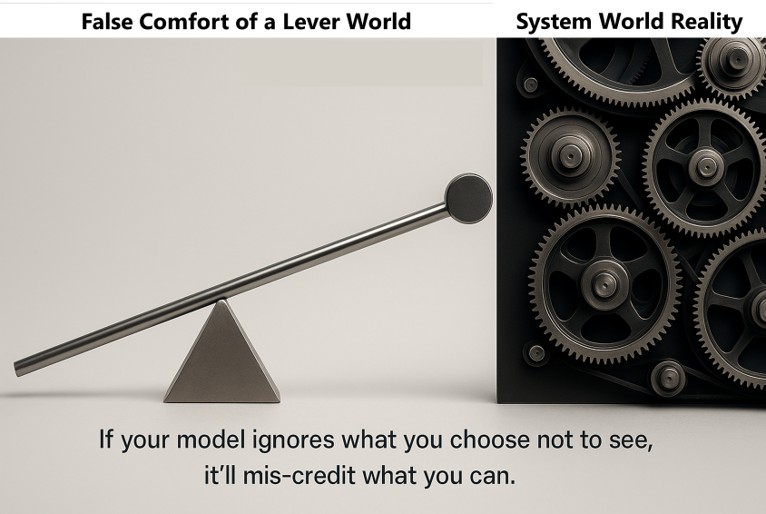 Be honest: is your or your agency’s fundraising model basically this?
- “People give because we ask, so ask more in more places.” Volume stands in for strategy, if the metric twitches, we credit the extra touch. If it doesn’t, we add more touches.
- “Engagement” is what’s easy to count, not what it is. We chase opens, clicks, shares, comments, RSVPs. Meanwhile, the most common by a country mile, high-intent behavior,reading, is barely measured. Attention is a better signal than clicks, and most “clickers” don’t read anyway.
- “Everyone’s the same.” One cadence, one message. Personality and identity differences are treated like abstraction while superficial demographics get high attention.
If your view is narrow, you’ve already shrunk your ability to influence outcomes. If you or your agency doesn’t understand the system, the parts you control and the parts you don’t, you misattribute causality to the lever you can see.
Control theater vs. causal change
Control theater feels great because it’s legible. You can show the memo, count the sends, and point to activity. But activity is not effect.
- Systems compensate. Kids reduced phone use in school, then shifted it elsewhere. Donors may reduce response in one channel if you flood another, or avoid you entirely when pressure rises. Field experiments show people pay a real cost just to avoid being asked. Over-solicitation can look like short-term lift while simultaneously baking in long-term loss.
- Outcomes sit downstream of “unseen” drivers. Brand trust, identity fit, pay-period timing, news salience, deliverability and inbox throttling, checkout friction. These forces are predictable even if they’re not on your dashboard.
- The base case is brutal. Retention remains low. If you can’t beat the counterfactual, what donors would have done without your extra touch, you’re shouting into the wind. In Q1 2025, the sector’s year-to-date retention was ~18%. You don’t fix that with a seventh reminder; you fix it by changing the experience.
What to do instead (the anti-hallway plan)
- Model the base case.
Always hold out a true control: people who were eligible but did not receive the extra touch. If your incremental lift can’t beat natural giving, the touch is noise, not signal. - Personalize by trait, not just transaction.
Conscientious planners, empathic responders, novelty seekers—they need different stories, cadences, and ask logic. Psychologically matched messaging outperforms generic blasts in field settings reaching millions. - Optimize journey, not volume.
Decide who shouldn’t get the next ask yet to protect momentum and prevent churn. Over 6–12 months, this yields more total revenue than squeezing one more gift this week. The retention math demands it.
Kevin
One response to “The Fundraiser’s Phone Ban”
Behavioral Science Q & A
Thanks so much for raising this. Yes, capturing donor information can be helpful for stewardship like newsletters, thank-you letters, impact updates. But how you ask matters. Forcing full data capture introduces friction that can significantly depress conversion, many donors may simply abandon the process. Beyond the friction itself, required fields also shift the emotional experience […]
Read Full Answer
Unlike holidays that everyone already knows, Giving Tuesday is a created event. Many donors recognize the name but not the exact timing, so referencing it becomes a helpful cue. It serves as a reminder and taps into social norm activation (“everyone’s giving today”), which boosts response. However, we still want it paired with the mission, […]
Read Full Answer
When a subject line leads with the match (“Your gift matched!”), it risks triggering market-norm thinking: the sense that giving is a financial transaction rather than an act rooted in values, identity, and care. This shift reduces intrinsic motivation and, over time, can weaken donor satisfaction and long-term engagement. It also makes the email indistinguishable […]
Read Full Answer
There’s no evidence that QR codes suppress mid-value giving; all available research suggests they either help or have no negative effect. In fact, behavioral and usability research consistently shows the opposite: reducing friction at any point in the donation process increases completion rates and total response. And that has nothing to do with capacity and […]
Read Full Answer
What you’re experiencing is very common. Resistance often isn’t about capability, but about motivation quality. If board members feel pushed into fundraising, that triggers controlled motivation (low quality motivation) i.e. obligation, guilt, or fear of judgment, which often results in avoidance. Instead, we need to create conditions for volitional motivation (high quality motivation) by satisfying […]
Read Full Answer
That’s a really thoughtful question, and you’re not the first to raise it. Many of our clients have been cautious about placing the ask at the very end. To address their concern, we’ve tested both approaches, and the results are clear: when the ask comes last, even if that means it appears on the second […]
Read Full Answer
What is working for me right now is being straightforward and truthful. In this mess, we lost 1/3 of our funding. I wanted my donors to know exactly what is happening because incorrect information was coming from legislators of our state. 🙁 I sent a personal note to every single major, mid-level, and recurring/WPG donor to tell them what is happening and offering to speak to them personally about it, if they wish. I told them we were throwing everything we have and dipping into our reserves that I’ve built carefully over ten years to keep doing our work. I didn’t ask for a donation. That wasn’t the point. Yet, people gave, and they gave more than they have in the past. I don’t think we do this enough. We tend to want to make everything seem so positive and rosy, but when things are hard, we need to be real. People appreciate that. My year-end appeal for the rest of our folks is to show them that they CAN actually make something good happen, while a lot of ugly is happening all around us, through our little nonprofit. People want something positive they can do, and they want to be told the truth when truthfulness is hard to find.
Thanks for this post!