

The Middle Is Crowded
In 1929, economist Harold Hotelling described the “principle of minimum differentiation.” Competing stores, given the same information and the same incentives, rationally locate next to each other. If customers are spread along a street, the profit-maximizing position is the center. The goal is to minimize average distance to the largest number of buyers.
Picture a long street with Target on one end and Walmart on the other. In theory that spreads coverage. In practice, both migrate toward the center because they’re solving the same equation with the same data. That’s why CVS and Walgreens cluster together. Why McDonald’s and Burger King share an intersection. They aren’t copying each other, they’re responding to identical incentives.
The concept later migrated into political science as the Median Voter Theorem: in a two-candidate race, the candidate closest to the median voter wins. Candidates tack toward the center after primaries for the same reason retailers cluster; the math rewards convergence.
Minimum differentiation is rational and it’s easily findable in fundraising.
Go sit in a donor’s inbox during the last week of December. You will find a synchronized barrage so uniform it starts to blur. Matching gift deadlines. Countdown timers. Subject lines that differ by maybe three words. Every organization has converged on the same calendar window, the same offer mechanics, the same urgency cues, because the data and the consultants and the calendar all point to the same median donor at the same median moment.
Nobody decided to be identical, the incentives decided for them.
The pattern extends well past the calendar. How many international relief charities describe themselves as focused on women and children, in-country for the long haul, partnering locally? Those aren’t bad claims and may even be true. But when every organization in a category says the same thing, the message stops functioning as differentiation and starts functioning as a category tax — the minimum you need to say just to be recognized as a member of the set.
There’s a defensible case for this as being known is often more important than being different and the latter might be more expensive. Further, behavioral science suggests standing out too much can create friction; we prefer what feels familiar and category-consistent. A slight deviation can attract attention, but a radical deviation can trigger avoidance. People skip past the thing that doesn’t look like it belongs.
This is the strongest argument for staying in the middle, and it deserves more weight than most strategy conversations give it.
So if minimum differentiation is your strategy, own it. Compete on efficiency and execution and accept that you’re playing an optimization game inside a crowded lane and get very good at the details that matter within that lane — deliverability, timing precision, creative testing. Drop the innovation talk, run the machine.
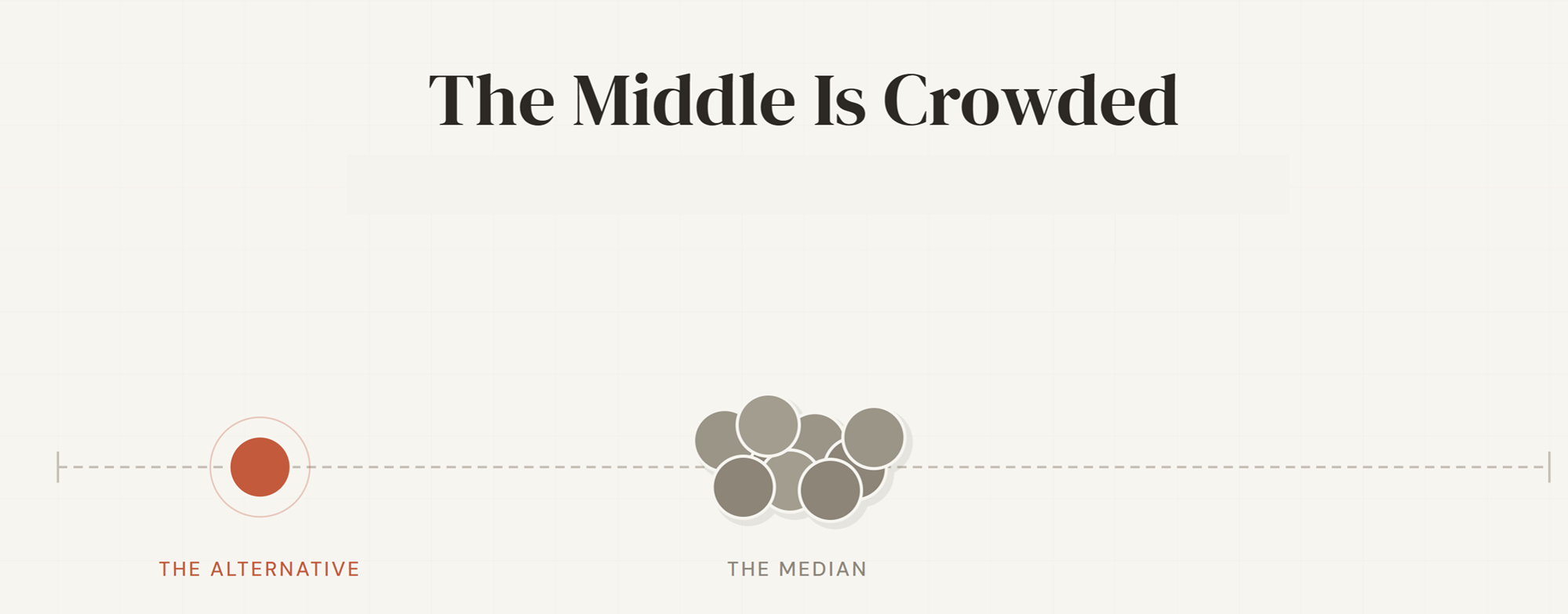
The alternative isn’t to move five feet left on the same street, it’s to question the street.
Dollar General didn’t try to out-middle Walmart and Target. Their logic was simple: we’ll be where they ain’t, which translated to low-density towns, rural areas, places large-format retailers dismissed as unattractive. They built a network on a different map entirely, and the result was decades of same-store sales growth and a defensible position that the median-seeking giants couldn’t easily contest.
The nonprofit equivalent isn’t a new tagline or a different envelope size. It’s choosing a different axis — a different donor, a different problem framing, a different relationship model, a different theory of how change happens and who funds it. It’s a harder move as it requires giving up the familiar.
I’m mostly advocating for a concious, deliberate choice, don’t default to the middle because the volume machine rewards convergence.
Minimum differentiation is rational but crowded. If you haven’t explicitly chosen which game you’re playing, you’re probably playing the middle by default.
Kevin
Behavioral Science Q & A
Thanks so much for raising this. Yes, capturing donor information can be helpful for stewardship like newsletters, thank-you letters, impact updates. But how you ask matters. Forcing full data capture introduces friction that can significantly depress conversion, many donors may simply abandon the process. Beyond the friction itself, required fields also shift the emotional experience […]
Read Full Answer
Unlike holidays that everyone already knows, Giving Tuesday is a created event. Many donors recognize the name but not the exact timing, so referencing it becomes a helpful cue. It serves as a reminder and taps into social norm activation (“everyone’s giving today”), which boosts response. However, we still want it paired with the mission, […]
Read Full Answer
When a subject line leads with the match (“Your gift matched!”), it risks triggering market-norm thinking: the sense that giving is a financial transaction rather than an act rooted in values, identity, and care. This shift reduces intrinsic motivation and, over time, can weaken donor satisfaction and long-term engagement. It also makes the email indistinguishable […]
Read Full Answer
There’s no evidence that QR codes suppress mid-value giving; all available research suggests they either help or have no negative effect. In fact, behavioral and usability research consistently shows the opposite: reducing friction at any point in the donation process increases completion rates and total response. And that has nothing to do with capacity and […]
Read Full Answer
What you’re experiencing is very common. Resistance often isn’t about capability, but about motivation quality. If board members feel pushed into fundraising, that triggers controlled motivation (low quality motivation) i.e. obligation, guilt, or fear of judgment, which often results in avoidance. Instead, we need to create conditions for volitional motivation (high quality motivation) by satisfying […]
Read Full Answer
That’s a really thoughtful question, and you’re not the first to raise it. Many of our clients have been cautious about placing the ask at the very end. To address their concern, we’ve tested both approaches, and the results are clear: when the ask comes last, even if that means it appears on the second […]
Read Full Answer