

The Unit of Strategy Is the Unit of Reporting
I argued here that strategy shows up in allocation. You can say “personalization” all day, but if the budget is still a campaign calendar with channel line items, campaigns are the strategic unit and everything else is garnish.
The follow-on problem is reporting, which teaches the organization what counts. If you budget by campaign and report by campaign, you will keep getting a campaign-centric organization, even if the rhetoric shifts.
The simplest way to see this is the table itself. A performance table is an argument about causality. The rows are what you believe drives outcomes, the columns are the descriptors. If rows are campaigns, your operating logic is campaign-first. If rows are audiences, your operating logic is audience-first, and campaigns become just one descriptor among many.
That crosstab shift changes what competes for mindshare and dollars.
In an audience-based view, rows are the people grouped into strategically meaningful units: identity segments (e.g. parents, veterans), cadence classes (mode of 1, responsive multiples) or trait-based groups (e.g. Big Five personality tags).
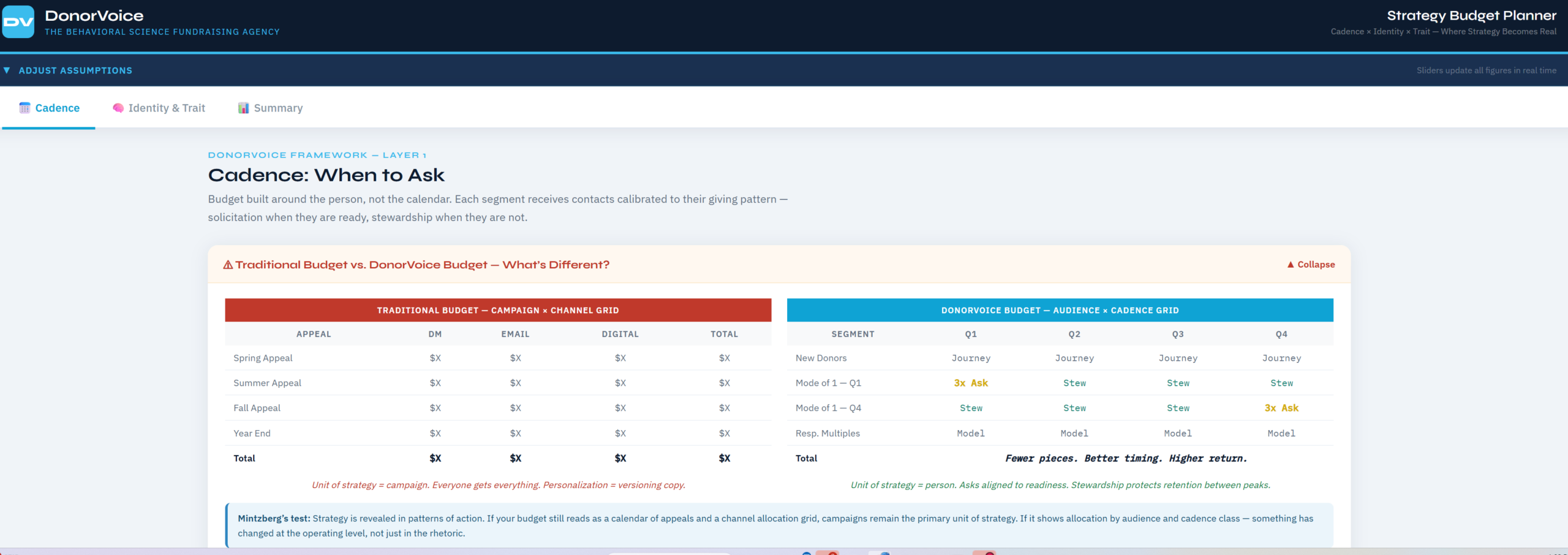
Columns include financial outcomes, channel, offer type, creative family, and campaign labels, but those fields stop being the “thing” and start being descriptors of how you engaged an audience over time. The reporting layout is how deliberate strategy becomes real, rather than a set of slides floating above the spreadsheet.
This is where attribution usually breaks down, mostly because the organization mistakes “clean” for “true.” Consider matchback. In many shops, matchback is not treated as a routine default. When it’s introduced seriously, mail-attributed revenue can jump 50-100%, not because donors suddenly got religion about envelopes, but because a giant bucket of unattributed web giving and white mail finally gets assigned to a plausible influence stream.
That jump makes people nervous though the irony is that nothing inflated. The system simply stopped pretending that only perfectly tagged transactions count as influenced. Most of the dollars come out of the black hole. A smaller portion comes out of digital buckets that were already enjoying lofty, hard-to-believe ROAS thanks to generous lookback windows and credit claims that are more confident than causal.
Now run the counterfactual in the direction that matches reality. Assume matchback-informed reporting is the norm. Then someone proposes a “stricter” standard: only count gifts as mail if the reply device physically returns with the check. Everything else becomes “unattributed” or, by default, drifts toward the most aggressive attribution machinery in the building.
That proposal would destroy insight by pushing revenue into the fog and, conveniently, make already-unbelievable digital ROAS look even better. It’s the measurement equivalent of taking a high-resolution image and compressing it until the details disappear, then congratulating yourself on having a cleaner file.
Audience-based attribution is the antidote because it assigns credit to the unit you actually invest in. You often cannot cleanly attach a gift to a single touch. You can attach it to a known person, and that person belongs to a defined audience with known exposure over time. Once you do that, attributable revenue increases because the unattributed bucket shrinks, not because you created new dollars.
This also makes ROI less fictional. Campaign ROI depends on a brittle story about which touch caused which gift. Audience ROI rests on something more durable: relationship investment over time, measured against what you actually spent on that audience. If the spend is known and the audience is known, the return becomes legible without pretending the world is single-touch.
This is why our Strategy Budget Planner (illustration here) is structured the way it is. It’s budgeting architecture that forces rows to be audiences and columns to be descriptors. Once you allocate capital that way, the reporting has to follow, because otherwise you have created a governance contradiction: you funded audiences, then evaluated campaigns, then acted surprised when the organization kept optimizing campaigns.
Mintzberg’s distinction between deliberate and emergent strategy shows up here in a very practical form. Reporting architecture is part of emergent strategy. If you report by campaign, campaigns remain the competitive unit. If you report by audience, audiences become the unit that competes for attention and capital.
You do not get out of the volume machine by announcing a new philosophy. You get out by changing what the system can see and therefore what it can optimize. The table is not the last step of strategy. For most organizations, it is the step that decides what strategy becomes.
Kevin
Behavioral Science Q & A
Thanks so much for raising this. Yes, capturing donor information can be helpful for stewardship like newsletters, thank-you letters, impact updates. But how you ask matters. Forcing full data capture introduces friction that can significantly depress conversion, many donors may simply abandon the process. Beyond the friction itself, required fields also shift the emotional experience […]
Read Full Answer
Unlike holidays that everyone already knows, Giving Tuesday is a created event. Many donors recognize the name but not the exact timing, so referencing it becomes a helpful cue. It serves as a reminder and taps into social norm activation (“everyone’s giving today”), which boosts response. However, we still want it paired with the mission, […]
Read Full Answer
When a subject line leads with the match (“Your gift matched!”), it risks triggering market-norm thinking: the sense that giving is a financial transaction rather than an act rooted in values, identity, and care. This shift reduces intrinsic motivation and, over time, can weaken donor satisfaction and long-term engagement. It also makes the email indistinguishable […]
Read Full Answer
There’s no evidence that QR codes suppress mid-value giving; all available research suggests they either help or have no negative effect. In fact, behavioral and usability research consistently shows the opposite: reducing friction at any point in the donation process increases completion rates and total response. And that has nothing to do with capacity and […]
Read Full Answer
What you’re experiencing is very common. Resistance often isn’t about capability, but about motivation quality. If board members feel pushed into fundraising, that triggers controlled motivation (low quality motivation) i.e. obligation, guilt, or fear of judgment, which often results in avoidance. Instead, we need to create conditions for volitional motivation (high quality motivation) by satisfying […]
Read Full Answer
That’s a really thoughtful question, and you’re not the first to raise it. Many of our clients have been cautious about placing the ask at the very end. To address their concern, we’ve tested both approaches, and the results are clear: when the ask comes last, even if that means it appears on the second […]
Read Full Answer