

Your Generational Mkt Deck: Horoscopes in Business Casual
I’m still alive and the world hasn’t ended, so it must be time for our semi-irregular tilt at the horsh$% windmills of generational marketing.
The equine dung pile of evidence against is deep, here’s another gem.
BBH Labs created a “Group Cohesion Score” to measure how alike different groups actually are, using UK survey data on everything from “I use a refillable water bottle” to “there’s little I can do to change my life.”
The baseline? UK citizens agree with each other 48.7% of the time. That feels right.
Those who read The Financial Times readers show more cohesion than The Sun readers. That intuitively holds, the former is a niche, specialized pub, the latter a mass market rag.
And generational cohorts? They scored barely better than random groups. Hell, daily nut eaters had more in common with each other than Millennials do with other Millennials.
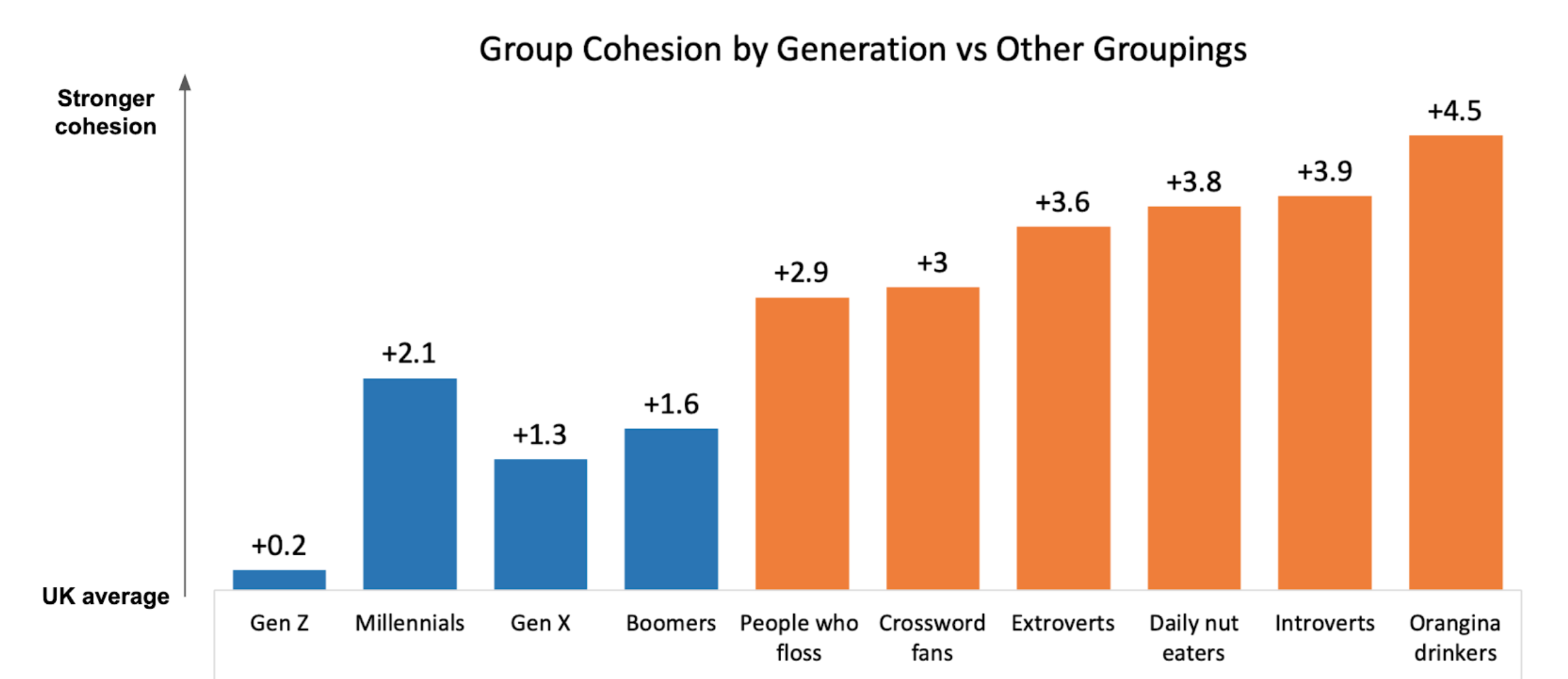
Let that sink in. People who eat nuts every day are a better marketing segment than an entire generation. That too, makes sense as absurd as it reads.
Why This Is Absurd
In the UK, there are 78,000 Millennials whose children are also Millennials. Parent and child, same “cohort,” supposedly thinking and acting alike. But if that kid were born a year later? Boom, Gen Z. Totally different creature. Makes perfect sense, right?
The reality: Parent and child might share important characteristics, both nature lovers open to supporting environmental causes, both high in agreeableness and responding to certain messaging. But you’ll never find those meaningful connections through the horoscope of generational marketing.
The Real Problem
If your segment has more variation within it than between segments, it shouldn’t see the light of day. Yet countless organizations waste money on segmentations built on random attributes—birth year, grab-bag attitude statements, whatever data happens to be lying around.
Why? BBH Labs nails it:
“Why do we fall prey to these sweeping, often useless groupings? Part of it is laziness. Carrying around a caricature is easy, negotiating the complexities of real, breathing human beings is harder. We reduce people to tropes (millennials = experiences, avocados, purpose) to avoid the real work of understanding them.”
Want proof? Watch this actual Diet Coke ad—not a parody—built on the insight that Millennials value experiences, are independent, wear athleisure, would stay in a yurt, and run marathons. It’s every lazy stereotype in 30 seconds.
What Actually Matters
People are different, just not in the ways we typically segment them. What truly unites and differentiates people:
- Identity
- Personality
- Motivational Quality
- Quality of Experience
All of these are measurable and usable in mass market fundraising for a step change improvement. We do it everyday on behalf of our clients.
Like Don Quixote, we’re probably just getting knocked off our horse here. Confirmation bias makes people dig in deeper when confronted with evidence that contradicts their worldview, no matter how wrong.
So screw it. Have a Diet Coke. Just don’t blame it on your generation.
Kevin
3 responses to “Your Generational Mkt Deck: Horoscopes in Business Casual”
Behavioral Science Q & A
Thanks so much for raising this. Yes, capturing donor information can be helpful for stewardship like newsletters, thank-you letters, impact updates. But how you ask matters. Forcing full data capture introduces friction that can significantly depress conversion, many donors may simply abandon the process. Beyond the friction itself, required fields also shift the emotional experience […]
Read Full Answer
Unlike holidays that everyone already knows, Giving Tuesday is a created event. Many donors recognize the name but not the exact timing, so referencing it becomes a helpful cue. It serves as a reminder and taps into social norm activation (“everyone’s giving today”), which boosts response. However, we still want it paired with the mission, […]
Read Full Answer
When a subject line leads with the match (“Your gift matched!”), it risks triggering market-norm thinking: the sense that giving is a financial transaction rather than an act rooted in values, identity, and care. This shift reduces intrinsic motivation and, over time, can weaken donor satisfaction and long-term engagement. It also makes the email indistinguishable […]
Read Full Answer
There’s no evidence that QR codes suppress mid-value giving; all available research suggests they either help or have no negative effect. In fact, behavioral and usability research consistently shows the opposite: reducing friction at any point in the donation process increases completion rates and total response. And that has nothing to do with capacity and […]
Read Full Answer
What you’re experiencing is very common. Resistance often isn’t about capability, but about motivation quality. If board members feel pushed into fundraising, that triggers controlled motivation (low quality motivation) i.e. obligation, guilt, or fear of judgment, which often results in avoidance. Instead, we need to create conditions for volitional motivation (high quality motivation) by satisfying […]
Read Full Answer
That’s a really thoughtful question, and you’re not the first to raise it. Many of our clients have been cautious about placing the ask at the very end. To address their concern, we’ve tested both approaches, and the results are clear: when the ask comes last, even if that means it appears on the second […]
Read Full Answer
OMG, I’m SO sharing this post of yours, Kevin. A delectable snark; just what the fundraising feast needed. I do believe you have killed for all time (at least until tomorrow) the myth/mists of generational marketing.
On a personal note: it’s Diet Dr. Pepper in this house, and it IS generational sort of. I first tasted it in my 20s at the home of my chief early mentors, Keith and Rosmarie Waldrop; still drinking it in my 70s. In fact I’m going downstairs right now to pop one…
Hi Tom, good to hear from you as always. Yes, I’m certain we’ve slayed this beast until at least tomorrow.
My generational drinks were a) sunkist and b) birch beer. I’m assuming both were proven to be the equivalent on ingesting a toxic waste dump and sunset from existence. My new life-stage drinks are higher octane and they’ll have to pry those from my cold, dead hands.
[…] Agitator reports (at Your Generational Mkt Deck: Horoscopes in Business Casual) on a recent study in the UK found that there’s group cohesion among people who eat nuts every […]