

We Said “Donor First.” The Budget Said “Same as Last Year.”
Henry Mintzberg is not a fundraiser. He’s one of the most cited management thinkers of the past 50 years, and the author of The Rise and Fall of Strategic Planning. His most durable idea is simple: there is deliberate strategy, what leaders intend, and there is emergent strategy, the pattern that actually materializes from decisions and behaviors over time.
I think about this distinction constantly.
My role at DonorVoice is trying to avoid peeing on flat rocks and more productively, helping shape strategy with research and behavioral insights. The team validates identity segments that explain giving, appends personality tags to further personalize, and models cadence at the person level to match preference. The work is rigorous, the strategy is clear.
And then the budgeting process begins.
Last year’s campaign grid reappears. Spring, Summer, Fall, Year End. Direct mail, digital, email. Baselines are defended, forecasts are adjusted, the calendar needs filling. The cost structure assumes a familiar cadence for most of the file. By the time the numbers are locked there is a financially coherent plan, and one that is 10% deliberate strategy, 90% emergent.
Strategy is revealed in patterns of action. In fundraising, one of the most powerful pattern-setting mechanisms is the annual budget. It encodes what is funded, what is tolerated, and what is considered too risky. Whatever the slide deck or planning memo says, the spreadsheet sets the operating logic.
This tension becomes especially visible when personalization is positioned as strategy rather than as creative variation.
If personalization means identity plus trait as the organizing principle, and cadence as the expression of readiness, then the unit of design is the person – i.e. who they are, when they should be asked. That is the work we do and that the research supports.
Most budgets, however, are not built around people, they’re built around campaigns and channels. They ask what the Fall Appeal will generate, how many drops will be sent, and what revenue is projected per mailing.
When you retrofit person-level strategy onto campaign-level budgeting, personalization shrinks. It becomes versioning. A veteran version of the appeal. A rural story for a subset of the file. Meanwhile the cadence remains largely intact because cadence is embedded in the cost model and the revenue forecast. The most consequential part of the strategy — when to ask and how often — is constrained by a calendar built for everyone.
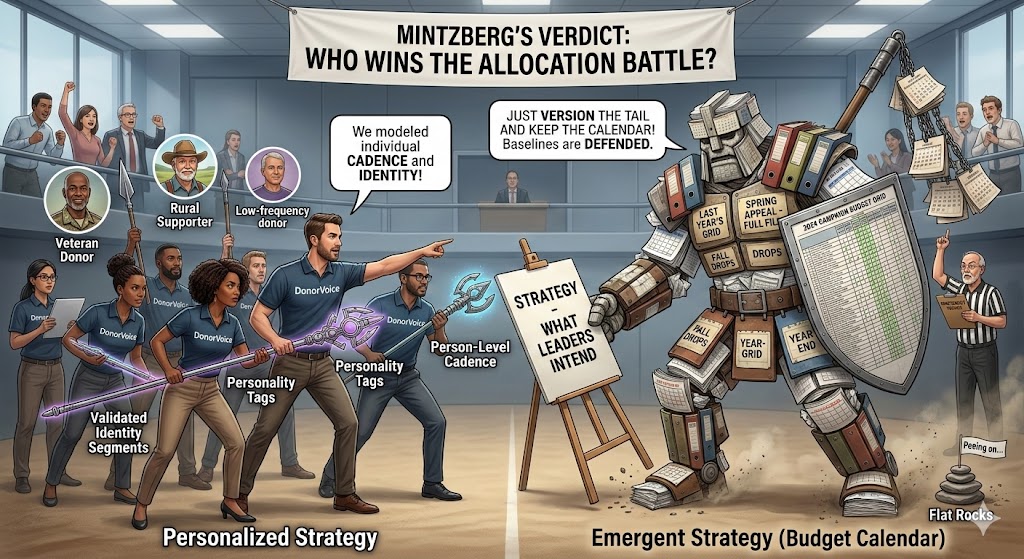 The intention was to mail less to some donors and differently to others. The budget locks in “a lot” for most of them.
I have watched this happen inside my own company, led by smart people who genuinely believe in what the research shows and the strategy. The constraint isn’t conviction, it’s architecture.
Management thinkers such as Rita McGrath and Clayton Christensen have shown that resource allocation processes tend to favor the known over the uncertain. Capital flows to proven activities with stable returns, emerging approaches that cannot yet demonstrate predictable short-term ROI struggle to compete. This is how systems behave and the annual budget is one such system; efficient at preserving continuity, less effective at enabling structural change.
If identity segments have been validated as explaining variance in giving, then they should not merely receive tailored copy. They should compete for capital. That is where the conversation shifts from creative execution to strategic allocation.
What is the projected value of the veteran segment over three years? What is the return profile of rural supporters under optimized cadence versus standard volume? If Mode of 1 donors retain at different rates when contacted less frequently, what is that restraint worth in lifetime value? How much should be invested in deepening those audiences relative to a generic pool?
These are the questions our work makes possible and they’re allocation questions. And allocation is where strategy either becomes real or remains decorative.
When segments compete for capital, consequences follow. The familiar comfort of mailing the full file and versioning where possible gives way to harder choices about who gets what and why.
Those choices are visible only in the budget.
If the budget still reads like a calendar of appeals and a channel allocation grid, then campaigns remain the primary unit of strategy. If it begins to show allocation by audience and cadence class, then something has changed at the operating level, not just in the rhetoric but in the math.
Strategy, if it is real, requires tradeoffs. Tradeoffs, if they are real, show up in the numbers.
Mintzberg would remind us that what actually materializes is what matters. If personalization is truly the strategy, the budget will reveal it. If the budget mirrors last year’s campaign plan with incremental adjustments, then the emergent strategy is continuity — no matter how good the research was that preceded it.
The spreadsheet is not a technical document. It is the clearest expression of how an organization intends to operate.
Read it closely and you will see which strategy won.
Kevin
2 responses to “We Said “Donor First.” The Budget Said “Same as Last Year.””
Leave a Reply
Leave a Reply
Behavioral Science Q & A
Thanks so much for raising this. Yes, capturing donor information can be helpful for stewardship like newsletters, thank-you letters, impact updates. But how you ask matters. Forcing full data capture introduces friction that can significantly depress conversion, many donors may simply abandon the process. Beyond the friction itself, required fields also shift the emotional experience […]
Read Full Answer
Unlike holidays that everyone already knows, Giving Tuesday is a created event. Many donors recognize the name but not the exact timing, so referencing it becomes a helpful cue. It serves as a reminder and taps into social norm activation (“everyone’s giving today”), which boosts response. However, we still want it paired with the mission, […]
Read Full Answer
When a subject line leads with the match (“Your gift matched!”), it risks triggering market-norm thinking: the sense that giving is a financial transaction rather than an act rooted in values, identity, and care. This shift reduces intrinsic motivation and, over time, can weaken donor satisfaction and long-term engagement. It also makes the email indistinguishable […]
Read Full Answer
There’s no evidence that QR codes suppress mid-value giving; all available research suggests they either help or have no negative effect. In fact, behavioral and usability research consistently shows the opposite: reducing friction at any point in the donation process increases completion rates and total response. And that has nothing to do with capacity and […]
Read Full Answer
What you’re experiencing is very common. Resistance often isn’t about capability, but about motivation quality. If board members feel pushed into fundraising, that triggers controlled motivation (low quality motivation) i.e. obligation, guilt, or fear of judgment, which often results in avoidance. Instead, we need to create conditions for volitional motivation (high quality motivation) by satisfying […]
Read Full Answer
That’s a really thoughtful question, and you’re not the first to raise it. Many of our clients have been cautious about placing the ask at the very end. To address their concern, we’ve tested both approaches, and the results are clear: when the ask comes last, even if that means it appears on the second […]
Read Full Answer
Can you share what a budget based on audience and cadence class would look like?
Hi Lisa, good question. Probably should have included that from the jump. Here is a live, interactive template, I took the liberty of tailoring the Identities in this case to what might match for Depelchin. The rest is built on default assumptions with adjustable toggles to tailor.
https://thedonorvoice.com/strategyplanner/. Would love your feedback or questions.