

What Makes a Story Stick? The Psychology Behind Fundraising Narratives
We all want a story that speaks to us, one that fits the inner narrative we’re writing, editing, and living every day.
But who is this “me” the story should speak to? That’s a surprisingly complex answer as I’m a bundle of contradictions—just like you, and exactly not like you.
Personality psychologists often describe three evolving layers of self.
- The first is the rough sketch: broad personality traits. You’re extroverted, I’m introverted. You’re agreeable, I’m not. These traits are relatively stable and measurable—through surveys, behavioral observation, or even inferred from digital behavior. They’re foundational, but not the full picture.
- The second layer is more situational and dynamic: identities, motivations, values, and current goals. This is where nuance enters. Two people can share the same traits but diverge completely in how those traits express based on context, culture, or life stage. Not all extroverts act alike. And the same extrovert doesn’t act the same in every setting.
- The third layer is the richest: our self-authored life story. This is how we make sense of ourselves over time. It’s how we link cause and effect, create meaning, and weave together diverse experiences—good, bad, contradictory—into a coherent whole.
The message I’ll resonate with most is the one that aligns with my story. But in mass-market fundraising, I don’t know your life story. So I need to make my best guess using what I can know from layers one and two.
For instance, donors high in Conscientiousness tend to value achievement and mastery. Their stories often focus on personal growth, responsibility, and success against the odds. So I might tell a story about a beneficiary in a homeless shelter who gains stability and self-sufficiency through job training. That storyline aligns with how a high-Conscientiousness person sees the world: structure, agency, results.
Here is more extensive research from McAdams of Northwestern University, a personality researcher. This table shows the correlation between what I’d call Life Story themes or styles and the Big Five, which should have been arranged to spell OCEAN but academics must like word jumbles.
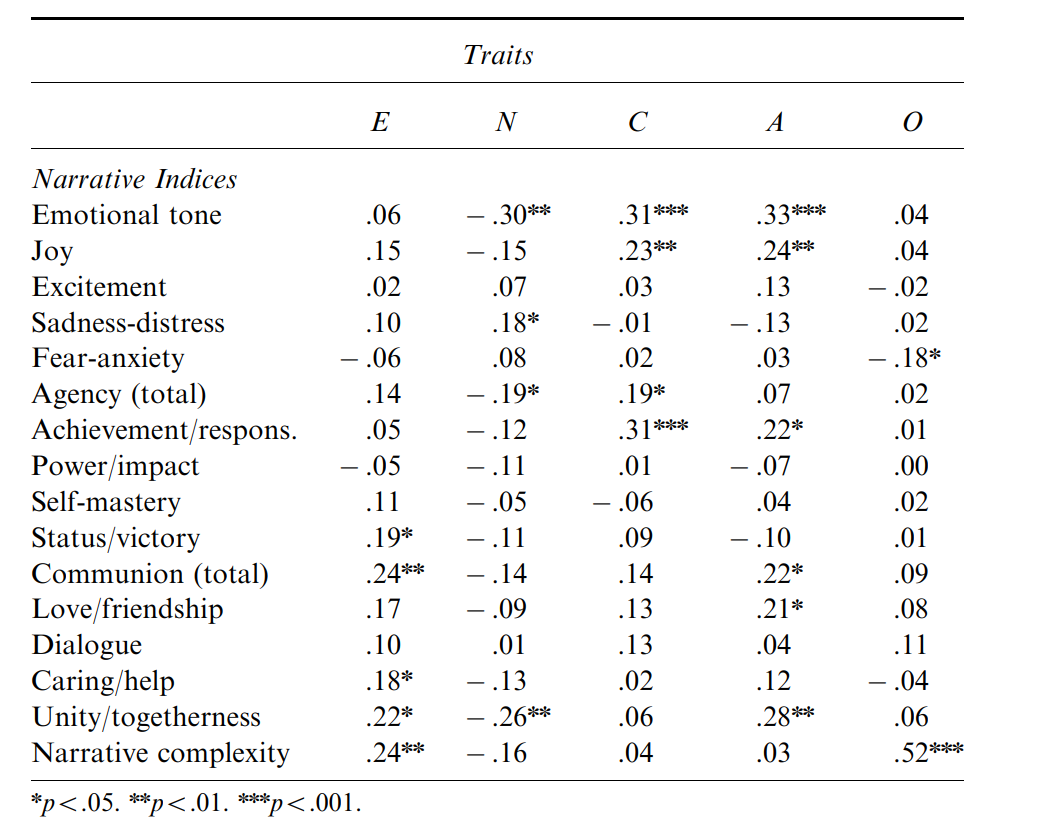
There is one really big, man bites dog finding on the last row, Narrative Complexity, and the really high correlation with Openness. Narrative complexity does not mean use big words, adjectives and the full exposition of your theory of change along with the kitchen-sink of programs with wonky titles.
Narrative complexity is about integration. A complex life story contains sophisticated ideas—about love, meaning, moral tension—and blends conflicting experiences into a larger, coherent whole. It’s the kind of story that doesn’t tidy up the messiness of life too quickly. And people high in Openness see the world this way, they’re intellectually curious, driven by ideas, drawn to nuance, and comfortable with ambiguity.
So if you’re trying to reach that kind of donor, you don’t lead with transactional appeals or slogans. You give them a story that feels layered, real, unresolved in the right ways.
Here’s an illustration of what that difference looks like.
Simple version:
John is a veteran who was struggling to feed his family. The food bank gave him what he needed, and now he’s thriving.
More complex version:
John, a decorated soldier, never imagined coming home would be harder than deploying. His pride kept him from asking for help—until his daughter asked why there was no dinner again. The food bank gave him food, yes—but more importantly, they gave him dignity. He now volunteers there, quietly ensuring others don’t feel the shame he once did.
Most mass fundraising treats people as one-dimensional. But no one is just a trait, just a donor segment, or just a dollar sign. Start by understanding the layers of the human onion then match the message to the mind that’s reading it.
Kevin
P.S. You can know the Personality of your donor file and how to tailor to trait for $0.15 per name. You can have these scores and “cheat sheets” and a workshop from our team well before the summer ends. The choice is yours and we’re happy to address your questions or ideas as part of that decisioning.
Behavioral Science Q & A
Thanks so much for raising this. Yes, capturing donor information can be helpful for stewardship like newsletters, thank-you letters, impact updates. But how you ask matters. Forcing full data capture introduces friction that can significantly depress conversion, many donors may simply abandon the process. Beyond the friction itself, required fields also shift the emotional experience […]
Read Full Answer
Unlike holidays that everyone already knows, Giving Tuesday is a created event. Many donors recognize the name but not the exact timing, so referencing it becomes a helpful cue. It serves as a reminder and taps into social norm activation (“everyone’s giving today”), which boosts response. However, we still want it paired with the mission, […]
Read Full Answer
When a subject line leads with the match (“Your gift matched!”), it risks triggering market-norm thinking: the sense that giving is a financial transaction rather than an act rooted in values, identity, and care. This shift reduces intrinsic motivation and, over time, can weaken donor satisfaction and long-term engagement. It also makes the email indistinguishable […]
Read Full Answer
There’s no evidence that QR codes suppress mid-value giving; all available research suggests they either help or have no negative effect. In fact, behavioral and usability research consistently shows the opposite: reducing friction at any point in the donation process increases completion rates and total response. And that has nothing to do with capacity and […]
Read Full Answer
What you’re experiencing is very common. Resistance often isn’t about capability, but about motivation quality. If board members feel pushed into fundraising, that triggers controlled motivation (low quality motivation) i.e. obligation, guilt, or fear of judgment, which often results in avoidance. Instead, we need to create conditions for volitional motivation (high quality motivation) by satisfying […]
Read Full Answer
That’s a really thoughtful question, and you’re not the first to raise it. Many of our clients have been cautious about placing the ask at the very end. To address their concern, we’ve tested both approaches, and the results are clear: when the ask comes last, even if that means it appears on the second […]
Read Full Answer