

What Your Appeals Sound Like When You’re Not in the Room
Every fundraising appeal is written by someone, often many someones. It’s you, your agency, a committee, a boss, or a document that’s been revised so many times nobody remembers who it was originally for.
A voice emerges out of that process and not one in the brand guide but instead, the one that survives review, feels reasonable to the people inside the organization, and quietly repeats itself across campaigns.
That voice is always there, it is never neutral and it is perhaps counterintuitively, never really measured.
What we mistake for measurement is looking at aggregate response rates and inferring meaning after the fact.
That doesn’t measure voice, it measures preference, performance, or outcomes downstream of a much deeper constraint.
The Voice lives upstream and it shapes which donors will pay attention and by extension, those that won’t. As long as that layer goes unexamined, optimization just reinforces whatever voice you already have for whoever it already resonates with.
Measuring voice requires isolating it. Hold the facts and protagonist, need, solution and ask constant, changing only the psychological constraints under which the message is written.
If the same appeal behaves very differently when rewritten for different donor dispositions, then voice is doing more work than most teams admit. If it doesn’t, then voice is less important than we think.
That’s the test and we built a straightforward app to do exactly that.
- Measure your voice
- The copy and paste an appeal you already use
- The app generates alternate versions of that appeal for voices different than yours – for voices that exist on your file and that exist in meaningul quantities.
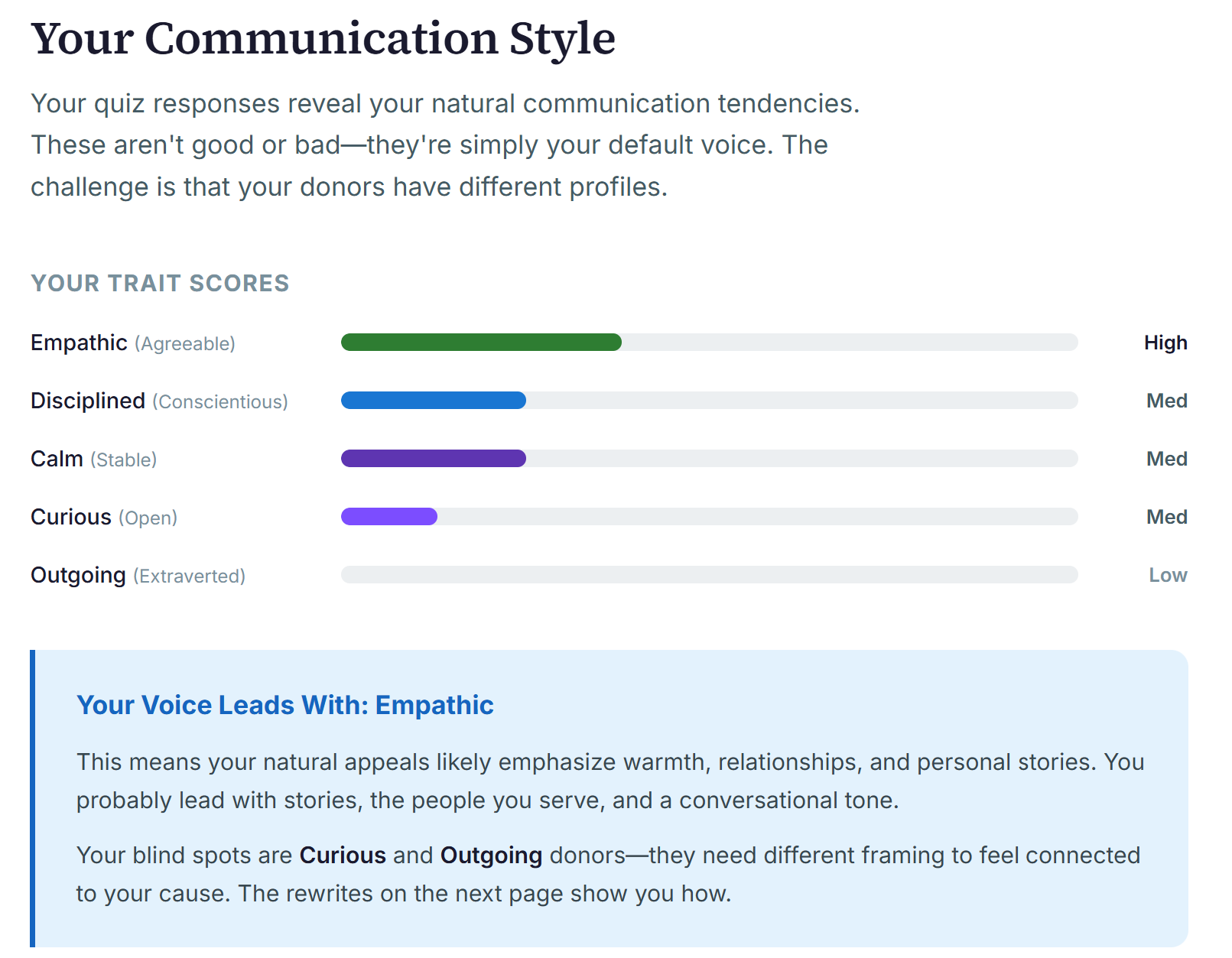
What most people notice immediately is not which version they like, it’s which versions feel unfamiliar, even uncomfortable, despite being built from the same facts and intent.
That discomfort is diagnostic, showing you where your natural voice stops working. The accompanying playbook makes this explicit by identifying which psychological traits your current voice already serves well and which ones it consistently under-serves.
Non-response is not always rejection, it’s misfit because writers and committees don’t create neutral language, they entrench a shared psychology. Most importantly, you can finally separate “this didn’t work” from “this didn’t work for this kind of donor.”
That’s a different level of control than most fundraising teams have today.
Kevin
Give it a try, the price is right, free.
Behavioral Science Q & A
Thanks so much for raising this. Yes, capturing donor information can be helpful for stewardship like newsletters, thank-you letters, impact updates. But how you ask matters. Forcing full data capture introduces friction that can significantly depress conversion, many donors may simply abandon the process. Beyond the friction itself, required fields also shift the emotional experience […]
Read Full Answer
Unlike holidays that everyone already knows, Giving Tuesday is a created event. Many donors recognize the name but not the exact timing, so referencing it becomes a helpful cue. It serves as a reminder and taps into social norm activation (“everyone’s giving today”), which boosts response. However, we still want it paired with the mission, […]
Read Full Answer
When a subject line leads with the match (“Your gift matched!”), it risks triggering market-norm thinking: the sense that giving is a financial transaction rather than an act rooted in values, identity, and care. This shift reduces intrinsic motivation and, over time, can weaken donor satisfaction and long-term engagement. It also makes the email indistinguishable […]
Read Full Answer
There’s no evidence that QR codes suppress mid-value giving; all available research suggests they either help or have no negative effect. In fact, behavioral and usability research consistently shows the opposite: reducing friction at any point in the donation process increases completion rates and total response. And that has nothing to do with capacity and […]
Read Full Answer
What you’re experiencing is very common. Resistance often isn’t about capability, but about motivation quality. If board members feel pushed into fundraising, that triggers controlled motivation (low quality motivation) i.e. obligation, guilt, or fear of judgment, which often results in avoidance. Instead, we need to create conditions for volitional motivation (high quality motivation) by satisfying […]
Read Full Answer
That’s a really thoughtful question, and you’re not the first to raise it. Many of our clients have been cautious about placing the ask at the very end. To address their concern, we’ve tested both approaches, and the results are clear: when the ask comes last, even if that means it appears on the second […]
Read Full Answer