

When the Close Up Image Doesn’t Work
Hopeful or sad for your appeal? It sounds like a practical choice, which is probably why it sticks around. But it pushes into the wrong level of thinking by assuming emotion is a dial you adjust independently as single variable when instead, it’s more of a holistic, gut level reaction.
How many appeals are you involved with that ask a donor to,
- Confront something immediate and unresolved? These might invoke anger, pain or urgency and tied to what’s happening right now.
What about asking a donor to,
- See themselves, their identity and the possibility – what could happen, what the donor enables over time?
Both can work but they’re not the same kind of ask.
Now consider the images that get paired with those stories. A tight crop pulls you in, creating proximity with you inside the moment. A wider frame does the opposite, giving you context, space and a sense of where this fits in a larger story. Neither is inherently better but they’re not interchangeable, and they do not ask the same thing of the donor.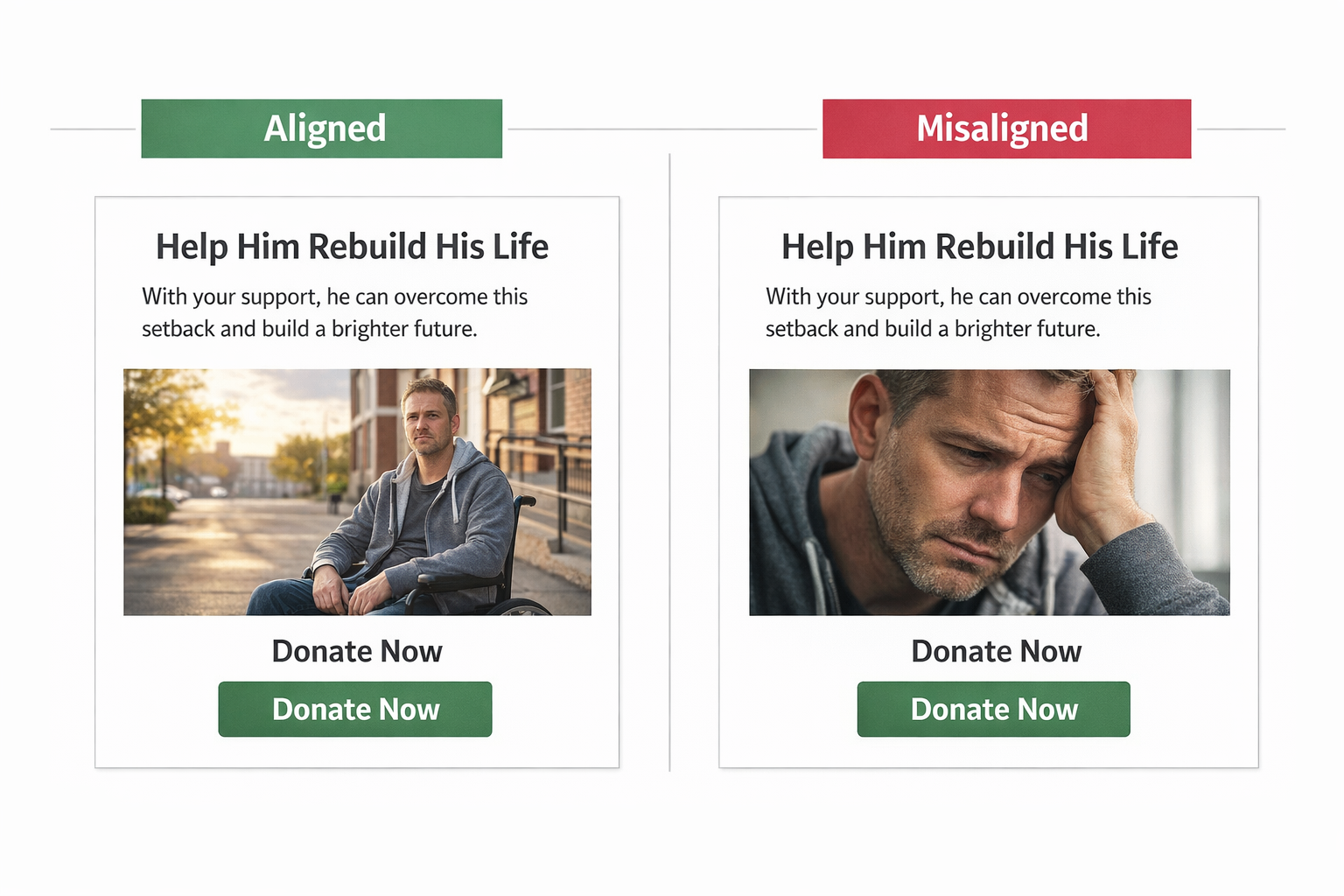
But what if you end up with a story about rebuilding, agency, forward motion, paired with a close, almost suffocating image of distress. Or a story that is meant to convey urgency paired with a distant image that softens the impact.
Nothing looks obviously wrong but something feels off. This misalignment means the donor has to do a small amount of extra work to make sense of what they’re seeing and while they won’t notice it consciously, they’ll move on a little more often.
On the flip side, when the story and the image are aligned, the message is easier to process. Not simpler in content, but more coherent in how it feels and so the meaning comes through more cleanly.
There is research pointing in this direction. When narrative framing and visual perspective reinforce each other, you tend to see stronger response. When they don’t, you lose something. The academic explanation is “processing fluency,” but that term hides more than it explains.
How message and image work together
| Close / Immediate Image | Wide / Contextual Image | |
|---|---|---|
| Identity / Possibility resilience, future, agency |
Misaligned Feels constricting, conflicts with forward-looking story |
Aligned Supports perspective, trajectory, and meaning |
| Immediate / Suffering pain, urgency, present need |
Aligned Direct, emotionally coherent, reinforces urgency |
Misaligned Dilutes urgency and creates emotional distance |
If the appeal is about identity and trajectory, the image should give the donor enough distance to take that in. If the appeal is about immediacy and need, the image should bring them closer, not pull them away.
When everything lines up, the decision feels straightforward. When it doesn’t, the donor hesitates, even if only slightly.
Kevin
Behavioral Science Q & A
Thanks so much for raising this. Yes, capturing donor information can be helpful for stewardship like newsletters, thank-you letters, impact updates. But how you ask matters. Forcing full data capture introduces friction that can significantly depress conversion, many donors may simply abandon the process. Beyond the friction itself, required fields also shift the emotional experience […]
Read Full Answer
Unlike holidays that everyone already knows, Giving Tuesday is a created event. Many donors recognize the name but not the exact timing, so referencing it becomes a helpful cue. It serves as a reminder and taps into social norm activation (“everyone’s giving today”), which boosts response. However, we still want it paired with the mission, […]
Read Full Answer
When a subject line leads with the match (“Your gift matched!”), it risks triggering market-norm thinking: the sense that giving is a financial transaction rather than an act rooted in values, identity, and care. This shift reduces intrinsic motivation and, over time, can weaken donor satisfaction and long-term engagement. It also makes the email indistinguishable […]
Read Full Answer
There’s no evidence that QR codes suppress mid-value giving; all available research suggests they either help or have no negative effect. In fact, behavioral and usability research consistently shows the opposite: reducing friction at any point in the donation process increases completion rates and total response. And that has nothing to do with capacity and […]
Read Full Answer
What you’re experiencing is very common. Resistance often isn’t about capability, but about motivation quality. If board members feel pushed into fundraising, that triggers controlled motivation (low quality motivation) i.e. obligation, guilt, or fear of judgment, which often results in avoidance. Instead, we need to create conditions for volitional motivation (high quality motivation) by satisfying […]
Read Full Answer
That’s a really thoughtful question, and you’re not the first to raise it. Many of our clients have been cautious about placing the ask at the very end. To address their concern, we’ve tested both approaches, and the results are clear: when the ask comes last, even if that means it appears on the second […]
Read Full Answer