

Why Your Best Copy Starts With Silence
George Orwell wrote “Politics and the English Language” in 1946. One line from it should hang over every fundraising shop in the country:
“Probably it is better to put off using words as long as possible and get one’s meaning as clear as one can through pictures and sensations. Afterward one can choose — not simply accept — the phrases that will best cover the meaning.”
A lot of writing violates this principle structurally, not stylistically as the meaning is never established before the template is.
Why the Template Wins
“Transformative impact.” “Now more than ever.” “Make a difference in the life of a child.” These are not failures of talent, they’re the output of a production process that rewards speed, repeatability, and internal safety. A campaign has a deadline, someone opens last year’s file, adjusts the dates, and fills the frame.
Template-first copy persists because it lowers risk while specificity increases it – it can offend a board member or surface a story that makes someone uncomfortable. So, language defaults to warm, vague, and interchangeable. The phrases were accepted more than chosen.
What Chosen Language Requires
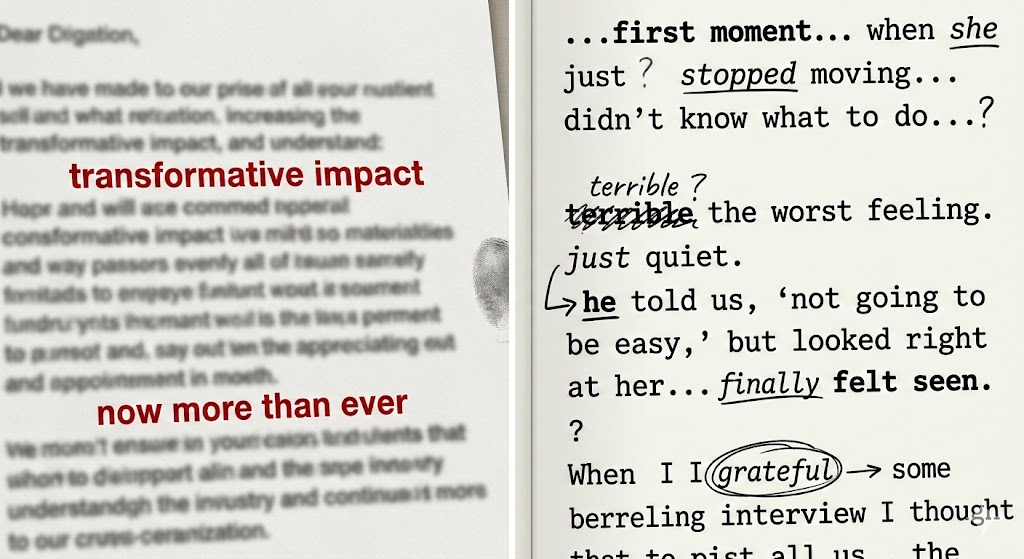 We build interview guides designed to do what Orwell described: delay the writing and start with pictures and sensations.
You sit with a parent, you give them an open prompt and shut up. “I’d love to hear your story in your own words, from the moment you first knew something was wrong, through what it was like to arrive at this place, and how life has changed. Start wherever feels right.” Then silence. “Tell me more about that.” “What happened next.”
The goal is a narrative arc that surfaces organically: fear, turning point, hope, gratitude. You don’t impose that structure, you listen for it. When the speaker lands on a vivid moment, you ask them to paint the scene. “Can you take me back to that moment? Where were you? What do you remember most?”
You let the person’s story emerge in their own words. You ask about stakes: what would have happened without these resources. You ask them to talk about what the support makes possible.
What makes the guide strategic rather than journalistic is a second layer. Every story contains multiple psychological entry points. The interview guide is designed to surface them deliberately. After the open narrative, you ask questions that map to validated personality dimensions.
- A question about surprise and perspective shifts draws out reflective language.
- A question about trust and preparation surfaces competence and agency.
- A question about small acts of kindness reveals warmth.
- A question about waiting without answers captures vulnerability.
- A question about a child simply being a child again produces joy.
The same parent’s story, drawn out through these different lenses, produces raw material that can be shaped for different donor audiences without manufacturing anything. We don’t invent resonance, we capture it from multiple angles so the donor hears the version that connects to how they process the world.
At the end, you ask the speaker to address donors directly. “If you could say one thing to the people who make this care possible, what would it be?” Then you ask permission to share the story. Ethical storytelling is part of the method, not an afterthought or a label.
The Sequence Is the Strategy
The writer’s job in telling another’s story is curation. You sit with the recording and the moments that carry weight and then you write.
Template-first copy produces “your gift makes a transformative impact.” Interview-first copy produces a specific mother describing the moment she trusted strangers with her child’s life.
One is a phrase, the other is a scene and donors can tell the difference.
If your first draft begins with a phrase, you are already in trouble. If it begins with a recorded voice, you have a chance.
Kevin
Behavioral Science Q & A
Thanks so much for raising this. Yes, capturing donor information can be helpful for stewardship like newsletters, thank-you letters, impact updates. But how you ask matters. Forcing full data capture introduces friction that can significantly depress conversion, many donors may simply abandon the process. Beyond the friction itself, required fields also shift the emotional experience […]
Read Full Answer
Unlike holidays that everyone already knows, Giving Tuesday is a created event. Many donors recognize the name but not the exact timing, so referencing it becomes a helpful cue. It serves as a reminder and taps into social norm activation (“everyone’s giving today”), which boosts response. However, we still want it paired with the mission, […]
Read Full Answer
When a subject line leads with the match (“Your gift matched!”), it risks triggering market-norm thinking: the sense that giving is a financial transaction rather than an act rooted in values, identity, and care. This shift reduces intrinsic motivation and, over time, can weaken donor satisfaction and long-term engagement. It also makes the email indistinguishable […]
Read Full Answer
There’s no evidence that QR codes suppress mid-value giving; all available research suggests they either help or have no negative effect. In fact, behavioral and usability research consistently shows the opposite: reducing friction at any point in the donation process increases completion rates and total response. And that has nothing to do with capacity and […]
Read Full Answer
What you’re experiencing is very common. Resistance often isn’t about capability, but about motivation quality. If board members feel pushed into fundraising, that triggers controlled motivation (low quality motivation) i.e. obligation, guilt, or fear of judgment, which often results in avoidance. Instead, we need to create conditions for volitional motivation (high quality motivation) by satisfying […]
Read Full Answer
That’s a really thoughtful question, and you’re not the first to raise it. Many of our clients have been cautious about placing the ask at the very end. To address their concern, we’ve tested both approaches, and the results are clear: when the ask comes last, even if that means it appears on the second […]
Read Full Answer