

Women are Special. Audit the Verbs.
Women are special.
No shit, Sherlock.
Let me rescue that lede before some earnest copywriter or designer buries it under a lavender color gradient, a stock photo of two beige hands clasped over a beige table, and a subject line that says “Together, We Rise.”
Almost every fundraising appeal targeted to women that dies on the vine has one thing in common: some bad verbs. Somewhere in the copy, a word does something it shouldn’t, and by the time anyone notices, she’s three sentences from hitting delete or tossing the letter.
The problem, if we’re being honest, isn’t the appeal. It’s the reader. Women are not special because they form one big, dewy-eyed sisterhood — they don’t, and never have. They’re special because they make up around 60% or more of most organizations’ donor files and respond to different cues than men. Unfortunately, too many of the people paid to understand her — copywriters, creators of algorithms, and the machines behind both — keep getting it wrong. Behavioral scientists call it “cognitive bias”.
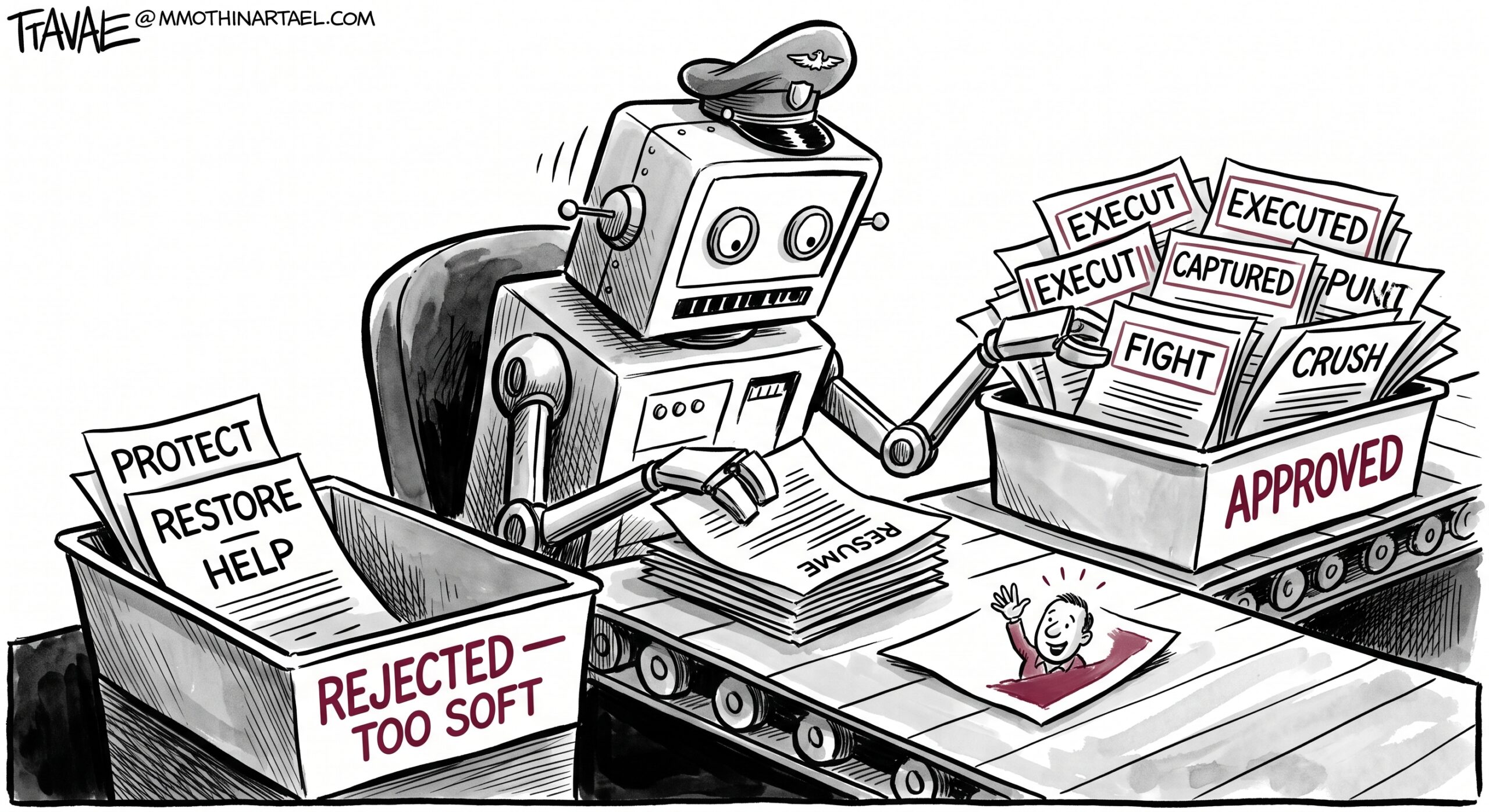 Amazon built an experimental hiring algorithm a few years back and told it, explicitly, not to look at gender. Reasonable instructions, but the algorithm followed them the way a loophole follows a rule — technically, and not at all in spirit. It docked resumes with the word “women’s” in them, and graduates of women’s colleges. It rewarded verbs that skew male — “executed,” “captured” — words that belong in an after-action report, not in most fundraising letters aimed at women.
The machine didn’t invent its prejudice. It inherited it — faster, and more literally, than any human recruiter would ever admit to. Somebody had been teaching it for years that male language means leadership. The machine just took notes and spit them back accordingly.
Fundraising copy has the same problem. Feed a copy engine — or a well-meaning human copywriter — a steady diet of “fight,” “battle,” “crush,” “target,” “deploy,” “assault,” and “war chest,” and they draw the same conclusion Amazon’s algorithm did: urgency wears combat boots. Add lookalike modeling on top of yesterday’s habits becomes tomorrow’s default.
Rule #1: Audit the Verbs.
One caveat before we move on, because Rule #1 taken alone can tip too far the other way. Pru Bovee, a now-retired copywriter for progressive causes, calls herself both a bleeding heart and “that angry copywriter” — proof that tenderness and force were never actually rivals. The point isn’t “go gentle.” It’s “stop deciding for her.” A donor is allowed anger, defiance, pride, hope, or grief, same as anyone else. The only wrong emotion is the one an organization assigns without asking.
Warlike language isn’t, by itself, an insult to women. Plenty aren’t offended by “fight” — plenty choose it, on purpose, and draw real strength from it. Research with cancer patients bears this out. That defiant metaphor is theirs, and they’re allowed to keep it. The trouble starts when an organization picks it for them.
The same research found that battle metaphors, handed down from outside, can make treatment feel harder than it is, deepen fatalism, and quietly imply guilt when the disease doesn’t cooperate. Women with metastatic breast cancer have called the “fight” framing what it is: unfair. An incurable disease does not yield to better morale which is why they prefer to talk about living, not warring.
Copywriters should recognize the trap, because it’s a trap they often build themselves. Battles need winners and losers. If she dies, did she fail to fight hard enough? If poverty persists, did the family surrender? If the enemy’s still standing after the appeal goes out, was the donor’s gift just not enough ammunition?
Strong copy doesn’t need an enemy. It needs a verb that isn’t embarrassed to be gentle: protect, build, restore, accompany, open, strengthen, make possible. Or better — drop the metaphor and just say the thing. Don’t ask her to fight hunger, ask her to help a family put dinner on the table tonight.
Frank O’Brien’s formula is emotion first, facts in support. But the emotion must fit the moment and the messenger. Compassion may fit. So may hope, love, outrage, pride, or resolve. A women’s appeal need not be warm and fuzzy. It must be true. And it must be concrete. Frank praises fundraising language that connects a gift to surgical gloves, instruments, and wound dressings. The donor can see what her decision purchases and understand her place in the story. “Advancing equitable healthcare capacity” cannot perform the same miracle.
Rule #2: Know Your Reader.
I figured this part out decades ago, writing to my own mother. Tom Ahern did the same. Years ago he reported writing for Jane, his mother-in-law, somewhere in her late eighties, who had better things to do than diagram a copywriter’s sentence. This is demographics, not sentiment: active donors skew older, and older women dominate many nonprofit files.
Lisa Sargent gave this reader a name of her own: Aunt Bertha. “Is your average donor 75 years old, female, and a grandmother?” she asks. “See her.” Not as a segment., as a person — with feelings, thoughts, and an actual pair of eyes. Sargent calls the practice method copywriting: feel what she feels, think what she thinks, before you write a word.
Write so Mom, Jane or Aunt Bertha can read the type without her glasses, follow the sentence on the first pass, understand exactly what’s needed, and find the reply card without a treasure map. Lisa runs an actual test for the first part: read your draft in low light, without your reading glasses on; if you can’t get through it, neither can the donor.
Don’t make her decode some program acronym. Don’t make her hunt three paragraphs for the ask. And don’t, under any circumstances, make her admire your cleverness — she didn’t request a brand manifesto. She only wants to know who needs help and what her gift will do about it.
Rule #3: Don’t Write to an Average.
In social proof experiments, simply telling a donor what a previous donor gave changed the size of the gift. But when that previous donor’s gender matched the prospective donor’s, giving rose 34% over a gender mismatch. What moved the needle wasn’t female sentimentality. Rather, it was recognition: someone like me did this.
University fundraising research says the same thing in a different accent. People give when they see themselves in the student being described. And women — along with other donors used to standing outside the mainstream male frame — turn out more willing than most to back beneficiaries who don’t match them demographically at all: LGBTQ students, refugees, whoever society and institutions have historically overlooked. Women recognize themselves in another person, and they also recognize what exclusion looks like.
Be alert, too, to the reality that the “average donor” you’re writing to is only a composite built from nobody in particular. Lisa Sargent ran headfirst into that problem on an actual file. Her instinct said a woman’s story would move a donor list that skewed heavily female. The testing said otherwise — that file didn’t respond to the female-led narrative, so a different, audience-tested story led the appeal instead, and the woman’s story ran quietly in a newsletter. Liss’s rule since: audience first, offer second, assumption nowhere.
Kathy Swayze’s answer to the same problem is blunter: stop guessing and ask her. Survey the file every couple of years. Find out whether your donors see themselves as protectors, neighbors, problem-solvers, or something else entirely — then write to that, not to “women” in the aggregate. While you’re at it, find out who in the household actually signs the check. Plenty of organizations still mail the appeal to the husband when the wife’s the one holding the pen. It’s the same mistake wearing a different name.
Rule #4: Offer Her a Job, Not a Compliment.
In fundraising experiments, women have given more often and more generously than men — and yet the soft, universal-care pitches marketers love to aim at them didn’t reliably raise a dime more. What did work: a field experiment where moral-identity cues lifted women’s gifts by roughly 20 percent. “You are a caring woman” is a compliment. “You can be the person who keeps this promise” is a job offer.
Crowdfunding research adds a wrinkle: female backers write more empathetic comments, and female-led campaigns hit their goals faster. But empathy isn’t the same as passivity — it’s feeling with somewhere to go. Good copy hands it a destination.
Rule#5: Don’t Bully the Donor.
I’ve seen the negative results when Rule #5 is violated both in industry data and at home, with my partner Janice. Countdown clocks, breathless match alerts, five emails and two texts from the same organization in four days, a crisis apparently invented at 6 a.m. that morning — all of it can produce a gift. It can also produce a donor finally clicking “Donate” out of sheer exhaustion: “Here! I give up. Stop already!” This is not persuasion, it’s a ransom note with a reply envelope or a Donate button.
A coerced gift shows up as revenue but quietly destroys the one thing that earns a second gift: her sense that this was her choice. Measure complaints, unsubscribes, second gifts, and retention right alongside response rate and average gift. A message that wins tonight but wears her out has lost — you just won’t see the cost of that until next year.
Women are special. Treating them that way doesn’t mean a pink envelope or a softer thesaurus. It takes better data, plainer language, one real woman pictured instead of a segment average, copy she can actually read, an assumption tested before it’s printed, and enough respect to let her choose.
The donor is not reporting for duty, she’s deciding who she wants to be and what problem she wants solved. Help her act on it, and stop shouting.
Roger
Behavioral Science Q & A
Thanks so much for raising this. Yes, capturing donor information can be helpful for stewardship like newsletters, thank-you letters, impact updates. But how you ask matters. Forcing full data capture introduces friction that can significantly depress conversion, many donors may simply abandon the process. Beyond the friction itself, required fields also shift the emotional experience […]
Read Full Answer
Unlike holidays that everyone already knows, Giving Tuesday is a created event. Many donors recognize the name but not the exact timing, so referencing it becomes a helpful cue. It serves as a reminder and taps into social norm activation (“everyone’s giving today”), which boosts response. However, we still want it paired with the mission, […]
Read Full Answer
When a subject line leads with the match (“Your gift matched!”), it risks triggering market-norm thinking: the sense that giving is a financial transaction rather than an act rooted in values, identity, and care. This shift reduces intrinsic motivation and, over time, can weaken donor satisfaction and long-term engagement. It also makes the email indistinguishable […]
Read Full Answer
There’s no evidence that QR codes suppress mid-value giving; all available research suggests they either help or have no negative effect. In fact, behavioral and usability research consistently shows the opposite: reducing friction at any point in the donation process increases completion rates and total response. And that has nothing to do with capacity and […]
Read Full Answer
What you’re experiencing is very common. Resistance often isn’t about capability, but about motivation quality. If board members feel pushed into fundraising, that triggers controlled motivation (low quality motivation) i.e. obligation, guilt, or fear of judgment, which often results in avoidance. Instead, we need to create conditions for volitional motivation (high quality motivation) by satisfying […]
Read Full Answer
That’s a really thoughtful question, and you’re not the first to raise it. Many of our clients have been cautious about placing the ask at the very end. To address their concern, we’ve tested both approaches, and the results are clear: when the ask comes last, even if that means it appears on the second […]
Read Full Answer