

Year-End Appeals Are Never Routine When The Republic Is At Stake
I’ve been digging through advocacy copy I wrote in the early 1970s, when the country was in upheaval. Not exactly like today, but a frighteningly similar era of turmoil, media spectacle, and debates about victimhood and radicalization.
Back then, we witnessed a series of violent confrontations between government forces and protesters, prisoners, and activists. The National Guard killed students at Kent State. Mississippi State Police killed students at Jackson State. New York State Police killed prisoners at Attica. The FBI and U.S. Marshals killed activists at Wounded Knee.
These events unfolded under President Nixon’s “law and order” administration, which responded to antiwar, civil rights, and Native sovereignty movements with increased surveillance, crackdowns, and an IRS enemies list.
Meanwhile, the right wing was mobilizing politically and culturally—rallying the “silent majority,” opposing desegregation and affirmative action, building new business and religious networks that would shape conservative politics for decades.
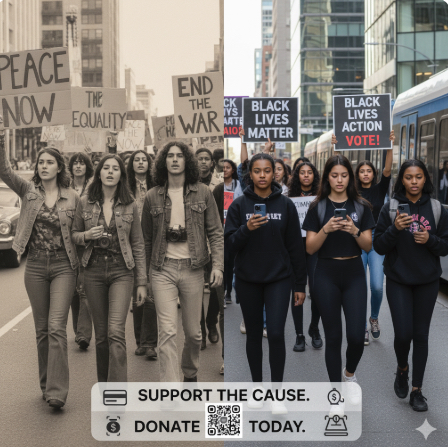 In reaction to Vietnam and other Nixon administration actions, radical groups like the Symbionese Liberation Army were setting off bombs. In just 18 months between January 1971 and June 1972, the FBI recorded more than 2,500 bombings in the United States. Nearly five bombings a day. Most were low-casualty, symbolic attacks—timed at night or preceded by warning calls, hoping to smash windows, not bodies.
It was a fearful time. But also one filled with possibility.
The advocacy appeals we crafted weren’t hackneyed “help us reach our budget goal” pleas. They were calls to action to build something new. Out of that turmoil came organizations that are household names today: Common Cause, the National Organization for Women, NARAL [now Reproductive Freedom for All)], Greenpeace, NRDC, EDF, Public Citizen, Southern Poverty Law Center, and dozens more.
Those messages weren’t about keeping the lights on; they were about lighting a fire. Donors weren’t asked to maintain—they were asked to create. And they did, writing the checks that birthed institutions still shaping our civic life fifty years later.
The Echo of History
Now it’s 2025, and the times feel every bit as unsettled—perhaps more so.
The assassination of Charlie Kirk has thrown accelerant on an already volatile nation. Stephen Miller, Trump’s ghoul-in-residence, has said the quiet part out loud: “Take away their money. Take away their power.” “Their” being whatever Miller broadly defines as any group opposing the MAGA agenda.
Their strategy is plain: Target the platforms—ActBlue above all—that power grassroots giving. Target philanthropists like George Soros who bankroll progressive causes. Turn donors into suspects. Chill the act of giving itself.
It’s intimidation with a new face. The goal remains the same: stop the money, starve the movement.
What We Do in Such a Moment
First, I recommend reading, downloading, and sharing two excellent year-end guides by veteran progressive fundraiser Frank O’Brien.
For political and advocacy groups, check out Part One of “Year-End Messaging in a Year Like No Other.” His counsel rings true: Donors are tired of “existential threat” boilerplate. They know the threats are real. What they hunger for is action—tangible, urgent, specific. They want to see how their gift today becomes impact tomorrow.
If you’re not part of a political or advocacy organization, don’t think you can ignore the times and carry on as usual. Check out Frank’s Part Two for charities and nonpolitical groups. He wisely warns: “Even nonprofits whose work and mission remain untouched by Trump administration activities are communicating to audiences anything but immune from the overall climate in this year like no other.”
Bottom Line
Just as in the early ’70s, the opportunity is larger than many admit. Back then, out of chaos came the chance to create new institutions. Now, out of crisis, comes the opportunity/need to strengthen and reinvent the organizations we have and the fundraising practices that fuel them. We can’t go to donors with maintenance letters. We must go with building letters– building for 2026 and beyond. Building to resist authoritarian schemes. Building to secure rights and freedoms before they’re erased.
Year-end giving has always been more than a line item. It’s the period when the majority of nonprofits raise the bulk of their money. In the early ’70s, it gave birth to organizations that endured. In 2025, it must give birth again—this time to resilience, to courage, to a refusal to let fear dictate our future.
The bell is tolling. We can hear it. History tells us the only way to answer is to raise hell and raise the money that keeps movements alive when everything else conspires against them.
Roger
3 responses to “Year-End Appeals Are Never Routine When The Republic Is At Stake”
Behavioral Science Q & A
Thanks so much for raising this. Yes, capturing donor information can be helpful for stewardship like newsletters, thank-you letters, impact updates. But how you ask matters. Forcing full data capture introduces friction that can significantly depress conversion, many donors may simply abandon the process. Beyond the friction itself, required fields also shift the emotional experience […]
Read Full Answer
Unlike holidays that everyone already knows, Giving Tuesday is a created event. Many donors recognize the name but not the exact timing, so referencing it becomes a helpful cue. It serves as a reminder and taps into social norm activation (“everyone’s giving today”), which boosts response. However, we still want it paired with the mission, […]
Read Full Answer
When a subject line leads with the match (“Your gift matched!”), it risks triggering market-norm thinking: the sense that giving is a financial transaction rather than an act rooted in values, identity, and care. This shift reduces intrinsic motivation and, over time, can weaken donor satisfaction and long-term engagement. It also makes the email indistinguishable […]
Read Full Answer
There’s no evidence that QR codes suppress mid-value giving; all available research suggests they either help or have no negative effect. In fact, behavioral and usability research consistently shows the opposite: reducing friction at any point in the donation process increases completion rates and total response. And that has nothing to do with capacity and […]
Read Full Answer
What you’re experiencing is very common. Resistance often isn’t about capability, but about motivation quality. If board members feel pushed into fundraising, that triggers controlled motivation (low quality motivation) i.e. obligation, guilt, or fear of judgment, which often results in avoidance. Instead, we need to create conditions for volitional motivation (high quality motivation) by satisfying […]
Read Full Answer
That’s a really thoughtful question, and you’re not the first to raise it. Many of our clients have been cautious about placing the ask at the very end. To address their concern, we’ve tested both approaches, and the results are clear: when the ask comes last, even if that means it appears on the second […]
Read Full Answer
Much needed Roger. There is a way forward and we must take inspiration and hope from lessons of the past to craft a path. Thank you.
Raise some hell every day. It’s a healthy dietary supplement. Thank you, Roger, for swinging today’s mess into perspective.
Roger, thank you for this, especially the clear “what you can do now” guidance. It’s practical, not performative, and that’s exactly what leaders need as they head into year-end.
I agree with your main argument. And I’ll go a step further… 2025 feels more perilous to me than 1970. In 1970, the country was coming off a generation of broad economic prosperity after WWII. There was turmoil, but there was also a sturdier floor under most families. Today we’re living with the compounding effects of two generations of wealth inequality, fueled by the neoliberal turn that began under Reagan. The social contract is thinner, household precarity is higher, and that makes civil society far more fragile than it was in 1970.
That’s why your point about moving beyond “keep the lights on” to “build something that lasts” really landed with me. Donors don’t need more existential rhetoric. They need specificity, agency, and a credible plan that turns today’s gift into tomorrow’s impact. Your checklist delivers that.
Count me in on urging organizations to treat year-end as a moment to build resilience, widen the tent of supporters, and protect the infrastructure of giving itself. Appreciate you, Roger. I’m bookmarking and sharing this.