

Donor Horoscopes
I enjoy mocking generational marketing. You know the genre; Boomers are loyal, Millennials want meaning, Gen Z wants authenticity, TikTok, and oat-milk.
But that doesn’t mean birth cohort tells us nothing. There are three things that get lazily shoved into the same generational bucket.
An age effect is what happens because people get older. Risk-taking tends to decline with age for everybody.
A period effect is what happens when everyone lives through the same external event. COVID is exhibit A, so is growing up with the internet or social media. Everyone experiences the thing, though not necessarily in the same way.
A cohort effect answers the question period effect leaves open: not just whether you lived through something, but when. The same event leaves a different mark depending on the age it catches you at. A recession at 22, right as you’re starting a career, can shape how you handle money for decades. The same recession at 55 is a few rough years you ride out.
The Global Preferences Survey, covering 80,000 people across 76 countries, found evidence of cohort effects in several preferences that matter for markets, institutions and civil society.
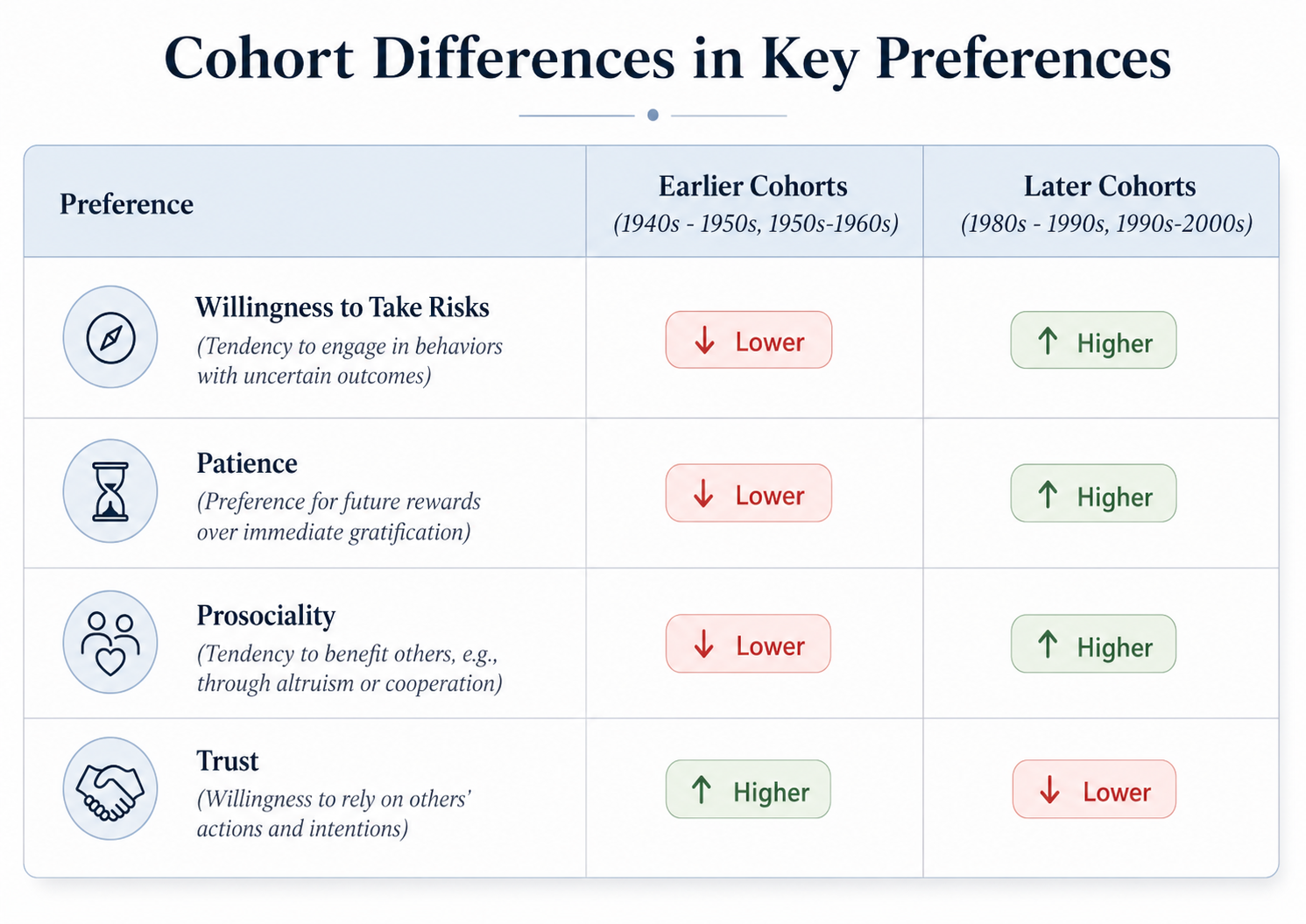 Later cohorts are
- More willing to take risks
- More patient and willing to delay gratification for future rewards and
- They are more prosocial, meaning more inclined toward cooperation and helping others.
- Trust moves the other way. Later cohorts are less trusting.
That’s interesting. It also gives the generational crowd a tiny bit of oxygen but let’s not hand them a flamethrower.
This does not mean “Gen Z donors need X” or “Millennials respond to Y.” That’s still horoscope segmentation.
What it does mean is more subtle and more useful. People are shaped by the world they grow up in. Preferences are not carved in stone. Technology, globalization and social conditions can leave a lasting imprint, especially when those forces hit early in life.
But the fundraising implication is not “build a campaign for people born between two dates.”
The implication is almost the opposite. sinc the differences within a generation still dwarf the differences between generations.
Take two donors born in the same year.
One sees herself as an environmental protector, scores high on Openness, and is drawn to possibility, discovery and big-picture change. Give her a rigid, institutional, proof-heavy appeal and have wildly missed the mark.
Another donor, same age, sees herself as a protector of family and community, scores high on Conscientiousness, and wants responsibility, order, proof and follow-through. Give her the dreamy exploration copy and she sees fluff.
That’s the part the generational deck never seems to get around to. Cohort effects can tell us something about the climate people grew up in. Useful, yes. But identity tells us what matters to someone and personality tells us how they process the ask.
And separate still, motivation tells us whether giving feels chosen, meaningful and doable.
Those are donor-level explanations not birth year make believe.
So yes, younger cohorts appear more risk-tolerant, more future-oriented and more prosocial, while also less trusting and while that’s accurate, it’s a cohort average and donor strategy has to explain individuals.
You can know, today, about the individual on your file – who do they believe they are? How do they process the ask? What makes giving feel chosen, meaningful and doable?
Birth year is not much of a clue to answering any of those but treating it as one is how we wind up with the “Millennials love experiences and authenticity” deck.
Kevin
3 responses to “Donor Horoscopes”
Behavioral Science Q & A
Thanks so much for raising this. Yes, capturing donor information can be helpful for stewardship like newsletters, thank-you letters, impact updates. But how you ask matters. Forcing full data capture introduces friction that can significantly depress conversion, many donors may simply abandon the process. Beyond the friction itself, required fields also shift the emotional experience […]
Read Full Answer
Unlike holidays that everyone already knows, Giving Tuesday is a created event. Many donors recognize the name but not the exact timing, so referencing it becomes a helpful cue. It serves as a reminder and taps into social norm activation (“everyone’s giving today”), which boosts response. However, we still want it paired with the mission, […]
Read Full Answer
When a subject line leads with the match (“Your gift matched!”), it risks triggering market-norm thinking: the sense that giving is a financial transaction rather than an act rooted in values, identity, and care. This shift reduces intrinsic motivation and, over time, can weaken donor satisfaction and long-term engagement. It also makes the email indistinguishable […]
Read Full Answer
There’s no evidence that QR codes suppress mid-value giving; all available research suggests they either help or have no negative effect. In fact, behavioral and usability research consistently shows the opposite: reducing friction at any point in the donation process increases completion rates and total response. And that has nothing to do with capacity and […]
Read Full Answer
What you’re experiencing is very common. Resistance often isn’t about capability, but about motivation quality. If board members feel pushed into fundraising, that triggers controlled motivation (low quality motivation) i.e. obligation, guilt, or fear of judgment, which often results in avoidance. Instead, we need to create conditions for volitional motivation (high quality motivation) by satisfying […]
Read Full Answer
That’s a really thoughtful question, and you’re not the first to raise it. Many of our clients have been cautious about placing the ask at the very end. To address their concern, we’ve tested both approaches, and the results are clear: when the ask comes last, even if that means it appears on the second […]
Read Full Answer
As usual, the analysis is wildly insightful and doesn’t seem to mention GenX by name. Kevin, I’m interested in knowing what the rationale is for not including / name checking GenX in your analysis.
Hi Brenda,
As a GenXer I admit that I fall prey to buying into the hype and considering us to be a truly useful marketing segment of 64 million people who are self reliant, latch key kids with a detached, cynical streak and a love of flannel shirts and garage bands.
Tongue removed from cheek – it was not an intentional oversight, Gen-X stereotypes are as useless as the others.
Kevin
Touché, Kevin! The market for GenX stereotypes is completely saturated!