

Election Night Is Not a Strategy Meeting
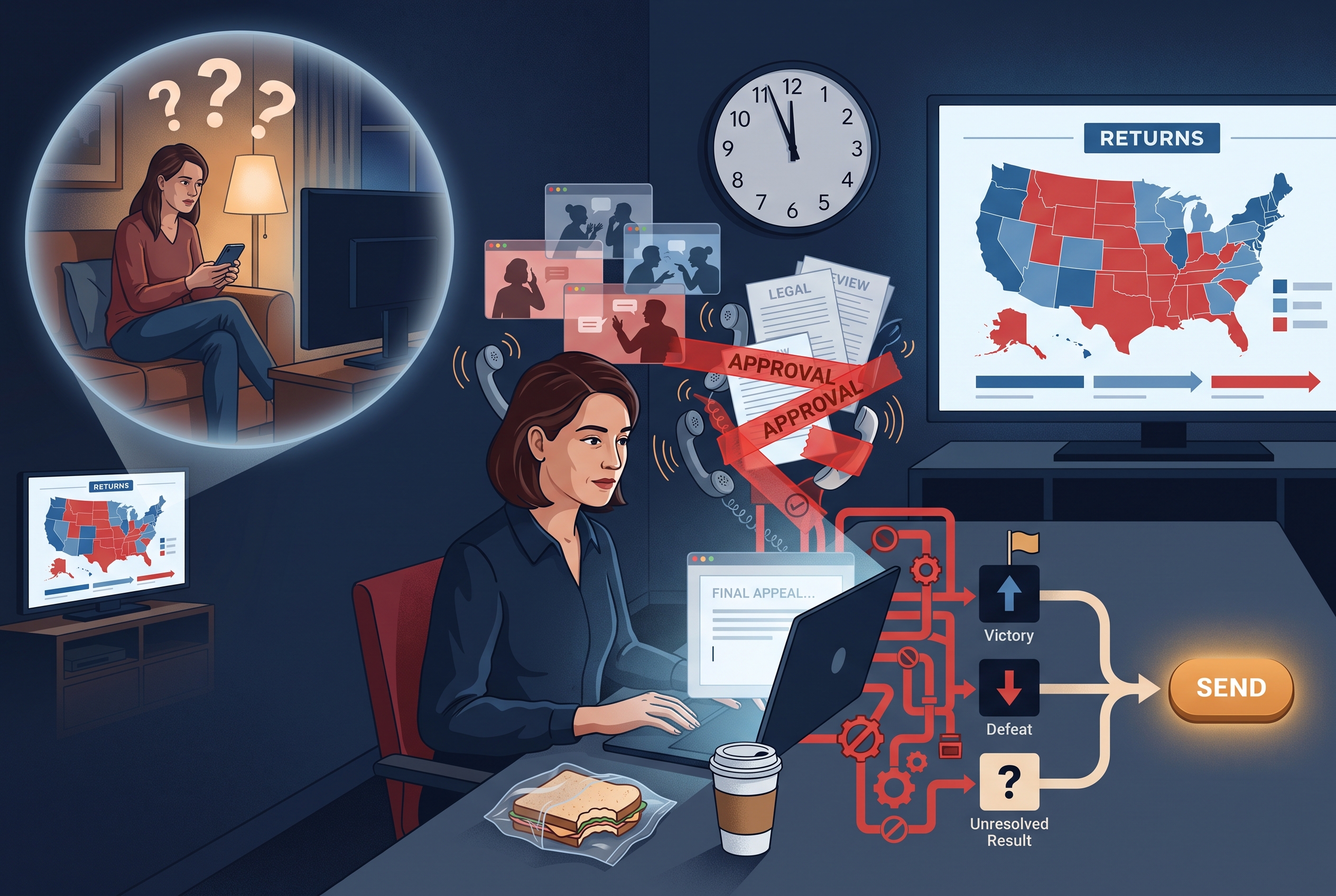
It’s 11:47 on election night November 3rd.
A fundraiser named Susan is sitting alone in the office conference room, half a sandwich beside her laptop and coffee long since gone cold. She’s has been told not to write anything until the organization knows what happened in this year’s mid-terms.
Nobody knows what happened.
The television network says the race is too close to call. The executive director is texting the board chair who’s consulting someone described only as “our political person.” The organization’s lawyer has gone to bed.
Susan watches the numbers change. At 12:16, her phone lights up. “We should send something” proclaims the Executive Director, a touch of panic and uncertainty in his voice. And so begins another episode of what the nonprofit industry calls “rapid-response fundraising.”
There will be a Zoom call. Then another Zoom call to discuss what was decided on the first Zoom call. Someone will suggest “meeting the moment.” Someone else will ask whether the moment has been approved by counsel. By the time the organization meets the moment, the moment will be showered, dressed and halfway through the rest of the week. This is not rapid response. It is delayed panic with a donation button.
The Election Was Not a Surprise
Election Day has been on the calendar for years. The possible outcomes are not hidden in the Dead Sea Scrolls and there are only three: Your side can win; Your side can lose; or the result can remain undecided while television anchors stare at electronic maps and Steve Kornacki explains, once again, that Pennsylvania has 67 counties and California is very slow in counting votes.
Three possibilities. Yet far too many organizations will wait until election night before deciding what each outcome means, what they should say about it and what they want donors to do next.
They will begin writing at precisely the moment when they should be communicating. And while they are writing, revising, circulating and seeking the approval of a board member attending a spa retreat in Sedona, the donor’s emotion will begin to fade.
Emotion Does Not Wait for Legal
People act on what moves them now. Immediate emotions influence the decision to give. Anger can move people, sadness can move people, so can hope and happiness But an emotion is not a canned ham. You can’t put it on a shelf and expect it to be waiting six days later.
On election night, a donor may feel relief, or fear, or fury. She may have spent months knocking on doors, talking to neighbors, sending postcards or arguing with her brother-in-law. Now she is sitting in her living room watching the returns come in. She wants to know what happened and what it means. And, more than anything, she wants to know whether there is still something she can or needs to do.
That is the moment a good organization meets her—not merely with an institutional announcement, but with a role. Bad fundraising says, “Here is our reaction.” Good fundraising says, “Here is what happens next, and here is what you can do and why you matter.”
One Appeal Cannot Survive Three Different Elections
The all-too-usual organizational shortcut is to prepare one basic message and swap out the first few paragraphs. If the election goes well: “Thanks to supporters like you, we achieved an historic victory.” If it goes badly: “Despite the heroic efforts of supporters like you, we suffered a devastating setback.” If nobody knows: “As we await the final results of this historic election….”
Then comes the same beige paragraph about the organization’s 43-year history, the same mission statement and the same red DONATE button. This is not scenario planning. It’s fundraising taxidermy. The organization has taken a dead appeal, propped it upright and dressed it for three different occasions.
A victory, a defeat and an unresolved election create entirely different emotional moments.
- A victory message should not stop at celebration. If it does, it tells the donor the job is finished: We won. Now the people we elected must keep their promises. Here is how we will hold them to those promises—and how you can help.
- A defeat message must do more than scream that the sky has fallen and request $25 for roof repairs: We lost this vote. We did not lose our purpose. Here is what remains, what is threatened and what we are going to do Monday morning.
- An unresolved result calls for something rarer in fundraising: steadiness. The outcome is not yet known. Every legitimate vote must be counted. Here is what we know, what we do not know and what your support enables us to protect while the process continues.
Victory calls for momentum. Defeat calls for resolve. Uncertainty calls for trust. Those are three different donor needs and they require three different messages. Changing the adjectives will not do it.
Everybody Else Wants Her Attention
According to the M+R Benchmarks, nonprofits sent an average of 31 fundraising emails per subscriber in 2025. The average fundraising-email response rate was 0.05%—about one donation for every 2,000 messages sent.
That is the ordinary inbox. During an election, campaigns, parties, PACs, candidates, advocacy organizations and a collection of barely housebroken political committees all come charging into the donor’s inbox.
The messages pile up. URGENT... BREAKING… DEVASTATING… We asked nicely… We’re begging…Roger, is this right? Apparently democracy will perish because I’ve not completed a survey thinly disguised as a fundraising appeal.
Against this cacophony of claims and message clutter, your organization is not entitled to attention merely because its mission is worthy. You must be relevant and credible. Your message must arrive while the donor still feels the event—and before 46 other organizations and politicians tell her what she ought to feel about it.
Speed matters, but speed is not the same as haste. Haste is what happens when you waited too long. Speed is what preparation makes possible.
Write It Before You Know the Outcome
Before Election Day, an organization should have three complete packages ready:
- Victory
- Defeat
- Unresolved outcome
Each should include:
- The email
- A matching donation page
- Subject lines
- SMS copy
- Social posts
- A clear and honest financial need
- The specific action the donor’s gift will make possible
- A designated final approver
- A decision establishing when each version will be used
The core copy can be approved before the votes are counted. Once the result is known, one responsible person inserts the verified facts, adjusts the emotional temperature and sends the message.
This requires neither a futurist nor a six-figure artificial-intelligence consultant. It requires a calendar and the willingness to make decisions during daylight some days ahead.
Prepared Does Not Mean Embalmed
The argument against advance preparation is usually that the message might sound canned. It might. And so might the message written at 1:30 in the morning by seven people sharing a Google Doc and a growing sense of panic.
The cure for canned copy is not procrastination, it is better copy. Begin where the donor is…say plainly what happened…tell her what it means… show her what can still be done and give her a consequential part in doing it. Spare her the organizational autobiography because nobody watching the Republic stagger across an election-night stage is wondering when your strategic plan was last updated or how many PhDs are on the staff.
Preparation is not prophecy. The final facts must be verified and the tone must fit the actual result. Occasionally something will happen that renders part of the prepared copy useless. Fine. Change it.
But starting with 90% of an effective, honest message is better than starting with a blank screen, cold coffee and a board chair who cannot locate the unmute button on that Zoom call.
The Question to Ask Now
If the election were tonight, how many people would have to approve your organization’s response before a donor could read it? If the answer is seven, you do not have a rapid-response program, you have a hostage situation.
If the answer is “we’ll decide after we see what happens,” you have already decided. You have decided to surrender the hour when your donor is most attentive, most emotionally present and most eager to act.
Someone else will reach her first, will give her a job and receive the donation she was ready to make. Susan will still be in the conference room. The sandwich will still be there. At 1:42 a.m., someone will finally approve the subject line. By morning, it will be accurate, maybe even be grammatical. It will also be late.
Preparing the message in advance is not merely an exercise in efficiency, it’s an act of respect. When a donor is prepared to show up for the moment the least you can do is be there when she arrives.
Roger
P.S.
If your approval chain includes the executive director, development director, communications director, general counsel, board chair and “our political person,” start drafting now because come Election Night chances are one of them will be in Sedona when most needed.
P.P.S. For Agitator readers working now on political-oriented campaigns and Election Night appeals I suggest you follow Frank O’Brien’s Path to Persuasion on Substack or his O’Brien on Messages his blog published each Monday.
One response to “Election Night Is Not a Strategy Meeting”
Behavioral Science Q & A
Thanks so much for raising this. Yes, capturing donor information can be helpful for stewardship like newsletters, thank-you letters, impact updates. But how you ask matters. Forcing full data capture introduces friction that can significantly depress conversion, many donors may simply abandon the process. Beyond the friction itself, required fields also shift the emotional experience […]
Read Full Answer
Unlike holidays that everyone already knows, Giving Tuesday is a created event. Many donors recognize the name but not the exact timing, so referencing it becomes a helpful cue. It serves as a reminder and taps into social norm activation (“everyone’s giving today”), which boosts response. However, we still want it paired with the mission, […]
Read Full Answer
When a subject line leads with the match (“Your gift matched!”), it risks triggering market-norm thinking: the sense that giving is a financial transaction rather than an act rooted in values, identity, and care. This shift reduces intrinsic motivation and, over time, can weaken donor satisfaction and long-term engagement. It also makes the email indistinguishable […]
Read Full Answer
There’s no evidence that QR codes suppress mid-value giving; all available research suggests they either help or have no negative effect. In fact, behavioral and usability research consistently shows the opposite: reducing friction at any point in the donation process increases completion rates and total response. And that has nothing to do with capacity and […]
Read Full Answer
What you’re experiencing is very common. Resistance often isn’t about capability, but about motivation quality. If board members feel pushed into fundraising, that triggers controlled motivation (low quality motivation) i.e. obligation, guilt, or fear of judgment, which often results in avoidance. Instead, we need to create conditions for volitional motivation (high quality motivation) by satisfying […]
Read Full Answer
That’s a really thoughtful question, and you’re not the first to raise it. Many of our clients have been cautious about placing the ask at the very end. To address their concern, we’ve tested both approaches, and the results are clear: when the ask comes last, even if that means it appears on the second […]
Read Full Answer
Handy guide, Roger… I love thinking about the midterms. What a night that will be (I hope).