

Every Board Member Has An Excuse.
Every fundraiser has heard some version of the board member excuse when it comes to raising money.
“I don’t know anyone with money.” …“I’m a terrible salesman.”… “I already gave.” …“I’ll help right after the gala.” (The gala, like the horizon, keeps moving.) …“I’d rather write a check than ask for one.” ….“If I ask my friends, they’ll stop returning my calls.”
I’ve heard each one, delivered with a straight face and a glance toward the exit. Nobody is lying, they’re just scared.
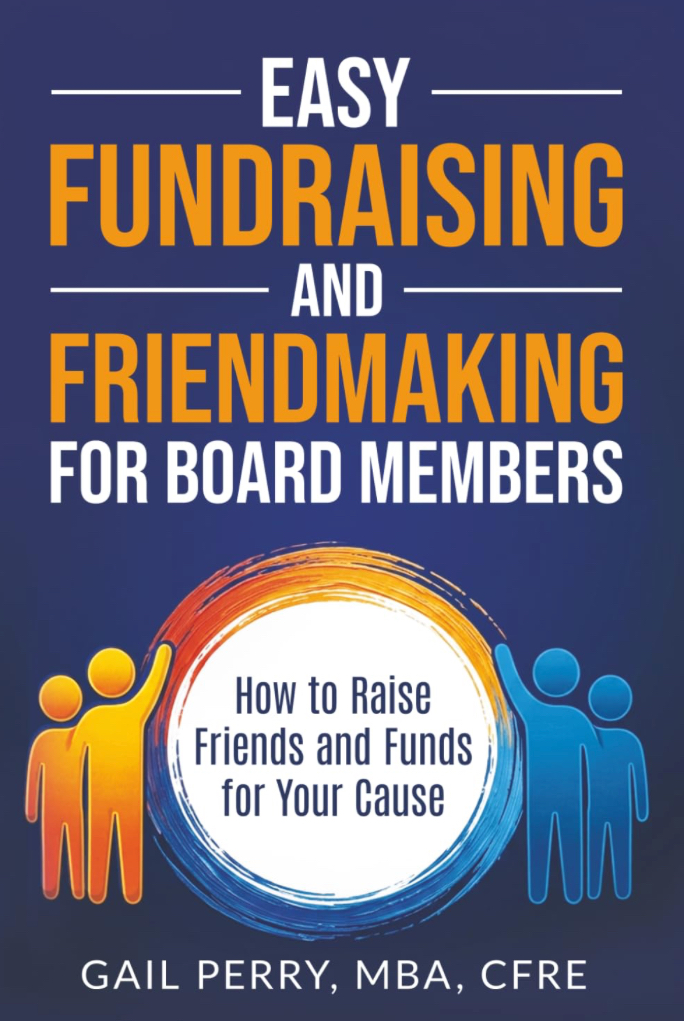 In Easy Fundraising and Friendmaking for Board Members, Gail Perry doesn’t scold the excuses. She hands the trustee a job small enough that the excuse stops applying. Her “Friends First Model” splits board work into four roles: Ambassador, Influencer, Occasional Asker and Steward. Trustees need only one. Here is what each job looks like.
Role # 1: Ambassador: spread the word, then invite people in.
Gail wants trustees to be “sneezers,” meaning people who talk about the cause wherever they already are, such as the gym, the hair salon and the family dinner, without making a pitch.
Next comes the invitation. Her main tool is the small social event, an informal gathering at a trustee’s home or porch whose only purpose is to introduce friends to the organization. It follows four rules:
- A board member does the inviting.
- Guests pay nothing.
- Nobody asks for money.
- The trustee plans the follow-up before the party.
The program takes about 12 minutes: the host says why they care, then a staff leader gives a short message. The rest of the time is conversation.
Gail reports she once hosted such a party on her porch for the Carolina Ballet, where she served on the board. About thirty people came to meet the new artistic director. She introduced one guest, a venture capitalist whose daughter was a dancer, to a staff member. He later became board chair and a key funder.
After any social, Gail thanks each guest and asks, “What were your impressions?” She also recommends tours of about an hour. At one medical center, staff and clinicians told short stories at each stop, starting with the receptionist.
Role #2: Influencer: make one call.
At University of North Carolina’s business school, Gail asked a trustee to phone a corporate CEO with two sentences of support. The gift arrived and the job took no elaborate ask, no meeting and no script.
Role #3: Advice visits: 30 minutes mostly listening.
An advice visit is a one-on-one conversation with someone who might care about your cause, and it has one rule: nobody asks for money. A trustee picks up the phone or sends an email: “We’re exploring a new project and would love your perspective. Can we come talk with you about it?” Most people say yes. Asking for someone’s judgment flatters them, and it respects their time.
Then the trustee stops talking. Perry quotes a Bridgespan partner: the biggest mistake in a thirty-minute donor meeting is a thirty-minute pitch. Give five minutes of presentation and leave twenty-five for questions. Her other rules: get out on time, even when the donor still has more to say. Let the donor do the talking. Follow up fast, because the energy fades.
Perry’s Raleigh example shows the payoff. She called a well-known community leader about a project to help struggling high schools and asked to “pick his brain.” He agreed at once. She gave him just enough context, then asked for advice. When he started saying “we” instead of “you,” she knew he had bought in. He named several funders and offered to make the introductions.
Role #4: Steward: the two-minute thank-you.
Eight in ten first-time donors never give again. Perry cites Penelope Burk’s research that donors who got a personal thank-you call from a board member gave 39% more the next time. At a women’s center auction, a top bidder told her no board member had ever called him. The next year he bought a table and brought the CEO of the state’s largest foundation. At a hospital “thankathon,” one reluctant trustee had a warm chat with a former patient. Two weeks later, an unsolicited $10,000 arrived.
None of this is theory. I’ve watched Gail apply a seemingly inexhaustible supply of enthusiasm and skill for 20+ years, giving practical advice that every nonprofit will find helpful and smaller, understaffed organizations find especially so.
When the Asking Day Arrives
Gail treats the ask as the last stretch of a long walk, and she gives trustees a tool for each part.
Before the ask, five questions. Gail’s five Power Questions are a pathway a trustee follows over several conversations, at the donor’s pace, not a script. They start with “How did you come to be a donor?” and move through “What resonates with you most about our work?”, “Tell me more,” and “What do you like to focus on in your giving?” The fifth is the turn: “Would you like to know how you can help?” When the donor says yes, the gift conversation has begun, and the donor chose to start it.
At every step, three habits: Listen. Ask. Watch. When a trustee doesn’t know what to do next, Gail says to fall back on these: Listen and don’t be rehearsing your next sentence. Ask open questions, and ask permission before each move, even permission to ask for the gift. Watch the donor’s face, posture and tone. If the energy drops, slow down and ask a gentle question.
On the day, eight steps.
- Thank the donor, confirm why you’re meeting, and ask whether they’re comfortable starting.
- Ask them to tell you “again” what first drew them to the cause. The word signals you have been listening all along, and the donor ends up making your case in their own words.
- Repeat back what you heard.
- Describe what is possible, starting with “Wouldn’t it be wonderful if…”
- Ask with three words, “Would you consider…” Lead with the impact, then name the project, then the amount. Perry’s example: 500 more children in a program over three years, then a $100,000 gift.
- Stop talking. Gail’s line: whoever speaks first after the ask loses. The donor needs time to think.
- Welcome questions and options such as a multi-year pledge or a gift of stock.
- Agree on next steps and follow up promptly. Many donors decide later.
The “I give my time” excuse.
Gail takes on this excuse directly. Trustees should make a “proud personal gift” sized to their means, without a give-or-get quota. As governance chair, she told candidates that everyone on the board gave at least $1,000 and that no one had to match it.
One chapter title deserves a second look. Chapter 29 is called “Succeeding With the Formal Gift Conversation: How to Ask and Never Get Turned Down.” The chapter itself is honest. Gail says many donors won’t decide in the meeting and that questions are a good sign. But the first-time asker, the reader this book is written for, may take the subtitle literally. Then comes “let me think about it,” and the trustee decides they did something wrong. “How to Ask Well, Whatever the Answer” or “How to Ask Without Fear of No” would promise what the chapter delivers: less dread, not zero rejection.
Buy a copy for every trustee before the next board meeting. Tell each one to pick a role and mark that chapter. Then retire the excuses.
— Roger Craver
P.S. If you read one chapter before your next board meeting, read Chapter 14, the Steward chapter (pages 80–85). A two-minute thank-you call is the easiest job on the list. Hand each trustee three donors’ names and a phone as you head into year-end giving season.
3 responses to “Every Board Member Has An Excuse.”
Leave a Reply
Leave a Reply
Behavioral Science Q & A
Thanks so much for raising this. Yes, capturing donor information can be helpful for stewardship like newsletters, thank-you letters, impact updates. But how you ask matters. Forcing full data capture introduces friction that can significantly depress conversion, many donors may simply abandon the process. Beyond the friction itself, required fields also shift the emotional experience […]
Read Full Answer
Unlike holidays that everyone already knows, Giving Tuesday is a created event. Many donors recognize the name but not the exact timing, so referencing it becomes a helpful cue. It serves as a reminder and taps into social norm activation (“everyone’s giving today”), which boosts response. However, we still want it paired with the mission, […]
Read Full Answer
When a subject line leads with the match (“Your gift matched!”), it risks triggering market-norm thinking: the sense that giving is a financial transaction rather than an act rooted in values, identity, and care. This shift reduces intrinsic motivation and, over time, can weaken donor satisfaction and long-term engagement. It also makes the email indistinguishable […]
Read Full Answer
There’s no evidence that QR codes suppress mid-value giving; all available research suggests they either help or have no negative effect. In fact, behavioral and usability research consistently shows the opposite: reducing friction at any point in the donation process increases completion rates and total response. And that has nothing to do with capacity and […]
Read Full Answer
What you’re experiencing is very common. Resistance often isn’t about capability, but about motivation quality. If board members feel pushed into fundraising, that triggers controlled motivation (low quality motivation) i.e. obligation, guilt, or fear of judgment, which often results in avoidance. Instead, we need to create conditions for volitional motivation (high quality motivation) by satisfying […]
Read Full Answer
That’s a really thoughtful question, and you’re not the first to raise it. Many of our clients have been cautious about placing the ask at the very end. To address their concern, we’ve tested both approaches, and the results are clear: when the ask comes last, even if that means it appears on the second […]
Read Full Answer
Great summary of this foundational book. In my 45 years in this field, this is EXACTLY how I counsel boards to proceed — and Gail has brought it all together beautifully. What I really love about this is it’s so very HUMAN. I’ve often found the best fundraising is a lot of common sense. If we just consider what it takes to develop and sustain a friendship, the blueprint for successful donor relationship building becomes clear.
We invite someone we just met to engage with us.
We thank them for doing so.
We then show them we listened to them and liked them and would love to get to know them better.
After that, we reach out with intention. No ghosting!
And then we keep inviting them to do more things with us… until they come to consider us members of their family.
That’s when the giving begins!
Reframing it this way for board members demystifies the process of “giving and getting” so it’s no longer scary.
Thank you Roger, and thank you Gail.
I love everything that Gail has laid out in this wonderful book. It’s an “ah, that’s not so scary” moment for Trustees. The “proud personal gift” points to the most essential aspect of board giving, “do I love the cause and trust the organization,” or am I on the board for personal reasons? When trustees love the cause and trust the organization, we can help them mine their personal experiences with the organization, what Matthew Dicks describes as 5-second moments. When Trustees, tap into their 5-second moments and tell those simple, genuine stories, it’s infectious. People want to know more. Then, we’re not just getting gifts, we’re building a band of believers.
Roger, thank you. Coming from you, this means the world.
You captured exactly what I hoped the book would do. Board members aren’t lazy. They’re scared. So give them one small job they can actually do.
My hope? That boards read this before year-end and each trustee picks one role. Make one call. Host one porch party. Organize a thankathon. These small steps can create momentum.
And point taken on the Chapter 29 title. “How to Ask Without Fear of No” is better. I may steal it! You are the world’s best wordsmith!
Gratefully,
Gail