

Fundraising At or With?
Does your fundraising start with:
“Who should we send this appeal to?”
Or with:
“What should we say to this person?”
That distinction isn’t about creative talent, it’s about which operating system you’re running. The Volume Machine model runs on a presumption that asking is the most important activity and sameness is the efficiency lubricant for the grinding gears.
Inside that system, the natural question becomes, “Who can we send this to?” because the appeal already exists and the machine needs fuel.
Another way to think of this is what we call bookend fundraising.
Brand on one end of the shelf, Program on the other. In between are Issue A, B, C or maybe Program X, Y, Z. The organization defines the story and distributes it at scale, hoping donors will see themselves inside it. Some will, most won’t. Not because they lack care or conviction, but because the story was not built around their identity in the first place and searching for it is too much mental effort.
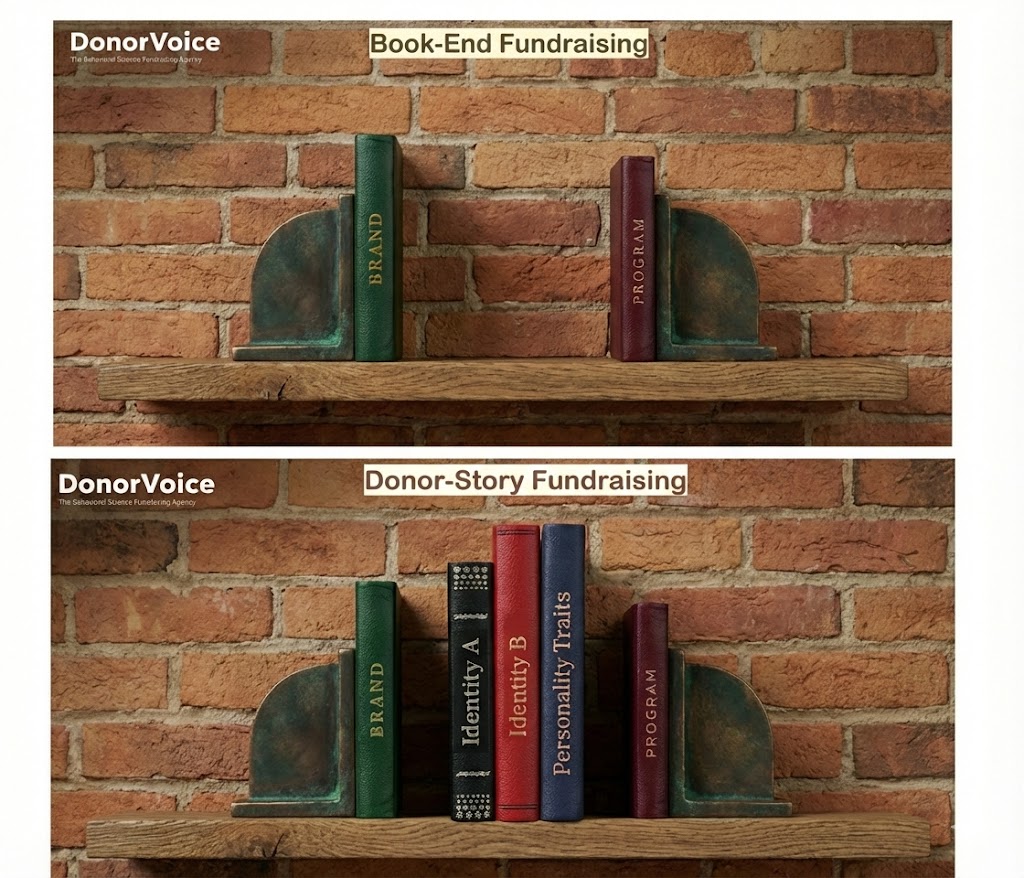
Brand and program are necessary, they provide context and credibility. But they’re supporting characters, the lead role belongs to the donor’s identity.
The alternative is the Human Operating System, designed to foster the conditions that make saying yes the easier choice. This fundraising model creates a donor aligned story and rationale.
- The flora person is not the same as the fauna one if you’re a conservation charity.
- Nor is a Veteran the same as a Parent, two identities that might explain giving to the same food bank situated near a military base.
It doesn’t strain or tax the imagination to see how the story, image and issue or program should change to better fit the values and goals of those examples.
And what of the Conscientious Veteran motivated by duty and stewardship as compared to the Open Veteran motivated by exploration and future possibility. Same cause, same story, different narrative frame.
The Human Operating System doesn’t try to push harder, instead it aligns message with identity and personality so the donor does not have to perform mental gymnastics to connect the dots.
The Volume Machine optimizes for operational efficiency – e.g. uniform creative, broad distribution, predictable cadence.
The Human Operating System optimizes for psychological alignment and yes, introduces a tad more complexity but only because humans are complex. The tradeoff is clear, as are the industry trends of the last 10-15 years.
Kevin
2 responses to “Fundraising At or With?”
Behavioral Science Q & A
Thanks so much for raising this. Yes, capturing donor information can be helpful for stewardship like newsletters, thank-you letters, impact updates. But how you ask matters. Forcing full data capture introduces friction that can significantly depress conversion, many donors may simply abandon the process. Beyond the friction itself, required fields also shift the emotional experience […]
Read Full Answer
Unlike holidays that everyone already knows, Giving Tuesday is a created event. Many donors recognize the name but not the exact timing, so referencing it becomes a helpful cue. It serves as a reminder and taps into social norm activation (“everyone’s giving today”), which boosts response. However, we still want it paired with the mission, […]
Read Full Answer
When a subject line leads with the match (“Your gift matched!”), it risks triggering market-norm thinking: the sense that giving is a financial transaction rather than an act rooted in values, identity, and care. This shift reduces intrinsic motivation and, over time, can weaken donor satisfaction and long-term engagement. It also makes the email indistinguishable […]
Read Full Answer
There’s no evidence that QR codes suppress mid-value giving; all available research suggests they either help or have no negative effect. In fact, behavioral and usability research consistently shows the opposite: reducing friction at any point in the donation process increases completion rates and total response. And that has nothing to do with capacity and […]
Read Full Answer
What you’re experiencing is very common. Resistance often isn’t about capability, but about motivation quality. If board members feel pushed into fundraising, that triggers controlled motivation (low quality motivation) i.e. obligation, guilt, or fear of judgment, which often results in avoidance. Instead, we need to create conditions for volitional motivation (high quality motivation) by satisfying […]
Read Full Answer
That’s a really thoughtful question, and you’re not the first to raise it. Many of our clients have been cautious about placing the ask at the very end. To address their concern, we’ve tested both approaches, and the results are clear: when the ask comes last, even if that means it appears on the second […]
Read Full Answer
This is so powerful and a key transformational concept! Even the older operational efficiency arguments for the standard approach of “Who should we send this appeal to?” fade in the presence of modern personalization options. If we are telling the story of the organization – there’s only one story. We just throw that same message as far and wide as we can. If we are telling the story of the donor (a donor who uses the organization as their powerful instrument of impact to accomplish their philanthropic goals), then we have as many stories as we have donors.
Hi Russell, yes, indeed. The possibility that two neighbors who look the same and give the same to Charity X get different appeals is zero in the “fundraising at” universe. In the more realistic universe where neighbors might differ in their reason for support, the door is open to different appeals.