

Have we made ignoring the appeal effortless?
Past giving predicts future giving. That’s useful for deciding whom to ask, but it becomes circular when we mistake prediction for understanding.
For this reason, I used to dismiss behavior beyond its predictive value but I overlooked an important mechanism: repetition in a familiar setting can make a response automatic.
The chart shows why this matters. An occasional behavior is caused more by being deliberate, weighing the choice and making it. But routine behaviors are more automatic, the repetition crowds out the deliberation part.
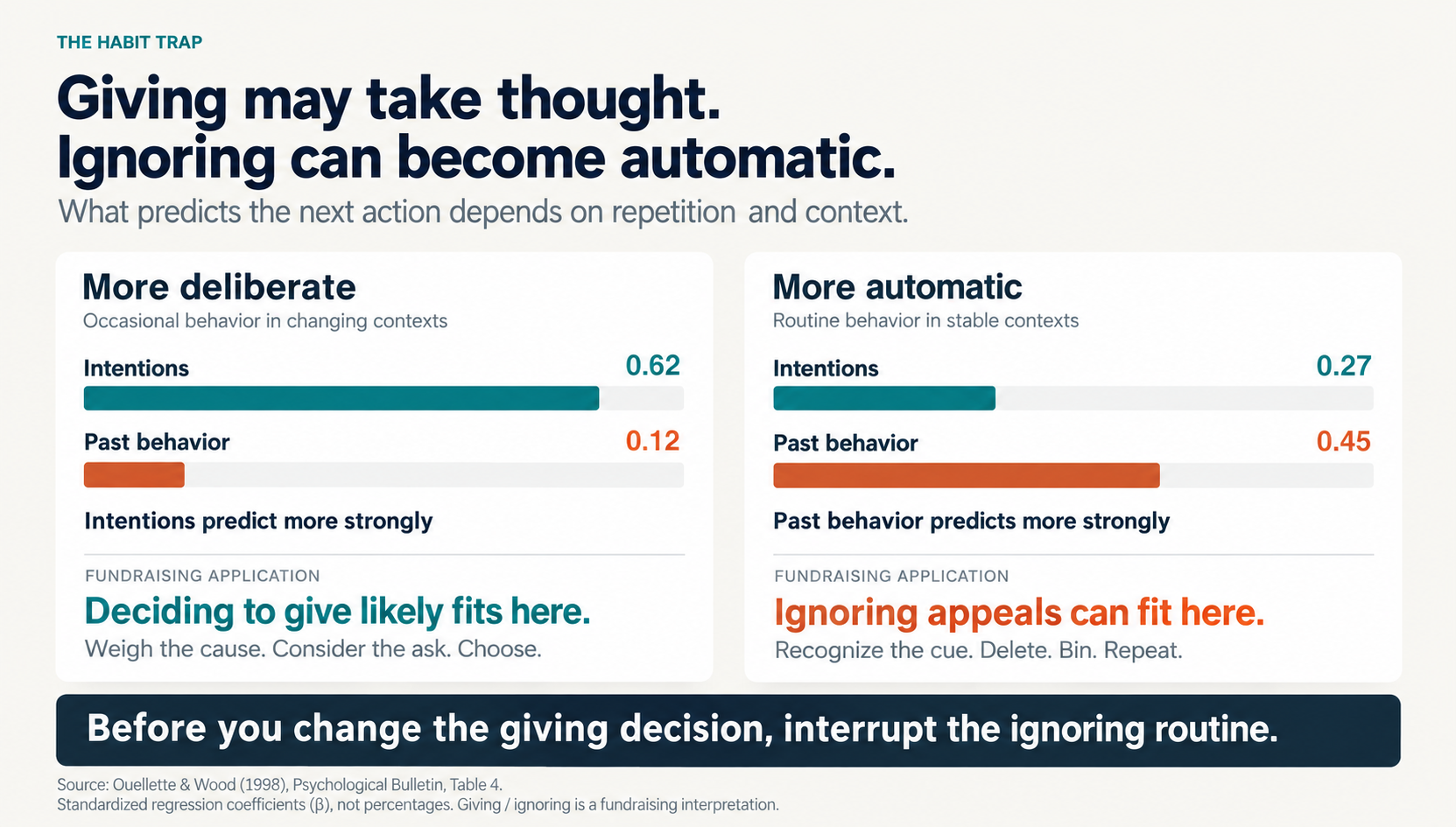
Which fundraising behavior gives people the most repetition? Not giving.
Donating tends to involve at least some deliberate thought. Ignoring another appeal takes much less effort. The envelope goes in the bin, the email gets deleted. Familiar cues can trigger a practiced response before the pitch gets a hearing.
Someone may care about your cause while barely registering your invitation to support it. The familiar envelope, the faux urgency, the same matching gift offer, the interchangeable premiums can all announce: another one of those.
We may be testing the words inside an appeal that people have learned to dismiss before reading. So, instead of starting with “What should our next appeal say?”, start with the dismissal routine: When and where does it happen, and what signals that this is another message to ignore?
The cue is what people recognize: the sender, envelope, subject line, design or familiar offer. The context is what they’re doing when they encounter it: clearing their inbox, sorting mail, reading something relevant or actively thinking about the cause.
That gives us a framework for generating tests:
| Keep the familiar cue | Change the cue | |
|---|---|---|
| Keep the familiar context | Your baseline. What happens when people encounter the usual signals in the usual setting? | Interrupt recognition. What could make someone pause before categorizing this as another appeal? |
| Change the context | Interrupt the routine. Where or during what activity might the familiar invitation receive more deliberate consideration? | Create a fresh encounter. What combination of setting and signal could make this invitation worth evaluating anew? |
For each idea, complete this sentence:
“When people encounter ___ while ___, they tend to ___. We’ll change ___ so they have a reason to ___ instead.”
Name the replacement behavior. “Pay attention” is too vague. Read the first sentence, examine the evidence, consider the need or choose whether to help gives the test a clearer purpose.
Then apply three checks:
- Does this change something people encounter before dismissal? If the change is buried inside unread copy, it cannot interrupt that first response.
- Does it give them a worthwhile alternative? Surprise can interrupt recognition; relevance or curiosity must justify continuing.
- Does it improve giving enough to justify the cost? More attention is an intermediate result, not the fundraising outcome.
Kevin
Behavioral Science Q & A
Thanks so much for raising this. Yes, capturing donor information can be helpful for stewardship like newsletters, thank-you letters, impact updates. But how you ask matters. Forcing full data capture introduces friction that can significantly depress conversion, many donors may simply abandon the process. Beyond the friction itself, required fields also shift the emotional experience […]
Read Full Answer
Unlike holidays that everyone already knows, Giving Tuesday is a created event. Many donors recognize the name but not the exact timing, so referencing it becomes a helpful cue. It serves as a reminder and taps into social norm activation (“everyone’s giving today”), which boosts response. However, we still want it paired with the mission, […]
Read Full Answer
When a subject line leads with the match (“Your gift matched!”), it risks triggering market-norm thinking: the sense that giving is a financial transaction rather than an act rooted in values, identity, and care. This shift reduces intrinsic motivation and, over time, can weaken donor satisfaction and long-term engagement. It also makes the email indistinguishable […]
Read Full Answer
There’s no evidence that QR codes suppress mid-value giving; all available research suggests they either help or have no negative effect. In fact, behavioral and usability research consistently shows the opposite: reducing friction at any point in the donation process increases completion rates and total response. And that has nothing to do with capacity and […]
Read Full Answer
What you’re experiencing is very common. Resistance often isn’t about capability, but about motivation quality. If board members feel pushed into fundraising, that triggers controlled motivation (low quality motivation) i.e. obligation, guilt, or fear of judgment, which often results in avoidance. Instead, we need to create conditions for volitional motivation (high quality motivation) by satisfying […]
Read Full Answer
That’s a really thoughtful question, and you’re not the first to raise it. Many of our clients have been cautious about placing the ask at the very end. To address their concern, we’ve tested both approaches, and the results are clear: when the ask comes last, even if that means it appears on the second […]
Read Full Answer