

Headline: Volunteering is a gateway to giving.
Volunteering as gateway to increased giving, that feels wholesome and easily worthy of a conference keynote slide next to a stock photo of smiling people in matching t-shirts.
This headline is from a large, randomized field experiment with nearly 150,000 people connected to a science/environment nonprofit. The charity isn’t named but I infer it’s probably 150k who signed up for an app tied to this charity, a birder app or the like.
None of the 150k had ever donated or volunteered and they were randomly assigned to test and control journeys.
The control (and test) got 21 non-ask emails that aren’t fully described but at least some promote a citizen science volunteer opportunity. Apparently the control condition was “light psychological siege.”
The treatment group received 3 additional emails promoting this volunteer, citizen science opporutnity.
The test and control got an email solicitation 7 weeks after this 21 (or 24) email barrage.
And guess what, people exposed to the extra volunteer emails donated later at higher rates. Case closed, write the paper, do the conference session.
Not exactly. The data tell a more interesting story. Volunteer rates did increas slightly in the test: 5.72% → 6.29%.
But look at donation rates.
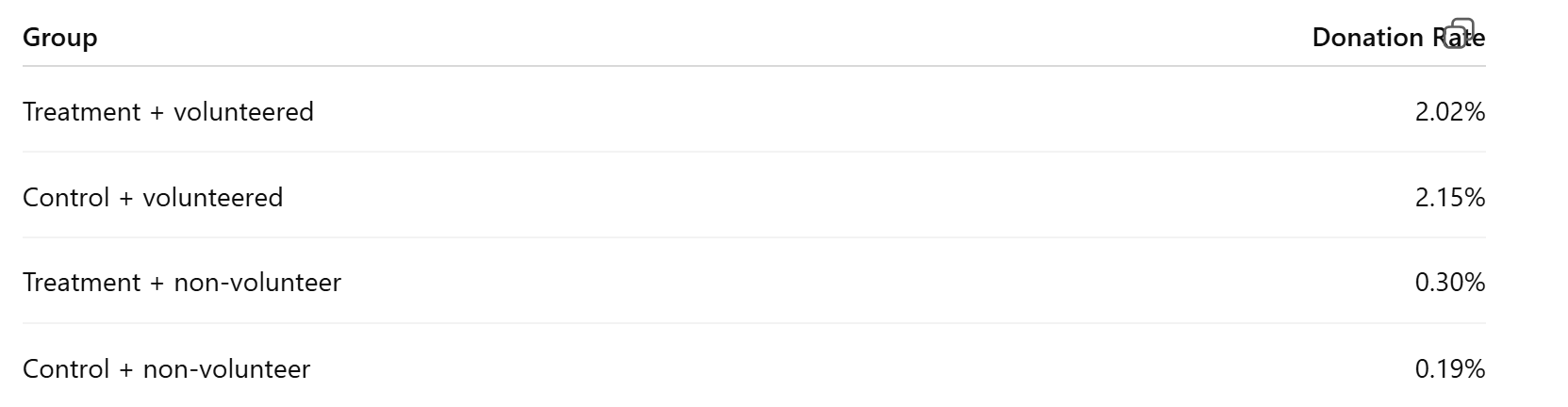
Among those who actually volunteered, donation rates did not improve. In fact, treatment volunteers donated at a slightly lower rate than control volunteers: 2.02% vs 2.15%. Your extra emails promoting the option to the group most interested in it made things slightly worse.
Meanwhile, the biggest increase in donors came from people who never volunteered at all. Treatment non-volunteers donated at a meaningfully higher rate than control non-volunteers: 0.30% vs 0.19%.
The study doesn’t addresss any of this but doesn’t it seem the mechanism causing increased giving isn’t volunteering itself?
Maybe the extra communications increased:
- app engagement
- mission salience
- familiarity
- perceived value
- psychological proximity to the organization
They were digitally acquired users participating in a platform with a citizen science option. The “volunteering” itself was submitting observations through the app. That starts to sound less like traditional volunteerism and more like: “people who became slightly more engaged with a mission-driven product later became slightly more willing to support it financially.”
That’s a very different interpretation and probably more useful as relationship formation often happens before visible conversion events.
Someone may:
- open more emails
- use the app more
- consume more content
- feel more connected
- perceive more value
- think about the organization more often
…without ever crossing the CRM threshold that says: VOLUNTEER = YES.
But the paper frames volunteering as the causal mechanism. The data seem to tell a broader story. Sometimes people give because they volunteered. Sometimes they give because, after the 24th email, they vaguely feel like they should chip in for the app they’ve been enjoying for free.
And for the people who were always inclined to do the thing you wanted them to do, more does not equal better.
Kevin
Behavioral Science Q & A
Thanks so much for raising this. Yes, capturing donor information can be helpful for stewardship like newsletters, thank-you letters, impact updates. But how you ask matters. Forcing full data capture introduces friction that can significantly depress conversion, many donors may simply abandon the process. Beyond the friction itself, required fields also shift the emotional experience […]
Read Full Answer
Unlike holidays that everyone already knows, Giving Tuesday is a created event. Many donors recognize the name but not the exact timing, so referencing it becomes a helpful cue. It serves as a reminder and taps into social norm activation (“everyone’s giving today”), which boosts response. However, we still want it paired with the mission, […]
Read Full Answer
When a subject line leads with the match (“Your gift matched!”), it risks triggering market-norm thinking: the sense that giving is a financial transaction rather than an act rooted in values, identity, and care. This shift reduces intrinsic motivation and, over time, can weaken donor satisfaction and long-term engagement. It also makes the email indistinguishable […]
Read Full Answer
There’s no evidence that QR codes suppress mid-value giving; all available research suggests they either help or have no negative effect. In fact, behavioral and usability research consistently shows the opposite: reducing friction at any point in the donation process increases completion rates and total response. And that has nothing to do with capacity and […]
Read Full Answer
What you’re experiencing is very common. Resistance often isn’t about capability, but about motivation quality. If board members feel pushed into fundraising, that triggers controlled motivation (low quality motivation) i.e. obligation, guilt, or fear of judgment, which often results in avoidance. Instead, we need to create conditions for volitional motivation (high quality motivation) by satisfying […]
Read Full Answer
That’s a really thoughtful question, and you’re not the first to raise it. Many of our clients have been cautious about placing the ask at the very end. To address their concern, we’ve tested both approaches, and the results are clear: when the ask comes last, even if that means it appears on the second […]
Read Full Answer