

Know or Listen to Those Who Know
Frank O’Brien has spent four decades helping some of the sector’s most consequential organizations—Doctors Without Borders, the ACLU, Planned Parenthood, Oxfam—find the words that move people.
I’ve known, competed with, and admired Frank’s commitment, dedication and skill ever since he arrived in Washington, D.C. 40+ years ago. Not only does he know what works, he has the receipts to prove it.
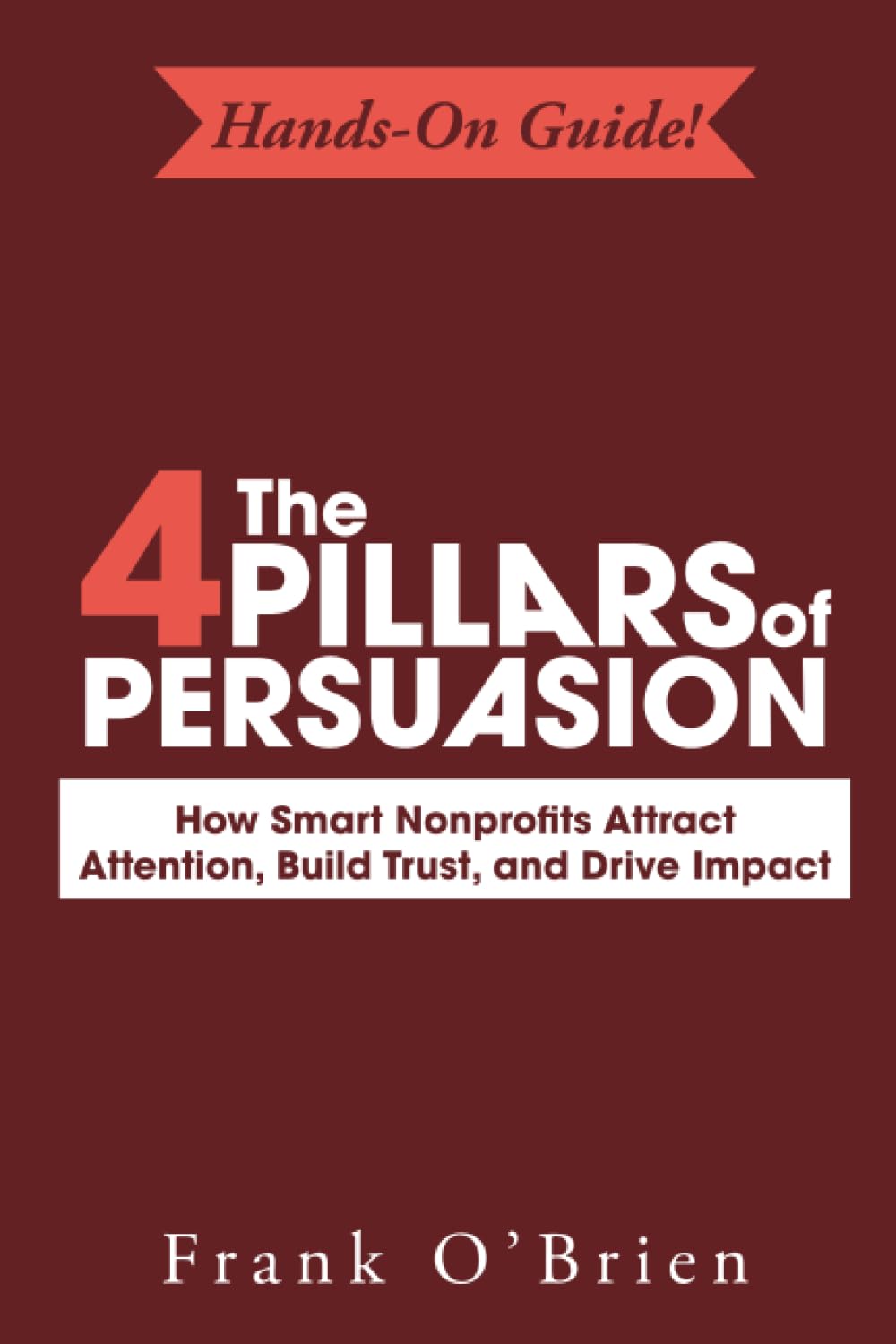
And in The 4 Pillars of Persuasion: How Smart Nonprofits Attract Attention, Build Trust, and Drive Impact , published yesterday, he’s organized those four decades of hard-won experience into a framework that is a genuinely useful hands-on guide.
That’s the good news. The better news is the framework is right. Attention, Audience, Emotion, Craft—these are the factors that actually determine whether your fundraising copy works or ends up in the delete folder. Frank doesn’t dress them up with academic jargon or hedge them with qualifications. He says what he means, shows you examples, and moves on.
A detail worth noting before you crack the spine: the very first page of this book carries a QR code with the prompt “Keep Learning After You Read This Book.” That’s not the usual publisher’s boilerplate. It’s an invitation to the reader to stay updated by subscribing to his free Monday on Message memo on persuasive messaging. Most of all it’s a signal about Frank’s entire operating philosophy—persuasion is a living practice, not a set of tactics you master once and file away. The book earns that posture.
What O’Brien Gets Dead Right
Start with Pillar One: Attention. Frank’s framing here is surgical. The failure mode he names is not “not enough content”—it’s the wrong relationship to attention itself. “Don’t just be an episodic distributor of information,” he writes. “Act like an ‘always on’ architect of attention.” That distinction matters. Most nonprofits manage output. They count emails sent, pieces mailed, posts published. Frank asks a different question: are you systematically moving people through an Attention→Intention→Action pipeline? If you don’t know how to answer that, Chapter 1 will tell you where to start.
Pillar Two: Audience is where O’Brien’s decades show most clearly. His insistence on writing to one specific person—not a segment, not a persona, not a cohort—is the oldest truth in direct response and the most persistently violated. “Who are you writing to?” He says it’s the first question he asks every copywriter on every project. It should be. Most nonprofit copy reads like it was written to everyone, which means it was written to no one. The moment a writer starts thinking about a group, Frank notes, the writing shifts away from “whispering something important into the ear of a close friend” and becomes a broadcast. That shift kills response.
On Pillar Three: Emotion—Frank offers something valuable: he complicates the conventional wisdom. “Lead with emotion” is not wrong, but it’s not sufficient. The emotions you invoke must fit the moment, fit your organization’s personality, and fit the narrator delivering them. His treatment of the identifiable victim effect, the power of surprise, and the six emotional roadblocks is the best single chapter I’ve read on this subject in years. His point on surprise alone is worth the price of admission: when was the last time you genuinely surprised your audience? If your most recent appeal’s recipient could have predicted the content before opening it, you’ve already lost them..
The chapter on the Intention-to-Action Gap belongs in Pillar Four on Craft, and it’s worth the price of the book by itself. Frank lays out the behavioral science behind why donors intend to give and then don’t—and more importantly, what to do about it: build implementation intentions into your messaging, answer the “why now” question explicitly, eliminate friction, link giving to identity, deploy social proof at the moment of decision. This is not theory. This is architecture. I have watched organizations bleed donors for years by ignoring exactly what Frank spells out here.
His AI guidance in Pillar Four deserves a separate mention. “Don’t use AI to think for you,” he writes. “Use it as a devil’s advocate to stress test your thinking.” He goes on to specify: test your assumptions, look for flaws in your logic, identify supporting information, surface facts you overlooked, find language that reads two different ways. Amen. The sector is currently drowning in AI-generated copy that sounds like it was written by a committee of algorithms optimizing for inoffensiveness. Frank’s human-first stance is correct. Save AI for research, devil’s-advocate testing, and bite-sized edits. Don’t forfeit the writing. If you forfeit writing, you forfeit thinking.
Where the Book Pulls Some Punches
Here’s where I have to be direct with Frank, as I would be with any colleague whose work I respect.
The book is written primarily for communicators and copywriters. That’s fine—they need this material. But the organizations that most desperately need the 4 Pillars framework are the ones whose leadership has never thought carefully about audience, emotion, or craft in their lives. Boards that green-light messaging by committee. CEOs who require every communication to lead with the organization’s founding story. Development directors whose annual appeal hasn’t changed in seven years because “it still works.”
Frank identifies all the failure modes—burying the lede, emotional monotone, generic copy that any organization could send—but he’s somewhat gentle about naming who creates those conditions. The candid answer is: organizational culture and leadership. His Clarity Commandment gets violated not because copywriters don’t know better, but because someone with approval authority insists on inserting mission statement language into the second paragraph of every appeal. That’s a governance and leasership problem. The book mostly treats it as a craft problem.
My only other reservation is the book’s treatment of data. Frank is right that deep audience knowledge requires more than demographics—it requires emotional intelligence about what keeps donors up at night. The book’s framework is strong on qualitative depth but could stand a harder look at the quantitative evidence that most organizations already own but consistently fail to use. Response rates, recency, frequency, giving history, upgrade patterns, lapse triggers—this behavioral data speaks with a precision no focus group can match. It tells you what donors actually do, not what they say they’ll do.
What To Do With It
Buy the book. Read it in full once, then use it as a reference and hands-on guide. Here’s where to start depending on your situation:
- If your copy buries the emotional lead: Go straight to the Emotional Roadblocks section. Read the material on burying the lede. Then apply O’Brien’s test—search your last three donor appeals for where you actually hit your emotional stride, and make that the new opening.
- If your donor retention is eroding: The personal identity material is your entry point. Stop writing copy that asks donors what they’re going to do. Start writing copy that confirms who they already are.
- If your acquisition copy isn’t converting: Work through the Intention-to-Action framework. Run your current acquisition package against Frank’s five-point checklist: Does it build a specific implementation intention? Does it answer “why now”? Does it eliminate friction? Does it link giving to identity? Does it invoke social proof at the point of decision? If the answer to two or more is no, you know where to start.
- If your organization’s copy all sounds the same: Go to the barriers section, specifically the material on generic copy that any organization could send. Frank’s test is surgical: change every organizational reference to a competitor. If the copy still makes sense, you haven’t found your voice yet. Keep writing.
- If you’re bringing a new copywriter on board: Give them the chapters on purposeful storytelling, writing to one person, and the Clarity Commandment. That’s the foundation. Everything else builds on it.
The Bottom Line
Frank O’Brien knows this craft as well as anyone in the sector. The 4 Pillars of Persuasion is smart, honest, and useful. It will make your copy better if you apply it. It will make your organization better if leadership reads it alongside the communications team—which is the part I’m not holding my breath for.
The framework is sound. The examples are real. The advice is specific. And the QR code on page one is not a gimmick—it’s O’Brien saying, in the most direct way possible: this work doesn’t end when you close the book.
What the sector does with it will depend, as always, on whether the people who control the approval process are willing to get out of the way of the people who understand persuasion.
That’s not Frank’s problem to solve. He’s more than done his part.
Roger
P.S. I realize we can’t all get to the top of our trade, and that isn’t the point of life anyway. What’s always troubled me are those folks who, no matter how busy they seem to be, have stopped learning. Frank’s not one of those. His Chapter 25—“Learnings from Beyond the Nonprofit World” – offers a quite marvelous sampler of persuasion takeaways from proven winners ranging from journalists, to novelists, song writers and social scientists that has informed and inspired his work. Don’t miss it.
7 responses to “Know or Listen to Those Who Know”
Behavioral Science Q & A
Thanks so much for raising this. Yes, capturing donor information can be helpful for stewardship like newsletters, thank-you letters, impact updates. But how you ask matters. Forcing full data capture introduces friction that can significantly depress conversion, many donors may simply abandon the process. Beyond the friction itself, required fields also shift the emotional experience […]
Read Full Answer
Unlike holidays that everyone already knows, Giving Tuesday is a created event. Many donors recognize the name but not the exact timing, so referencing it becomes a helpful cue. It serves as a reminder and taps into social norm activation (“everyone’s giving today”), which boosts response. However, we still want it paired with the mission, […]
Read Full Answer
When a subject line leads with the match (“Your gift matched!”), it risks triggering market-norm thinking: the sense that giving is a financial transaction rather than an act rooted in values, identity, and care. This shift reduces intrinsic motivation and, over time, can weaken donor satisfaction and long-term engagement. It also makes the email indistinguishable […]
Read Full Answer
There’s no evidence that QR codes suppress mid-value giving; all available research suggests they either help or have no negative effect. In fact, behavioral and usability research consistently shows the opposite: reducing friction at any point in the donation process increases completion rates and total response. And that has nothing to do with capacity and […]
Read Full Answer
What you’re experiencing is very common. Resistance often isn’t about capability, but about motivation quality. If board members feel pushed into fundraising, that triggers controlled motivation (low quality motivation) i.e. obligation, guilt, or fear of judgment, which often results in avoidance. Instead, we need to create conditions for volitional motivation (high quality motivation) by satisfying […]
Read Full Answer
That’s a really thoughtful question, and you’re not the first to raise it. Many of our clients have been cautious about placing the ask at the very end. To address their concern, we’ve tested both approaches, and the results are clear: when the ask comes last, even if that means it appears on the second […]
Read Full Answer
Love it, Roger, Frank. Always be learning! Thank you for adding this book to the list. Cheers, erica
Excellent dissection, Roger. Bought.
Roger, Thanks so much for the review. That my work hit home with you really means a lot. And I’m taking those places I pulled the punches to heart — including pushing to get the book in the hands of board chairs, CEOs, comms directors and others who too often block the path to persuasion.
Just bought copies for my entire team (and myself of course).
Joe Cross, Great to hear. Your team all exploring the book’s advice together is definitely the way to go. Hope you’ll let me know how it works out.
Thank you for this, Roger. Bought and can’t wait to read!
It’s all about trust, and I trust Roger and I trust Frank. Can’t wait to read the book.