

Mobile Giving and the Department of Me
You hear “mobile optimization” and likely think make the text readable, shorten the form, enlarge the button. But the device may also change what message works best. We’ve given considerably more thought to where the donor’s finger goes than where their attention goes.
Our phones are highly personal possessions, holding conversations, photos, favorite music and a potentially embarrassing record of what you find interesting. Its usage inherently brings your preferences, feelings and beliefs more sharply into focus. This is called private self-focus: greater attention to what matters to me.
That shift showed up in a novel 2×2 experiment that randomly assigned people to one of 4 treatments:
- Assigned to your phone/laptop x Assigned to charity message presented as match for person’s values/popular choice
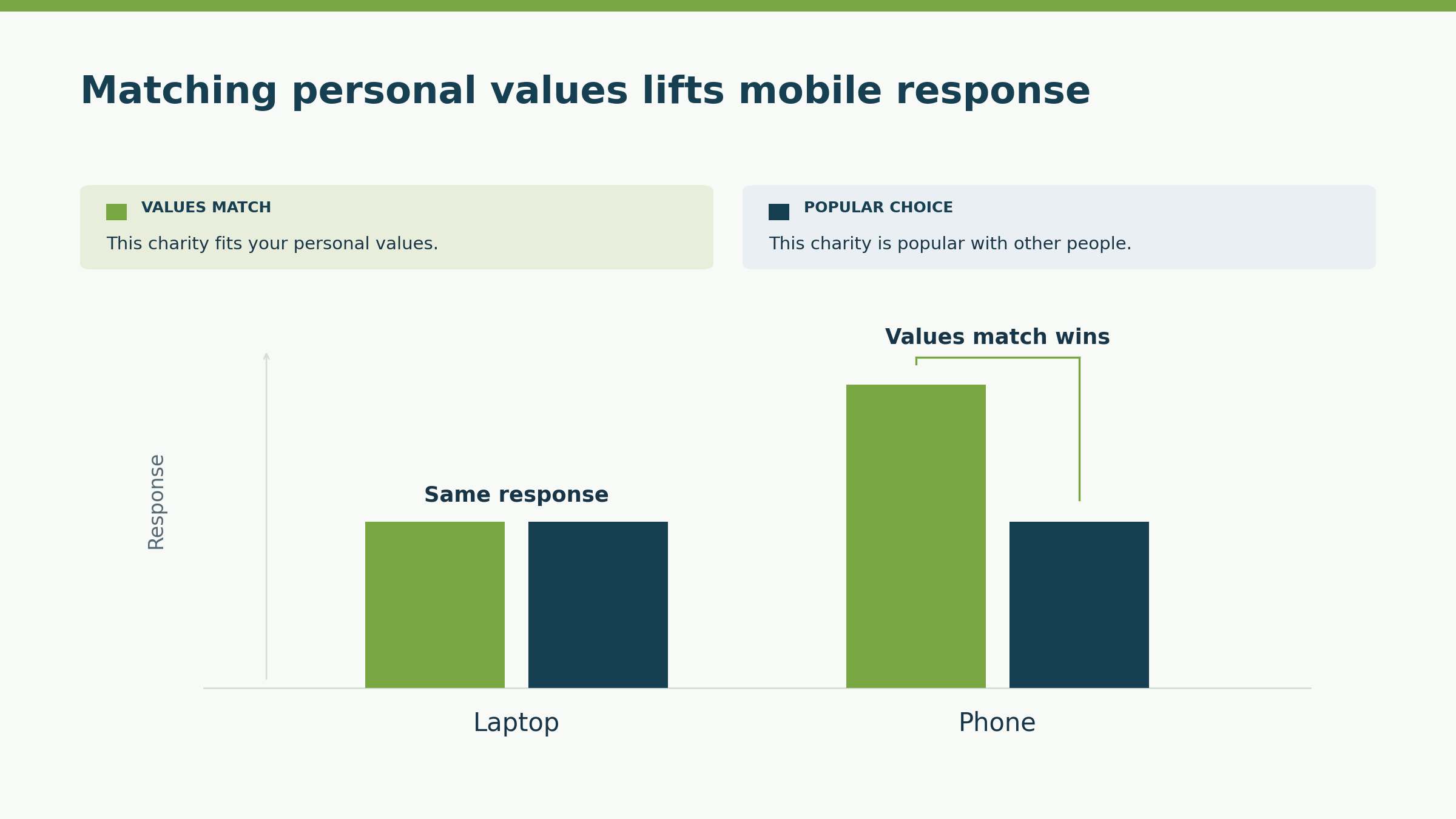
The personal values message did well with people when on their phones but didn’t matter if on a laptop. So, the device tells us something about the donor’s state of mind, but still, nothing about what matters to them. The deeper test is whether matching the message to their identity or personality improves response, and whether the device amplifies that effect.
The fundraising opportunity lies in connecting what matters to me with the help someone else needs. If being a parent is important to how I see myself, then helping another parent care for their child gives me a personal reason to care. My attention to my own values can become a route into their circumstance. The beneficiary gets helped, and I get to act on something I believe about myself.
This is how to deliver on the vague, empty request to make it “relevant” that is more than a blanket rule about emphasizing “me” or “we.”
We tested an outdoor-event ad among extroverts (you can know this for your file for 15 cents a name). The tailored version featured a crowd, energetic language and lines such as “the excitement never stops.” It beat the control overall and performed even better among mobile users.
A crowd might look like communal messaging when you’re classifying creative in a spreadsheet. To an extrovert, it looks like a great Saturday. The personal connection comes from matching the message to the person, including when that person happens to enjoy being surrounded by other people.
That gives you a specific test to run. Compare an appeal built around a known audience value or personality trait with your usual message, and randomly split the versions within mobile and desktop audiences. Does the matched message improve giving, and is that improvement greater on mobile? Comparing the effects within each device group will tell you more than simply comparing mobile and desktop response rates.
The useful question is how well the appeal connects the donor’s reasons for caring with the opportunity to help. A phone may make that connection especially consequential. “Mobile optimized” should describe the message as well as the page.
Kevin
Behavioral Science Q & A
Thanks so much for raising this. Yes, capturing donor information can be helpful for stewardship like newsletters, thank-you letters, impact updates. But how you ask matters. Forcing full data capture introduces friction that can significantly depress conversion, many donors may simply abandon the process. Beyond the friction itself, required fields also shift the emotional experience […]
Read Full Answer
Unlike holidays that everyone already knows, Giving Tuesday is a created event. Many donors recognize the name but not the exact timing, so referencing it becomes a helpful cue. It serves as a reminder and taps into social norm activation (“everyone’s giving today”), which boosts response. However, we still want it paired with the mission, […]
Read Full Answer
When a subject line leads with the match (“Your gift matched!”), it risks triggering market-norm thinking: the sense that giving is a financial transaction rather than an act rooted in values, identity, and care. This shift reduces intrinsic motivation and, over time, can weaken donor satisfaction and long-term engagement. It also makes the email indistinguishable […]
Read Full Answer
There’s no evidence that QR codes suppress mid-value giving; all available research suggests they either help or have no negative effect. In fact, behavioral and usability research consistently shows the opposite: reducing friction at any point in the donation process increases completion rates and total response. And that has nothing to do with capacity and […]
Read Full Answer
What you’re experiencing is very common. Resistance often isn’t about capability, but about motivation quality. If board members feel pushed into fundraising, that triggers controlled motivation (low quality motivation) i.e. obligation, guilt, or fear of judgment, which often results in avoidance. Instead, we need to create conditions for volitional motivation (high quality motivation) by satisfying […]
Read Full Answer
That’s a really thoughtful question, and you’re not the first to raise it. Many of our clients have been cautious about placing the ask at the very end. To address their concern, we’ve tested both approaches, and the results are clear: when the ask comes last, even if that means it appears on the second […]
Read Full Answer