

Motion Is Not Progress. Ask Less. Ask Better.
I should confess my bias upfront: for 15 years, I’ve watched Kevin Schulman build DonorVoice from a contrarian idea into one of the most rigorous enterprises in nonprofit fundraising. Plus, he’s a partner in The Agitator and a provocateur in the best sense, He “occasionally” blames me for bringing him into this world of fundraising as both mentor and co-conspirator. The truth is the learning has run mostly in the other direction.
But my bias runs far deeper than admiration and friendship. When I was writing Retention Fundraising: The Art and Science of Keeping Your Donors for Life, it was Kevin and his team at DonorVoice who provided the behavioral science foundation that makes it special. At that point — roughly 14 years ago — serious empirical behavioral research on why donors stay or leave was pretty scarce. Kevin helped changed that. He and his team conducted a large-scale behavioral science study of donor retention across thousands of donors in the United States and the United Kingdom, and the findings reoriented how the most thoughtful practitioners in the field understood and tackled the retention problem.
In the years since, as I watched the sector largely ignore those findings and press harder on the volume lever, Kevin kept working. Kept publishing many of his findings in The Agitator . Kept sharing what the data showed, post after post in these pages. And now, finally, he has put it all together — informed by 14 years of additional research, testing, and accumulated evidence — in The Volume Trap: Why Fundraising Scaled the Wrong Thing and What Comes Next.
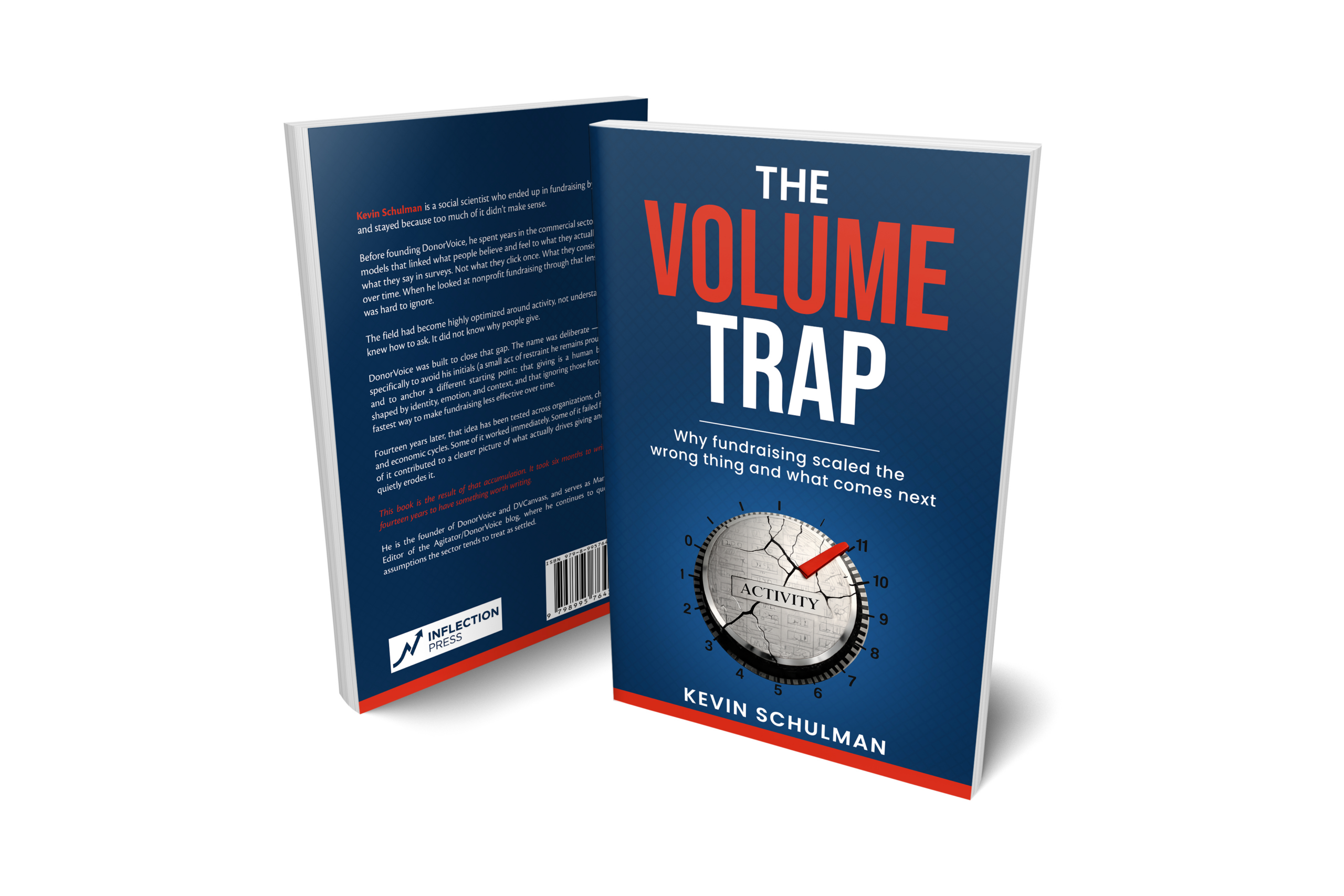
“Read it.” That is the short version of this review.
The longer version of this review begins with this moment we are all living through. Fundraising in 2026 is not a comfortable place. Donor files are shrinking. Retention rates remain stubbornly low — with three out of four donors vanishing after their first or second gift. Acquisition costs are climbing. And the environment outside our doors is turbulent in ways that make the job harder still: a difficult economy, profound demographic shifts, a social and political landscape that has left many donors uncertain about institutions, about causes, about the future itself. Competition for the charitable dollar has never been more intense, and the public’s patience with organizations that treat them as ATMs rather than partners has never been thinner.
Into this moment, Kevin delivers a diagnosis and a cure. The diagnosis is unflinching: the nonprofit sector built a volume machine and mistook it for a fundraising strategy. The logic at its core is seductively simple — if asking produces giving, then asking more produces more giving. And so the treadmill runs: more mailings, more emails, more urgency, more premiums, more matching gift deadlines. When revenue softens, increase volume. When volume stops working, add something shiny.
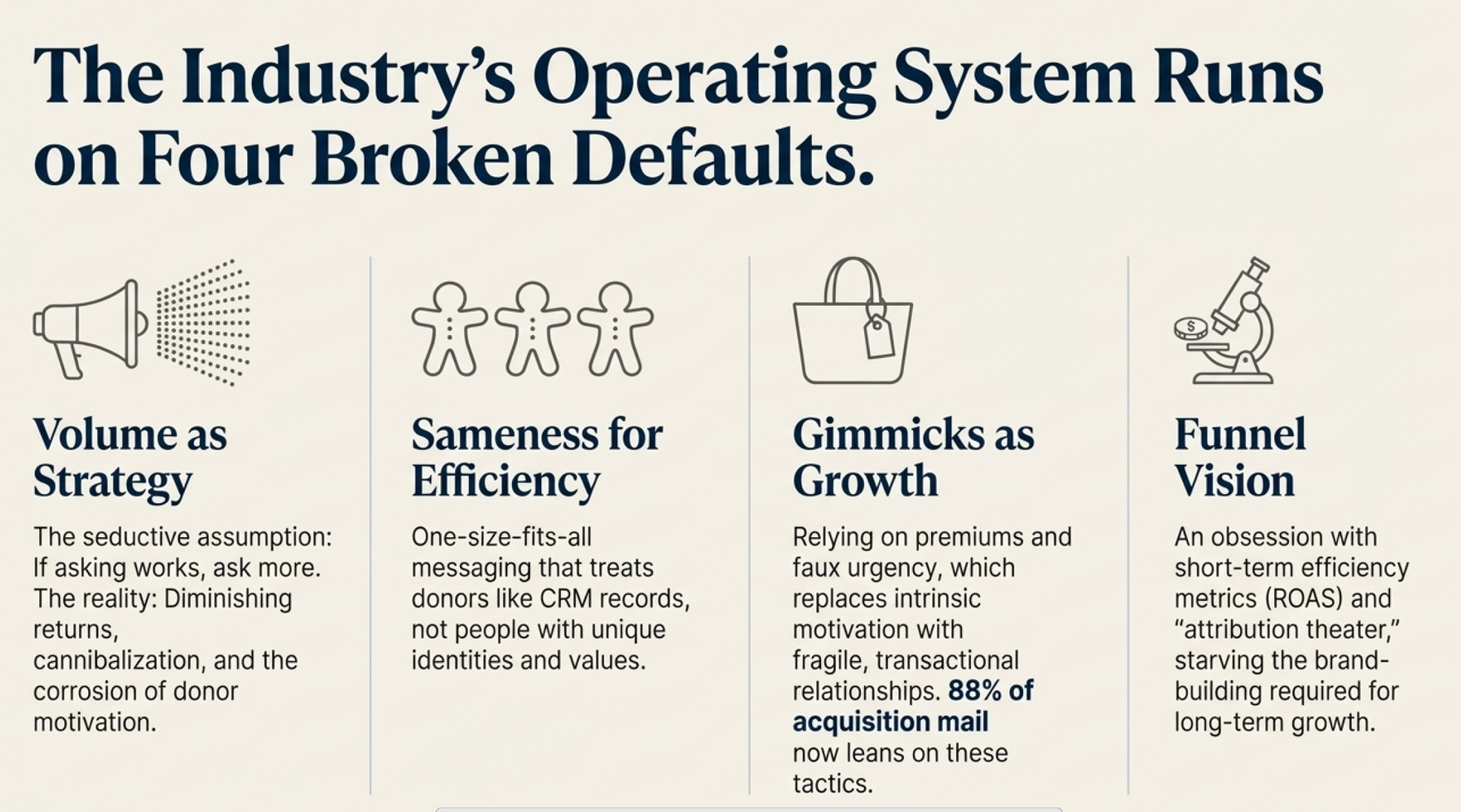
The data, Kevin shows in both words and a bountiful number of charts, tells a different story. Currently, nonprofits are sending 15 percent more emails to smaller lists — while conversions drop and revenue falls. One charity increased its appeal schedule from eight mailings a year to eleven, and gross revenue went down. More activity, less return. This is not a trend. It is the mathematically predictable output of a system optimized for the wrong thing.
What makes The Volume Trap more than a critique — and this is where Kevin’s years of accumulated research pay off — is that he doesn’t stop at indictment. He builds the alternative from the ground up, and he does it with the rigor of a social scientist and veteran marketing and fundraising practitioner. He lays out the blueprint for the future with the clarity of someone who has had to explain these ideas to skeptical clients for a decade and a half.
The Deceptively Simple Reframing of the Original Sin of the “Ask = Give Model “
Kevin’s tested and proven alternative begins with a deceptively simple reframe: people do not give because you ask. They give because giving means something to them. Your job is to understand what that something is, and to make it easy for them to act on it.
That understanding, Kevin argues, starts with IDENTITY — not demographics, not RFM scores, but the version of themselves a donor brings to your mission. Are they a parent, a veteran, an activist, a naturalist? And critically: which identity is active in the moment of decision?
From identity flows what Kevin calls the RESONANCE STACK — a structured framework connecting personality traits, moral frames, and emotional posture into a system for writing messages that feel, to the reader, as if they were written specifically for them. Because they were.
The book presents this not as theory but as a design system, complete with exercises, tested structures, and the experimental evidence to back them up.
Kevin is equally rigorous on the question of CADENCE — not simply how often to communicate, but who is ready, when, and what kind of contact they need between asks to remain motivated rather than worn down. The “MODE OF 1” framework he introduces here is among the most practically useful contributions in the book: a way to honor the reality that some donors give once a year, meaningfully and intentionally, and that trying to change that behavior is the fastest way to lose them.
And then there is BRAND — the chapter our sector most needs to hear and will most resist. Every direct response dollar raised is harvesting demand that already exists, Kevin argues. Brand is how you grow the field for future harvests. The three jobs of brand communication — associating the organization with the category in which it operates (conservation, civil rights, hunger, disaster relief, etc); linking it to giving moments; building distinctive memory over time. These are not marketing abstractions. They are investments in future revenue that the volume machine’s dashboards will never show, because the volume machine doesn’t look or care about the future.
Pay particular attention to metrics reflected in Kevin’s recommended dashboard by the acronym BRAIN — Beliefs, Revenue, Awareness, Incrementality, Nurture — a measurement framework designed to replace the narrow, extractive scoreboard of the volume machine with one that actually reflects whether an organization is growing or slowly consuming itself. The shift Kevin asks for is not merely tactical. It is a different way of seeing the whole enterprise of fundraising.
Donors are far more than data points. Behind every record in a database is a human being with values, emotions, and a genuine desire to matter. Kevin has spent fifteen years proving it, at scale, with evidence. The Volume Trap is the culmination of that work, and it arrives at exactly the moment the sector most needs to hear what it has to say.
The old ‘best practices’ playbook is not just underperforming. In an era of shrinking trust, rising competition, and donors who have more choices — and more reasons to disengage — it is actively dangerous. Kevin offers something better. The question is whether the sector has the courage to take it seriously.
Implementing the shift this book describes produces real results and doesn’t require a budget you don’t have. It does require you to challenge some of the myths you work under and the will to replace them with something better.
Ask less. Ask better. Raise more. Three phrases that belong on the wall of every fundraising shop in America.
Roger
7 responses to “Motion Is Not Progress. Ask Less. Ask Better.”
Behavioral Science Q & A
Thanks so much for raising this. Yes, capturing donor information can be helpful for stewardship like newsletters, thank-you letters, impact updates. But how you ask matters. Forcing full data capture introduces friction that can significantly depress conversion, many donors may simply abandon the process. Beyond the friction itself, required fields also shift the emotional experience […]
Read Full Answer
Unlike holidays that everyone already knows, Giving Tuesday is a created event. Many donors recognize the name but not the exact timing, so referencing it becomes a helpful cue. It serves as a reminder and taps into social norm activation (“everyone’s giving today”), which boosts response. However, we still want it paired with the mission, […]
Read Full Answer
When a subject line leads with the match (“Your gift matched!”), it risks triggering market-norm thinking: the sense that giving is a financial transaction rather than an act rooted in values, identity, and care. This shift reduces intrinsic motivation and, over time, can weaken donor satisfaction and long-term engagement. It also makes the email indistinguishable […]
Read Full Answer
There’s no evidence that QR codes suppress mid-value giving; all available research suggests they either help or have no negative effect. In fact, behavioral and usability research consistently shows the opposite: reducing friction at any point in the donation process increases completion rates and total response. And that has nothing to do with capacity and […]
Read Full Answer
What you’re experiencing is very common. Resistance often isn’t about capability, but about motivation quality. If board members feel pushed into fundraising, that triggers controlled motivation (low quality motivation) i.e. obligation, guilt, or fear of judgment, which often results in avoidance. Instead, we need to create conditions for volitional motivation (high quality motivation) by satisfying […]
Read Full Answer
That’s a really thoughtful question, and you’re not the first to raise it. Many of our clients have been cautious about placing the ask at the very end. To address their concern, we’ve tested both approaches, and the results are clear: when the ask comes last, even if that means it appears on the second […]
Read Full Answer
You had me at “read it”. Thanks Kevin & Roger, for the ongoing wisdom and insight. Ordered.
Many thanks, Harvey. Good move. And…I’ve now placed Kevin’s new book right beside the 5 dog-eared, underlined copies of five, yes 5!, of yours. Onward.
Wow. Powerful stuff. I have been admiring Kevin’s smart thinking for years.
Love the concept of “resonance:” is your communication resonating with the donor or turning them off. Ordering it now!
Gail
hi, this is great, exactly what I’ve been talking to clients about… smarter not more… unfortunately I don’t have a kindle… how can I order the book?
Exciting news. I’ve got my copy on order.
I, too, have been reading Kevin’s wisdom and shouting from the rooftops that it’s all about MEANING. I ordered the book! Erica, you can buy it in paperback. 😉
[…] The Agitator · […]