

Please Adjust Your Donors to Fit the Appeal
The Air Force built its cockpits around the average pilot. In 1950, it started collecting new measurements to update the design and the averages.
A researcher, Gilbert Daniels, had a more fundamental question: how many pilots actually matched the average? Zero out of 4,063. A pilot could be average height with long arms and short legs. The averages described a combination nobody possessed.
That changed the design problem and ushered in adjustable seats, pedals and straps.
Fundraising has been more inclined to ask the donor to stretch or shrink. Think about your typical campaign, by the time the donor enters the process, much of the fundraising has already been decided. Their job is to qualify for receiving it.
Then testing gives the arrangement scientific respectability. A beats B on overall response, so A becomes the control and everyone gets it. That answers which single version performed better across the tested audience. It leaves open whether different versions would perform better for different people.
And the message is only one of the things we’ve decided everyone should accommodate. There’s also our appeal calendar and our preferred way for them to respond.
Personalization deserves a somewhat bigger job than changing a couple words. We call this job personalized matching: matching the message, frequency and payment method to the person. Each is an adjustment to how the fundraising works.
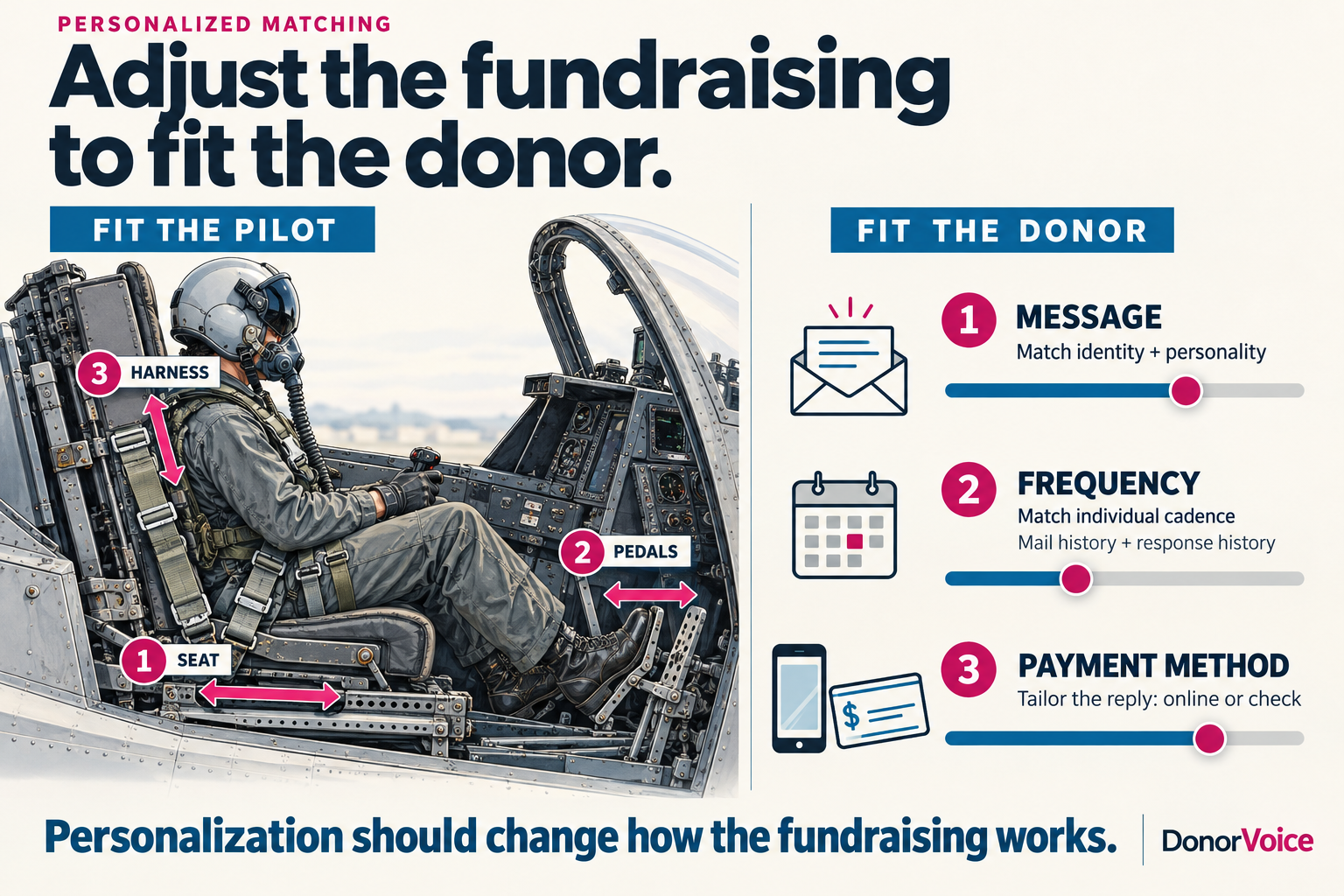
Match the message to the person. Two hospital supporters might have identical giving histories while caring for different reasons. One sees herself as a parent protecting children; the other wants to advance scientific discovery. Identity helps us understand why someone cares. Personality gives us hypotheses about how to present the case through language, imagery, emphasis and detail. Those differences give creative something useful to work with beyond “they both gave $100 last June.”
Match the frequency to the person. A donor who gives once a year gets a different appeal cadence. For the rest, we model cadence at the individual level using both mail history and response history. A gift history means more when we know the solicitation history behind it. The pattern of what someone received and how they responded gives us a basis for estimating a suitable frequency, rather than enrolling everyone in the spreadsheet decreed cadence.
Match the reply to how the person prefers to give. Someone who responds to a mailed appeal by donating online has told us something useful. Their reply should make that route prominent and easy. For a check writer, the return envelope makes sense but none for the online payer.
It’s past time to give personalization a consequential job. Let what we know about someone change the case they receive, how often they receive it and how easily they can act. Otherwise, we’ve put their name on the seat and congratulated ourselves on the fit.
Kevin
Behavioral Science Q & A
Thanks so much for raising this. Yes, capturing donor information can be helpful for stewardship like newsletters, thank-you letters, impact updates. But how you ask matters. Forcing full data capture introduces friction that can significantly depress conversion, many donors may simply abandon the process. Beyond the friction itself, required fields also shift the emotional experience […]
Read Full Answer
Unlike holidays that everyone already knows, Giving Tuesday is a created event. Many donors recognize the name but not the exact timing, so referencing it becomes a helpful cue. It serves as a reminder and taps into social norm activation (“everyone’s giving today”), which boosts response. However, we still want it paired with the mission, […]
Read Full Answer
When a subject line leads with the match (“Your gift matched!”), it risks triggering market-norm thinking: the sense that giving is a financial transaction rather than an act rooted in values, identity, and care. This shift reduces intrinsic motivation and, over time, can weaken donor satisfaction and long-term engagement. It also makes the email indistinguishable […]
Read Full Answer
There’s no evidence that QR codes suppress mid-value giving; all available research suggests they either help or have no negative effect. In fact, behavioral and usability research consistently shows the opposite: reducing friction at any point in the donation process increases completion rates and total response. And that has nothing to do with capacity and […]
Read Full Answer
What you’re experiencing is very common. Resistance often isn’t about capability, but about motivation quality. If board members feel pushed into fundraising, that triggers controlled motivation (low quality motivation) i.e. obligation, guilt, or fear of judgment, which often results in avoidance. Instead, we need to create conditions for volitional motivation (high quality motivation) by satisfying […]
Read Full Answer
That’s a really thoughtful question, and you’re not the first to raise it. Many of our clients have been cautious about placing the ask at the very end. To address their concern, we’ve tested both approaches, and the results are clear: when the ask comes last, even if that means it appears on the second […]
Read Full Answer