

Stop Asking for Innovation Then Grading It Like Yesterday’s Mail Plan
“We want creative and innovative ideas.”
What tends to accompany this request, though unsaid, is “as long as they feel familiar, fit our current process and come with a track record of success.” This is innovation ordered off the kid’s menu – new idea, but hold the new.
The unsaid part reveals itself subconciously through the judging process. Familiar ideas come with a shared template, we know what “good” looks like because we’ve seen it before, or at least seen something close enough to pretend. But novel ideas don’t have that luxury. Without a common template, everyone falls back on personal taste, pet theories and whatever scar tissue they collected in a 2017 budget meeting. That creates disagreement and disagreement gets mislabeled as risk.
In other words, consensus is often just familiarity. There’s research behind this.
In one study, participants associated creative ideas with words like “poison,” “vomit” and “agony,” which feels a bit dramatic.
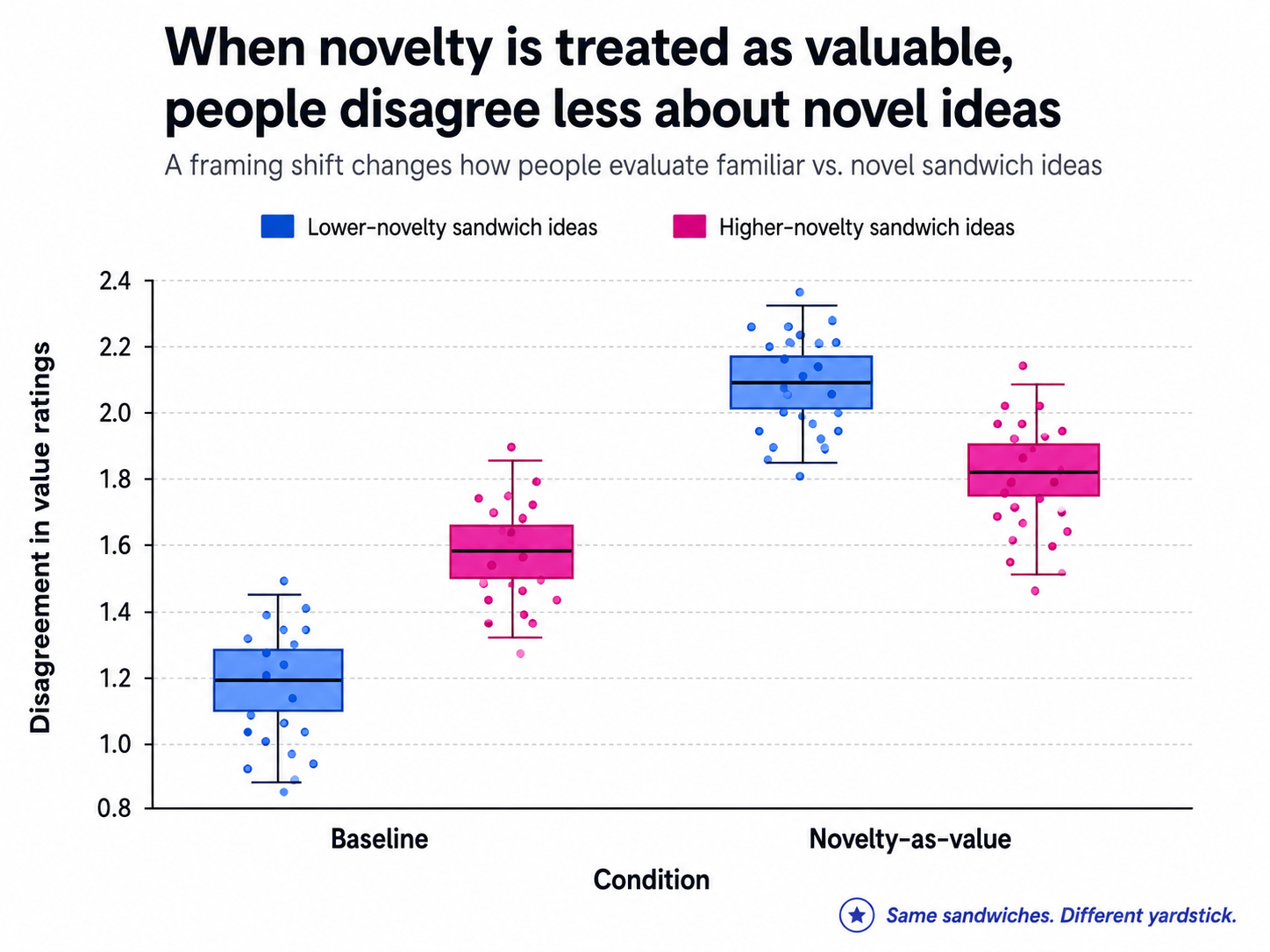
The chart below shows a cleaner version of the same problem using sandwich ideas. Sandwich shop employees evaluated menu ideas. Some were ordinary, others more novel.
- In the baseline condition, people were asked how successful each sandwich would be.
- In the novelty-as-value condition, they were asked to imagine a restaurant specializing in sandwiches no one had tried before.
That tiny framing changed everything.
In the baseline condition, people disagreed much more about the high-novelty sandwiches. Once novelty was framed as the whole point, that disagreement dropped. The odd sandwiches became easier to evaluate because people had been given the right yardstick.
That is the lesson hiding in the lunch meat. Organizations want innovation but tend to evaluate it using criteria built for predictability. “What’s the projected return?” “Where has this worked before?” “Can you show comparable results?” These are not bad questions for familiar tactics but they’re lousy questions for genuinely new ones since they turn novelty into a defect before the idea has a chance to breathe.
The fix isn’t to worship novelty for its own sake but rather to decide upfront when novelty is part of the value. If the goal is incremental improvement, fine, grade ideas on proof, predictability and ease of execution. But if the goal is to break out of a declining pattern, then the grading system has to change.
Ask different questions.
- Does this idea create a new reason to pay attention?
- Does it reach a different donor motivation?
- Does it break a category convention that deserves breaking?
- Is the downside containable?
- Can we test it cheaply?
- What would we need to learn before scaling?
Cost is usually knowable, time is somewhat knowable. Return, for a genuinely novel idea, is mostly make believe with decimals.
So the next time you send an RFP asking for innovative thinking, protect it from being judged by the same reflexes that make the familiar feel safe.
If you ask for a new sandwich and then punish everything that doesn’t look like turkey on wheat, don’t blame the kitchen when lunch tastes exactly like yesterday.
Kevin
One response to “Stop Asking for Innovation Then Grading It Like Yesterday’s Mail Plan”
Behavioral Science Q & A
Thanks so much for raising this. Yes, capturing donor information can be helpful for stewardship like newsletters, thank-you letters, impact updates. But how you ask matters. Forcing full data capture introduces friction that can significantly depress conversion, many donors may simply abandon the process. Beyond the friction itself, required fields also shift the emotional experience […]
Read Full Answer
Unlike holidays that everyone already knows, Giving Tuesday is a created event. Many donors recognize the name but not the exact timing, so referencing it becomes a helpful cue. It serves as a reminder and taps into social norm activation (“everyone’s giving today”), which boosts response. However, we still want it paired with the mission, […]
Read Full Answer
When a subject line leads with the match (“Your gift matched!”), it risks triggering market-norm thinking: the sense that giving is a financial transaction rather than an act rooted in values, identity, and care. This shift reduces intrinsic motivation and, over time, can weaken donor satisfaction and long-term engagement. It also makes the email indistinguishable […]
Read Full Answer
There’s no evidence that QR codes suppress mid-value giving; all available research suggests they either help or have no negative effect. In fact, behavioral and usability research consistently shows the opposite: reducing friction at any point in the donation process increases completion rates and total response. And that has nothing to do with capacity and […]
Read Full Answer
What you’re experiencing is very common. Resistance often isn’t about capability, but about motivation quality. If board members feel pushed into fundraising, that triggers controlled motivation (low quality motivation) i.e. obligation, guilt, or fear of judgment, which often results in avoidance. Instead, we need to create conditions for volitional motivation (high quality motivation) by satisfying […]
Read Full Answer
That’s a really thoughtful question, and you’re not the first to raise it. Many of our clients have been cautious about placing the ask at the very end. To address their concern, we’ve tested both approaches, and the results are clear: when the ask comes last, even if that means it appears on the second […]
Read Full Answer
Hi Kevin –
Thanks for this inspiration.
Wanted to ask about a study I believe you referenced about a year ago about the bump given to a campaign pitch when the donor is thanked twice – once during and once after the campaign. At least I think that’s how it was structured. Does this sound familiar?
Thanks! – mw.