

The Fundraising Coin Trick Doesn’t Add Up
In 1938, entertainer Eddie Cantor asked Americans to send dimes to President Roosevelt to fight polio. They responded with 2.68 million of them, flooding the White House mailroom and giving the March of Dimes its name.
The direction of travel seems rather important, people sending their money to the cause.
At some point, a fundraiser reversed the flow and began sending coins to prospects. I couldn’t establish who committed the original sin, but by 2010, The Chronicle of Philanthropy described coin mailings as an old technique enjoying a resurgence after “years of decline.”
Some tricks refuse to die. The latest example arrived at our house from the Tuskegee Airmen National Historical Museum. Three coins totaling 45 cents were glued to the reply form and positioned to show through the envelope window. The opening line explained:
“Enclosed is 45 cents, a small but powerful symbol. It represents 1945, when the courageous Tuskegee Airmen risked…”
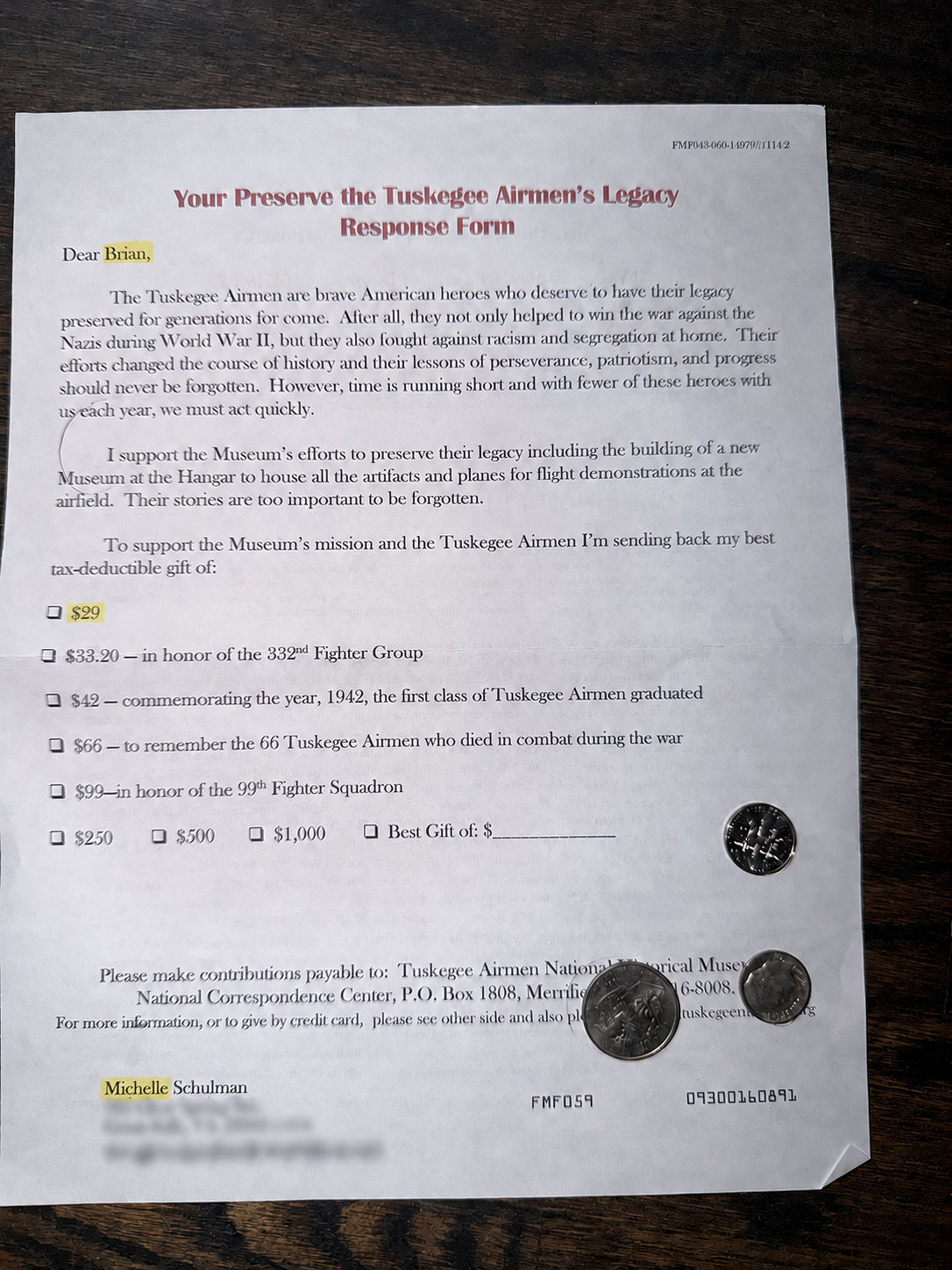 It represents 1945 because the copywriter needed the amount of money glued to the form to represent something. The reply form continues the numerology with asks of $33.20 for the 332nd Fighter Group, $42 for the first graduating class in 1942, $66 for the 66 Airmen killed in combat and $99 for the 99th Fighter Squadron.
It is fundraising numerology run amok, with every number conscripted into symbolic duty until the overkill drains the meaning from all of them.
There’s been more than a few published tests with coins.
- Coin package vs. card vs. control. Net return per piece was -$.52 for coin, $-.49 for the card and -$.24 for the control. The coin package did generate more response but the lift came from people mailing back the coin, no donation.
- Another sent a quarter vs. magnet vs. no gift. The coin produced no statistically significant increase in response and the lowest average gift and net per piece.
Perhaps the Tuskegee rationale is more meaningful than the generic coin offers in those tests? In another experiment, prospective donors were shown one of three explanations:
- “This 25 cents can help provide a meal.”
- “Please return this 25 cents along with your donation.”
- “This 25 cents is a gift to you.”
The explanation made no meaningful difference. Each coin treatment generated lower donations than a greeting card or no enclosure.
“This 45 cents represents 1945” is more historically dressed up, but the coin remains money and copy cannot turn loose change into a relationship.
The standard defense for this is reciprocity from someone who read a page or two in a behavioral economics book. Reciprocity is a legitimate and well-established human tendency but it’s been stretched beyond recognition here.
In one experiment for a children’s charity, postcards featuring artwork by children increased response by 75%. A university test found that a good-quality branded luggage tag roughly doubled response (though much worse on net than no tag). A cheap plastic version did nothing.
Introducing money tends to move people from a social relationship toward a market exchange and that is what the coin does. The prospective donor begins calculating, consciously or otherwise: You gave me something, so what do I owe you?
Charitable giving usually operates under a communal norm, where people respond to need, identity and shared purpose. The coin introduces an exchange norm, where the goal becomes settling the account. Mailing the quarter back is a perfectly rational way to close the transaction.
Coin mailings survive because the immediate benefit is visible and the damage is distributed across time, budgets and metrics.
The envelope gets opened and response may rise. The campaign report arrives before anyone has measured second-gift conversion, retention, commitment, net lifetime value. The agency can declare a winner, the fundraiser can circulate the case study and another charity can copy it.
This is the Volume Machine doing what it was built to do. And because other charities use coins, the practice acquires the protective coating of conventional wisdom. Nobody has to defend the underlying psychology or produce a donor-level longitudinal test. They can point to another package and say, “It must work or they wouldn’t keep mailing it.”
This is also the reasoning that keeps casinos in business.
The small executional details make this particular package almost too perfect.
It was mailed to Michelle, my wife. The eight-page letter begins “Dear Fellow Patriot,” apparently deciding that personalization was a bridge too far. Yet the reply form says “Dear Brian.”
There has never been a Brian in our household. Intriguingly, Brian Smith is identified as the museum’s president in its tax filings. Perhaps a merge field swallowed its own tail.
Then there are the museum’s finances. According to its 990, it reported $2.82 million in revenue and $2.88 million in expenses in 2024, producing a deficit of nearly $60,000. The museum classified $1.50 million as direct-mail expense, more than half of all spending and substantially more than the $1.04 million it reported for all program services.
A historically important institution with less than one year of cash coverage and somebody decided the answer was to place additional money inside the direct mail.
Dear Brian, not sure this is mission accomplished.
Kevin
2 responses to “The Fundraising Coin Trick Doesn’t Add Up”
Behavioral Science Q & A
Thanks so much for raising this. Yes, capturing donor information can be helpful for stewardship like newsletters, thank-you letters, impact updates. But how you ask matters. Forcing full data capture introduces friction that can significantly depress conversion, many donors may simply abandon the process. Beyond the friction itself, required fields also shift the emotional experience […]
Read Full Answer
Unlike holidays that everyone already knows, Giving Tuesday is a created event. Many donors recognize the name but not the exact timing, so referencing it becomes a helpful cue. It serves as a reminder and taps into social norm activation (“everyone’s giving today”), which boosts response. However, we still want it paired with the mission, […]
Read Full Answer
When a subject line leads with the match (“Your gift matched!”), it risks triggering market-norm thinking: the sense that giving is a financial transaction rather than an act rooted in values, identity, and care. This shift reduces intrinsic motivation and, over time, can weaken donor satisfaction and long-term engagement. It also makes the email indistinguishable […]
Read Full Answer
There’s no evidence that QR codes suppress mid-value giving; all available research suggests they either help or have no negative effect. In fact, behavioral and usability research consistently shows the opposite: reducing friction at any point in the donation process increases completion rates and total response. And that has nothing to do with capacity and […]
Read Full Answer
What you’re experiencing is very common. Resistance often isn’t about capability, but about motivation quality. If board members feel pushed into fundraising, that triggers controlled motivation (low quality motivation) i.e. obligation, guilt, or fear of judgment, which often results in avoidance. Instead, we need to create conditions for volitional motivation (high quality motivation) by satisfying […]
Read Full Answer
That’s a really thoughtful question, and you’re not the first to raise it. Many of our clients have been cautious about placing the ask at the very end. To address their concern, we’ve tested both approaches, and the results are clear: when the ask comes last, even if that means it appears on the second […]
Read Full Answer
Hey Kevin, I’ll take this on a relatively mundane tangent — thoughts about your most-favorite metric for evaluating acquisition mail?
You use net return per piece here, which I would say favors cheaper packages. I know net investment per donor is popular, which favors high response rates even if the average gift is low. I like a simple upfront ROI of gross divided by total cost — high response, high average gift, and low cost all affect it pretty evenly.
Hi John,
Thanks for the tangent. I’m of the view that there is an awful lot of spend on acquisition that is a lousy investment with break-even way too far out in future and the pile of humans left at the end of it, too small to generate a decent return.
I think all the typical acquisition metrics measure only upfront campaign activity and create all sorts of unintended consequence.
Here’s a simple alternative, requiring three inputs:
1) How much money did acquisition lose?
2) How many acquired donors are likely to give again? In our research, it’s 40% who will give again over the next two years (but this should be easy for any charity to calculate)
3) How much will each of those donors produce, after future fundraising costs? This is average value of a donor per year, net the solicitation costs.
Then divide the acquisition loss (#1) by the number likely to give again (#2). That tells you how much each continuing donor must produce for the acquisition effort to break even. I like people to stare at this number vs. the cost to acquire. Your break even year is this value per year required divided by #3.
I think there is argument for making this more conservative since there is still considerable donor loss after year one. Running this math can be sobering, showing a crappy break even and very few humans left after break even to ever make much of a profit.