

The Growth Your Acquisition Model Misses
Consider two pools of people:
- Group 1: People already visible in your donor-response universe. They give to you or other charities, and their giving history makes them easy for acquisition models to find and rank.
- Group 2: Additional people whose values and goals fit your mission. They sit outside your usual acquisition audience and may know little or nothing about you.
Direct response gets judged on how quickly today’s spending produces gifts, which means direct response will show up better against Group 1 even though Group 2 is much larger.
The irony is that acquisition sourcing, supposedly the growth part of your business, uses models that largely keep you inside Group 1 because the modelers know the names are being judged on immediate response. And so the models rank prospects to satisfy that need and only serves up today’s responder pool.
And someone who fits your mission but has never appeared in the giving data? Since recorded giving the co-op can see is the admission requirement, that person never enters the ranking.
A reliable responder pool can put a floor under performance but relying on it exclusively turns your floor into your growth ceiling. You can keep acquiring donors from this pool while struggling to grow beyond the losses. Acquisition reports that show costs going up and response going down don’t ever show how much unexplored market remains outside the machinery.
And finding those people outside the machinery is only part of the job. You also need an affordable way to introduce yourself and give the relationship time to develop.
A rented name costs 8 to 10 cents or more, is licensed for one mailing, and gets judged on that cold ask within weeks. Another contact means another rental charge. A prospect who needs several exposures to the brand before giving looks expensive under those economics.
DonorVoice has solved this pricing and usage problem
We call it Acquistion 2.0 and you can now license the names instead of renting them:
- five cents a name, unlimited use, for a full year, across mail, email, social, display and connected TV.
You’ll save 50% or more on your name costs but the cheaper name and unlimited use matters less than what it buys you; a way to pay for Group 2 names and the runway to test audiences that need warming. But Group 2 selection done well requires flipping the order of how names are selected.
Today, recorded giving often determines who gets considered. Instead, the first cut becomes identity and mission fit: who has a reason to care about this cause for years? That comes from someone’s life. Picture a woman raising two kids (Parent Identity) in the neighborhood she has lived in for 20 years (Community Identity) and she’s financially secure but has no giving history. She’s a great candidate to support a food bank or children’s hospital but she isn’t in a co-op.
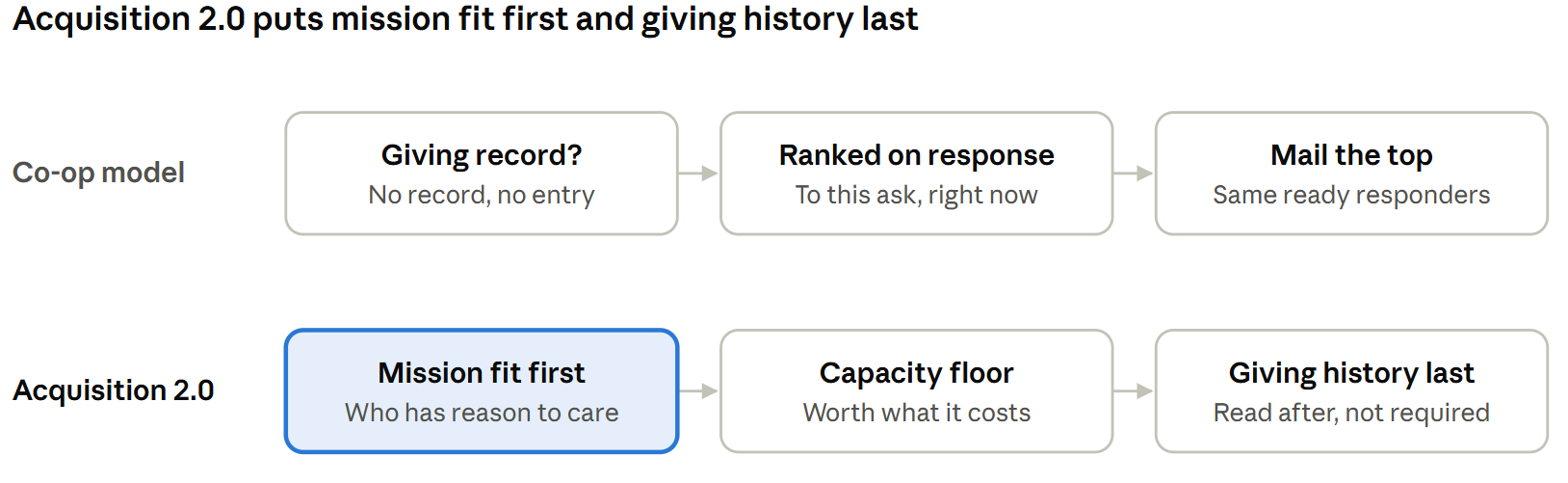
The growth question shifts from “how do we grow?” to “what is the optimal mix of media and channel to turn a new name with mission/Identity fit into a donor?”
And instead of asking a digital platform to find an audience that you never see, you start with selected people and test the ways of reaching them.
An illustration, within the Group 2 expansion audience, randomly assign prospects to three paths:
- Conversion ads only.
- The same conversion pushes, preceded and supported by brand ads.
- The same brand and conversion activity, plus mail after the brand phase.
Trying to run this set of funnel experiments without a list to upload to the ad platforms dials up the messy, pain in the ass factor to 11. By contrast, our list of people makes it straightforward. We get a clean read on if adding brand activity improves the economics of asking and if adding mail produces enough additional value to cover its cost.
The bar for a new audience is economic viability over an appropriate period. Its first ask may perform below your Group 1, reliable responder pool, but that isn’t the measuring stick since status quo and Group 1 offer no growth path.
Renew the prospect license, and year two can build on what year one taught you about those people. Group 1 will keep paying bills but growth requires finding out what Group 2 can become.
Acquisition 2.0 lowers the cost of repeated contact and gives you a practical way to answer that question.
Ping me in comments or directly if you’d like to learn more, kschulman@thedonorvoice.com. You can also visit this product page.
Kevin
Behavioral Science Q & A
Thanks so much for raising this. Yes, capturing donor information can be helpful for stewardship like newsletters, thank-you letters, impact updates. But how you ask matters. Forcing full data capture introduces friction that can significantly depress conversion, many donors may simply abandon the process. Beyond the friction itself, required fields also shift the emotional experience […]
Read Full Answer
Unlike holidays that everyone already knows, Giving Tuesday is a created event. Many donors recognize the name but not the exact timing, so referencing it becomes a helpful cue. It serves as a reminder and taps into social norm activation (“everyone’s giving today”), which boosts response. However, we still want it paired with the mission, […]
Read Full Answer
When a subject line leads with the match (“Your gift matched!”), it risks triggering market-norm thinking: the sense that giving is a financial transaction rather than an act rooted in values, identity, and care. This shift reduces intrinsic motivation and, over time, can weaken donor satisfaction and long-term engagement. It also makes the email indistinguishable […]
Read Full Answer
There’s no evidence that QR codes suppress mid-value giving; all available research suggests they either help or have no negative effect. In fact, behavioral and usability research consistently shows the opposite: reducing friction at any point in the donation process increases completion rates and total response. And that has nothing to do with capacity and […]
Read Full Answer
What you’re experiencing is very common. Resistance often isn’t about capability, but about motivation quality. If board members feel pushed into fundraising, that triggers controlled motivation (low quality motivation) i.e. obligation, guilt, or fear of judgment, which often results in avoidance. Instead, we need to create conditions for volitional motivation (high quality motivation) by satisfying […]
Read Full Answer
That’s a really thoughtful question, and you’re not the first to raise it. Many of our clients have been cautious about placing the ask at the very end. To address their concern, we’ve tested both approaches, and the results are clear: when the ask comes last, even if that means it appears on the second […]
Read Full Answer