

We Interrupt This Mission to Bring You a Tumbler
In Japan, taxpayers can take welding lessons near Mt. Fuji, test drive a Porsche or serve as mayor for a day. All they have to do is send those towns some of their tax dollars.
Japan’s “hometown tax” system lets taxpayers donate to towns or cities where they don’t live, receive tax relief and collect a gift in return. What began as a way to help rural places losing population has become a gifting arms race.
Former Prime Minister Yoshihide Suga helped create the program and said he donates to the town where he grew up in a family of strawberry farmers, “without a thank-you gift in return.”
Compare that with a financial planner in Yokohama who uses the program to stock her pantry with luxuries she wouldn’t otherwise buy. “I don’t usually choose to donate to somewhere because of a connection to the place,” she said. “It’s more because I look at the thank-you gift and think, ‘I really want to eat this thing.’”
The risk is familiar: the reward becomes the reason, and the cause becomes incidental. Behavioral scientists call it “crowding out” when external incentives displace someone’s existing, internal motivation. The standard defense of premiums, which a former version of me repeated, is that they increase response. A Faustian bargain many fundraisers accept: win the battle, lose the lifetime-value war.
But what if the premium doesn’t even win the battle? A public radio station tested that in its member renewal mailings. It had offered premiums elsewhere, including on-air pledge drives, but hadn’t used them in its direct mail campaign.
Researchers randomly divided members into 3 groups with everyone getting the same letter. But one group also got an insulated tumbler offer if the donated $180 or more. Another test group could provide 60 meals through a local food bank at the same giving level.
Both offers lost to the standard appeal, which reminded members why they valued public radio. Response fell from 6.9% without an extra offer to 4.0% with the tumbler and 3.5% with the meals. Adding another reason to give brought in fewer donors.
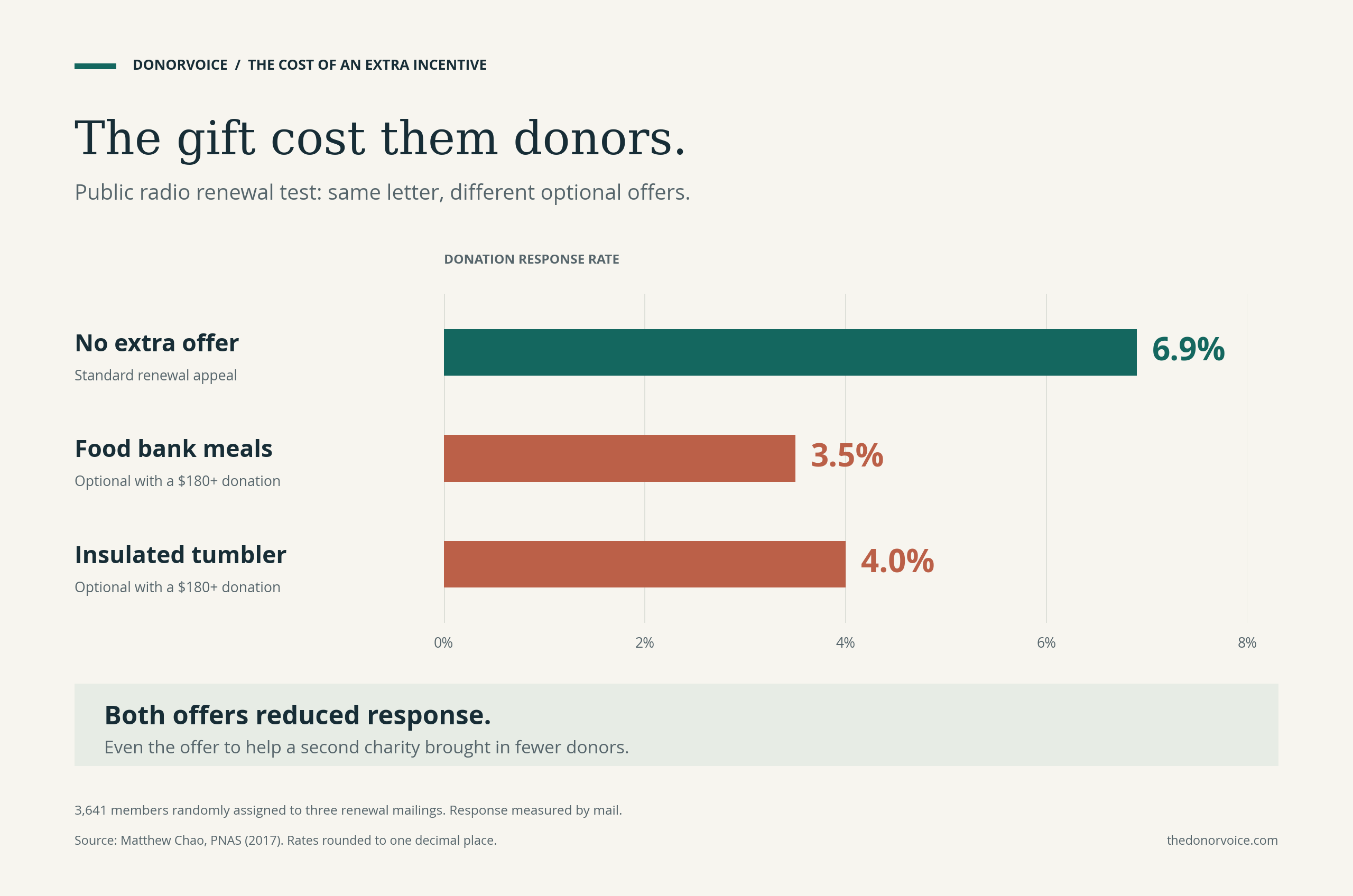
The eye-catching offers diverted attention from supporting public radio toward evaluating a deal. Even an offer to help someone else can distract from the reason someone supports you.
The decline was concentrated among people who’d given larger amounts the previous year. That’s consistent with crowding out stronger existing motivation, although the study didn’t directly measure their commitment.
Before adding another reason to give, check whether you’re obscuring the one donors already have. And don’t offer the welding lessons unless you know they’re aspiring welders.
Kevin
Behavioral Science Q & A
Thanks so much for raising this. Yes, capturing donor information can be helpful for stewardship like newsletters, thank-you letters, impact updates. But how you ask matters. Forcing full data capture introduces friction that can significantly depress conversion, many donors may simply abandon the process. Beyond the friction itself, required fields also shift the emotional experience […]
Read Full Answer
Unlike holidays that everyone already knows, Giving Tuesday is a created event. Many donors recognize the name but not the exact timing, so referencing it becomes a helpful cue. It serves as a reminder and taps into social norm activation (“everyone’s giving today”), which boosts response. However, we still want it paired with the mission, […]
Read Full Answer
When a subject line leads with the match (“Your gift matched!”), it risks triggering market-norm thinking: the sense that giving is a financial transaction rather than an act rooted in values, identity, and care. This shift reduces intrinsic motivation and, over time, can weaken donor satisfaction and long-term engagement. It also makes the email indistinguishable […]
Read Full Answer
There’s no evidence that QR codes suppress mid-value giving; all available research suggests they either help or have no negative effect. In fact, behavioral and usability research consistently shows the opposite: reducing friction at any point in the donation process increases completion rates and total response. And that has nothing to do with capacity and […]
Read Full Answer
What you’re experiencing is very common. Resistance often isn’t about capability, but about motivation quality. If board members feel pushed into fundraising, that triggers controlled motivation (low quality motivation) i.e. obligation, guilt, or fear of judgment, which often results in avoidance. Instead, we need to create conditions for volitional motivation (high quality motivation) by satisfying […]
Read Full Answer
That’s a really thoughtful question, and you’re not the first to raise it. Many of our clients have been cautious about placing the ask at the very end. To address their concern, we’ve tested both approaches, and the results are clear: when the ask comes last, even if that means it appears on the second […]
Read Full Answer