

Your Gift String Should Not Need a User Manual
I got a cold text donation ask for Ukraine relief with this gift string:
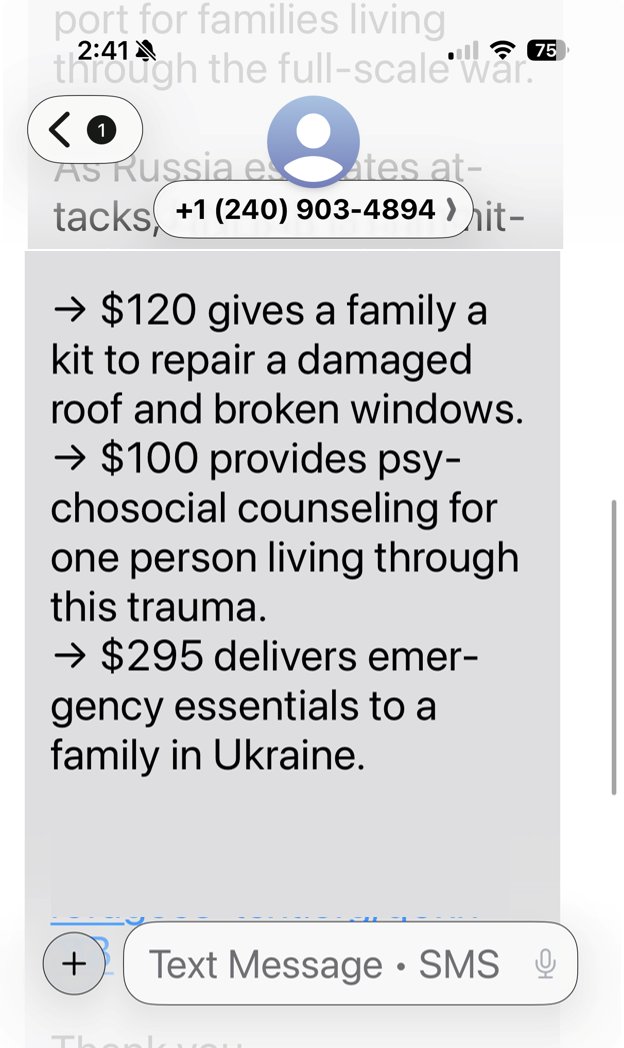
- $120 repairs a damaged roof and broken windows
- $100 provides psychosocial counseling for one person
- $295 delivers emergency essentials to a family.
There is a version of this that makes sense inside the organization. Someone probably had to get three different people to bless the equivalencies, and by the time everyone was done negotiating, the gift string had the behavioral flow of a shopping cart with one square wheel.
Here’s what the DonorVoice behavioral science team had to say:
- The first problem is dollar amounts that neither ascend nor descend. A rising ladder says, “choose how far you want to climb.” A descending ladder says, “here is the big gift, and here is a relief valve.” This does neither.
- Also, the first number tends to act as a door, not an anchor. Could $120 be defensible? Maybe the phone number or ZIP was matched to census data, wealth signals, property data or some other model that said this person could tolerate a higher ask. But it’s still a cold text, and that puts it in the category of smelling faintly of scam, even when it’s legit. That means the ask has to work harder to feel clear, safe and worth acting on.
- Another issue is the benefit list. There are two basic ways to build one. A symmetrical list says, “$100 helps 10 people, $200 helps 20, $300 helps 30.” The donor does not have to compare different goods. They just choose scale, and the math is easy.
An asymmetrical list is different benefits and amounts that could change at equal or unequal intervals. Perhaps the diverse list snags a wider net of interest if one person cares about shelter and another cares about trauma care. But the cost is cognitive load. Now the donor is comparing roofs to counseling to essentials. Is the $100 gift better because it is cheaper? Is $295 more urgent? The donor has been promoted from helper to unpaid logistics manager.
- There is a related, subtler problem: the ask keeps changing who the donor is helping. First it’s a family, then a person, then a family again. That breaks the donor’s mental picture. Each shift makes the donor restart the story, and momentum can leak out.
- The deepest problem is the job the gift is being hired to do. Donors are not buying a repair kit. They are helping a family keep rain out of a damaged home. They are not buying “psychosocial counseling,” which is the sort of phrase that should be kept in a locked cabinet with grant reports and conference lanyards. They are helping someone recover after living through shelling, displacement and fear.
The copy gives the donor program outputs and makes them translate those outputs into human outcomes. Some friction is good. Asking a donor to picture the cold air coming through broken windows can pull them deeper into the moment. That is useful mental work. Asking them to decode three unrelated price points and compare three different categories is not useful work.
What’s your take?
Kevin
6 responses to “Your Gift String Should Not Need a User Manual”
Behavioral Science Q & A
Thanks so much for raising this. Yes, capturing donor information can be helpful for stewardship like newsletters, thank-you letters, impact updates. But how you ask matters. Forcing full data capture introduces friction that can significantly depress conversion, many donors may simply abandon the process. Beyond the friction itself, required fields also shift the emotional experience […]
Read Full Answer
Unlike holidays that everyone already knows, Giving Tuesday is a created event. Many donors recognize the name but not the exact timing, so referencing it becomes a helpful cue. It serves as a reminder and taps into social norm activation (“everyone’s giving today”), which boosts response. However, we still want it paired with the mission, […]
Read Full Answer
When a subject line leads with the match (“Your gift matched!”), it risks triggering market-norm thinking: the sense that giving is a financial transaction rather than an act rooted in values, identity, and care. This shift reduces intrinsic motivation and, over time, can weaken donor satisfaction and long-term engagement. It also makes the email indistinguishable […]
Read Full Answer
There’s no evidence that QR codes suppress mid-value giving; all available research suggests they either help or have no negative effect. In fact, behavioral and usability research consistently shows the opposite: reducing friction at any point in the donation process increases completion rates and total response. And that has nothing to do with capacity and […]
Read Full Answer
What you’re experiencing is very common. Resistance often isn’t about capability, but about motivation quality. If board members feel pushed into fundraising, that triggers controlled motivation (low quality motivation) i.e. obligation, guilt, or fear of judgment, which often results in avoidance. Instead, we need to create conditions for volitional motivation (high quality motivation) by satisfying […]
Read Full Answer
That’s a really thoughtful question, and you’re not the first to raise it. Many of our clients have been cautious about placing the ask at the very end. To address their concern, we’ve tested both approaches, and the results are clear: when the ask comes last, even if that means it appears on the second […]
Read Full Answer
Great breakdown of ways that this effort to provide detailed “what your money can buy” options falls apart. This line is priceless: “The donor has been promoted from helper to unpaid logistics manager.”
Thank you Frank, yeah, admit I did enjoy writing that line.
To enlarge on your point #4: That type of ask string forces a donor to do complex emotional math: “I like the second activity on the list, but I want to give the first amount.” Why hand donors that kind of problem to solve? This approach is very common in fundraising, unfortunately.
Hi Jeff, hope all is well. It is indeed common and I suppose proponents think the variety is helpful, despite or without considering all the cons.
But set aside the donor processing part, this is also mentally taxing inside the org, requiring lots more back and forth with program staff (God forbid, legal) to get the list of options and approve the dollar equivalency.
[…] You’ve probably seen ask strings on reply devices like this one, shared by The Agitator at Your Gift String Should Not Need a User Manual: […]
I might use some of those details “after” a gift is made in an acknowledgement letter to share the impact of their donation. 🙂