

AI Won’t Fix the Mess You Feed It
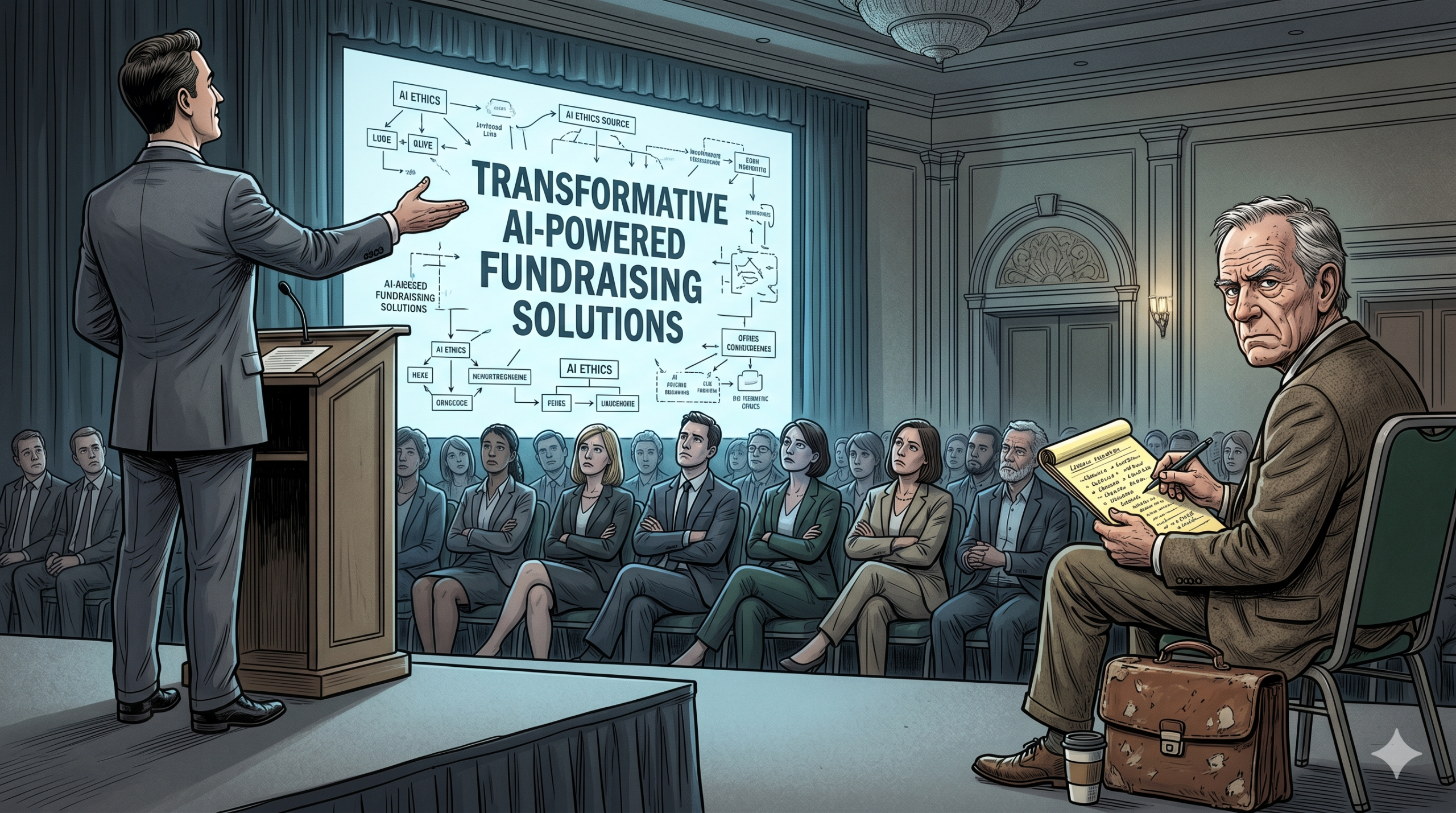
Somewhere in America right now, a self-proclaimed AI expert is taking the stage at a nonprofit conference. He has a logo. He has slides. He has the phrase “AI-powered fundraising transformation” in his bio. He’ll spend 45 minutes explaining what artificial intelligence means for your organization without once mentioning your data, your retention rate, or the actual mechanics of how any of this works.
He has written a book about AI. The book was written by AI. He will be invited back next year.
We’ve Seen These Sermons Before
I’ve worked in this sector for more than 60 years and watched every major technology wave move through nonprofit fundraising — direct mail, database systems, online giving, social media, mobile, analytics. Each wave carried its own class of evangelist with the same essential pitch: the future is here, it’s transformative, and for a modest consulting fee, I’ll help you not get left behind.
The ones who didn’t know what they were talking about were easy to identify in retrospect: they spoke exclusively in abstractions, had never actually built anything, and when you asked a specific operational question, they pivoted to a slide about the “changing landscape”.
The AI wave has produced more of that type than any I can recall. And the nonprofit trade press is platforming them at industrial scale.
The Ethics Fog Machine
Open almost any nonprofit-focused publication this week and you’ll find what I’ve come to think of as the Ethics Fog Machine: thousands of words about the moral imperative of responsible AI adoption, the urgent need for inclusive algorithms, and the organizational necessity of a comprehensive AI policy framework. Written in the language of seriousness. Containing, on careful inspection, almost nothing.
Here’s a sentence I didn’t fabricate, from a sector publication: “When using AI for donor stewardship, ensure your algorithms do not perpetuate racial or socioeconomic bias.” Right. And when you land the plane, make sure it doesn’t crash. The advice doesn’t tell your data manager how to audit the training set, weight alternative signals, or surface a different donor profile. It just tells her to feel bad about it.
The policy ritual is no better. Some consultants are telling nonprofits their first move must be a comprehensive AI usage policy. Here’s what happens after that policy is filed under “Governance 2026” in the organization’s shared Google Drive: nothing. Policy or no policy, the overworked grant writer or direct response copywriter facing a midnight deadline pastes the beneficiary case study into free ChatGPT anyway. More than 70% of nonprofit employees report using unapproved AI tools. More than half say they won’t tell their managers. Of course, that policy was never meant to stop them. It was meant to make leadership feel like it had done something.
Do you have The Ghost Workflow
The conference gurus seldom if ever mention operational failures, because naming them would require understanding how a nonprofit actually functions. A digital campaigner uses AI to generate three email versions in ten minutes instead of two hours. Looks like a win. But the copy still moves through the same three-person legal, policy, and executive approval pipeline. The bottleneck was never the writing, and so faster content just clogs the pipeline downstream.
Then there’s the failure so obvious it hurts to type. Most AI advice assumes you’re a blank slate waiting for an intelligent overlay. In fact, you’re most likely working in an organization whose donor data is trapped in an uncleaned CRM, whose volunteer lists live on three separate Excel sheets, and whose digital advocacy data is siloed in a completely separate system. Telling that organization to “integrate AI into your donor journey” is like handing someone a jet engine and congratulating them on their new bicycle.
The People Who Actually Know
There is a way to tell the gurus from the practitioners. The practitioners are uncomfortable with generalities. They push toward the specific.
Mark Phillips has been tracking AI adoption with the same rigorous skepticism he brings to everything else, surfacing the gap between what organizations claim they’re doing with AI and what their results show. He’s sounded the alarm on channel saturation — the mechanism by which every organization generating cheaper, faster appeals simultaneously creates an inbox so crowded that none of those appeals get read. He didn’t theorize this. He watched it happen and put numbers on it.
Frank O’Brien spent a career mastering the messaging and grinding mechanics of donor acquisition, retention, and lifetime value. His engagement with AI is exactly what you’d expect from a pro: he brought his experience to the tool, not the other way around. He tested it against things he already knew how to measure. When the results held up, he used it. When they didn’t, he said so. [ See Agitator’s review of Frank’s just-published The 4 Pillars of Persuasion packed with insights and resources on the practical use of AI. ]
Beth Kanter and Allison Fine, authors of The Smart Nonprofit: Staying Human in an Automated World, have been vocal critics of using AI as a shortcut for the difficult process of relationship-building — which is to say, they understand what AI can’t do because they understand what relationship-building actually requires.
My co-editor Kevin Schulman’s verdict on AI is the same as his verdict on everything else: get to root cause, obsess over the why of behavior. Kevin puts it plainly: “AI’s ability to do data analysis is extraordinary. Its ability to generate ideas is extraordinary. But it always requires a thinker behind the wheel. Always.”
What these practitioners share isn’t that they were early to AI. It’s that they came to it with something the gurus don’t have: decades of understanding what actually moves donors, what builds retention, what produces net revenue versus what merely produces activity. While upward of 90% of nonprofit staff report experimenting with AI, fewer than 10% report any meaningful improvement in organizational capability. That gap — between “I have opened ChatGPT” and “this has changed how we operate” — is exactly where experience separates practitioners from performers.
What the Machine Will Actually Eat
The organizations pulling ahead are not the ones with the best AI consultants or the most thorough ethics policy. They are the ones that spent the last several years treating their data as a strategic asset — cleaning it, centralizing it, building the discipline to keep it accurate. For them, AI is an accelerant applied to a prepared surface. For those who ignored the importance of accurate data, it is an accelerant applied to wet wood.
The conference agenda for 2026 is full of sessions on AI ethics and AI transformation. Sessions on data hygiene and CRM cleanup in preparation for the effective use of AI are harder to find. That’s the tell. The gurus sell transformation. The practitioners clean their lists.
Roger
P.S. Steve MacLaughlin, another fundraising veteran and author of the essential Data Driven Nonprofits, has been watching AI adoption with the same discipline he brought to data analytics — tracking what’s real versus what’s performance. His newest work is the clearest antidote I know to the fog. AI Driven Nonprofits: A Practical Guide to Artificial Intelligence for Nonprofits. I’ve written a Foreword for Steve’s new book and I promise, if you’re serious about AI Steve’s latest will be a must-have guide. Standby for news of its publication.
2 responses to “AI Won’t Fix the Mess You Feed It”
Behavioral Science Q & A
Thanks so much for raising this. Yes, capturing donor information can be helpful for stewardship like newsletters, thank-you letters, impact updates. But how you ask matters. Forcing full data capture introduces friction that can significantly depress conversion, many donors may simply abandon the process. Beyond the friction itself, required fields also shift the emotional experience […]
Read Full Answer
Unlike holidays that everyone already knows, Giving Tuesday is a created event. Many donors recognize the name but not the exact timing, so referencing it becomes a helpful cue. It serves as a reminder and taps into social norm activation (“everyone’s giving today”), which boosts response. However, we still want it paired with the mission, […]
Read Full Answer
When a subject line leads with the match (“Your gift matched!”), it risks triggering market-norm thinking: the sense that giving is a financial transaction rather than an act rooted in values, identity, and care. This shift reduces intrinsic motivation and, over time, can weaken donor satisfaction and long-term engagement. It also makes the email indistinguishable […]
Read Full Answer
There’s no evidence that QR codes suppress mid-value giving; all available research suggests they either help or have no negative effect. In fact, behavioral and usability research consistently shows the opposite: reducing friction at any point in the donation process increases completion rates and total response. And that has nothing to do with capacity and […]
Read Full Answer
What you’re experiencing is very common. Resistance often isn’t about capability, but about motivation quality. If board members feel pushed into fundraising, that triggers controlled motivation (low quality motivation) i.e. obligation, guilt, or fear of judgment, which often results in avoidance. Instead, we need to create conditions for volitional motivation (high quality motivation) by satisfying […]
Read Full Answer
That’s a really thoughtful question, and you’re not the first to raise it. Many of our clients have been cautious about placing the ask at the very end. To address their concern, we’ve tested both approaches, and the results are clear: when the ask comes last, even if that means it appears on the second […]
Read Full Answer
Once again Roger sow astute observations and excellent appraisal. AI might (sometime) be able to produce reasonably sounding copy but without a clear understanding of why people are giving to your cause ( lots of data but much more on behavioural psychology).
Keep up the good work.
Peter
thanks Roger, so true! AI is not going to build better relationships with your donors if you don’t communicate with them like a human being does and do the things humans like. Back to basics before anything else. send that thank you note. Make that thank you call. AI may make your plans look better and it may allow you to create a plan faster but planning your campaigns and communications you must.